

Featured
Yorubanisation of June 12! *If not Nwosu, why not Frank Kokori, et al?


By Sunny Igboanugo
Frank Kokori spent four good years behind bars for his historic efforts in the war for the restoration of the June 12, 1993 presidential election won by Moshood Kashimawo Olawale (MKO) Abiola but annulled by the military government of Ibrahim Babangida and sustained by Sani Abacha. As the General Secretary of the Nigeria Union of Petroleum and Natural Gas Workers (NUPENG), he became the arrowhead on which the war was fought.
His modus operandi was leading the famous NUPENG strikes, which completely crippled economic activities in Nigeria and almost made it ungovernable. These strikes were said to be the most effective weapon that made the most impact to the government of the day, if not the only weapon.
Abacha, then Head of State, who by records ran the most despotic regime in the country, was not one to be enamoured of street demonstrations or media criticisms, be they locally or internationally. But the crippling of the economic foundation of Nigeria, which Kokori and his men effected through those strikes, was said to have hit him where it hurt.

Worse still was that Kokori, having fought his war by going underground, could not be physically contained like other traducers of the government, who the dark-goggled dictator simply picked up and threw into his overflowing gulags across the country. But through some special military engineering, tactics and special operations, his efforts finally paid off, as the Chief of Ovu Kingdom in Ethiope East Local Government of Delta State, was eventually captured.
Sprung out from his underground fortress in August, 1994 and detained thereafter, the nine-week strike of NUPENG ended effectively. So too, the June 12 struggle. In fact, there must have been a party in Aso Rock, the seat of power in Abuja for Abacha and his henchmen to celebrate that particular feat.
To underscore the importance of Kokori’s capture and ensure there was no repeat, the junta made sure they put him so far away from the rest of the Nigerian society and from an environment he was familiar with – the Bama Prisons in Borno State – reputed to be one of the worst of such facilities in the country. Even there, he was forbidden from contact with human elements – detained in solitary confinement, where he only had ants and mosquitos as companions.
That was his ugly fate until the end of the Abacha junta in 1998. Kokori was eventually released by Abdulsalami Abubakar, the military General who not only took over from the ex-military dictator, but began a set of counter actions to redeem the testy firmament of the hitherto iron-fist regime, starting with the release of political prisoners and eventually the transition programme that produced a civilian government in 1999. That was how Kokori was relieved from his near fatal ordeal.
Now, with this stellar performance as the arrowhead of the June 12 struggle, it would have been expected that Kokori, would naturally assume a central place in the sharing of the accolades and the booties accompanying it after the war was finally won. Nada! This same Kokori died on December 7, 2023 and about three months later, was buried on March 8, 2024.
Accounts in certain quarters indicate that the fiery labour leader, who once boasted that without me, there will be no June 12, not only died in penury, but did lamenting on his deathbed about being abandoned, before he succumbed to the protracted kidney disease he battled for years. This was a whole five years after the June 12 struggle had been given its full essence in Nigeria’s democratic history and structure.
Recall that Muhammadu Buhari, President – 2015-2023, had in 2018 – ahead of his re-election campaigns, put in place a set of measures aimed at full recognition of the historic events in the Nigerian polity. Apart from recognising Abiola as the winner of the election, he capped it all by instituting June 12 as Nigeria’s Democracy Day.
It means for this period, no one remembered him. Of course he was not alone. Other frontliners in the struggle, many who had similarly passed away in all the ceremonies in Abuja and elsewhere, as the airwaves were practically thrown open to celebrate and mark the June 12 struggle, shared and still share the same fate.
Only a completely bereft would would be wondering about this turn of events. But for even a passive observer, the reason for this is not farfetched. It is all about the Yorubanisation of the epochal event. For a certain tendency in the Nigerian South West, June 12, was a struggle of the Yoruba, by the Yoruba and for the Yoruba. They hug this essence and guard it so jealously that any other non-Yoruba, no matter his contribution(s), is a gatecrasher.
Indeed, June 12 today is more associated to Tinubu and Nobel Laureate, Wole Soyinka, who actually took refuge in beautiful cities outside Nigeria from where they launched attacks, than those who actually sniffed gunpowder and were bloodied on the battlefield, including those who either died in the struggle unofficially or officially sentenced to death as a result of immediate and related events.
It is more wont for those names to prop up immediately, in some cases spruced up with other Yoruba June 12 leaders, especially those who lived long enough to be in the camp of Tinubu’s political machinery from the Alliance for Democracy (AD), up to the All Progressives Congress (APC) than other warriors from other ethnic groups.
Yes, the likes of Niran Malaolu of The Diet, Kunle Ajibade of The News Magazine, do not seem to come into much reckoning for the simple reason that they are not prominently known APC members, regardless that they not only bore and still bear the physical lacerations of the struggle, but practically smelt death. They come into distant mentions, not to talk of Chris Anyanwu of The Sunday Magazine and George Mba, the non-Yoruba, whose lives were equally sequestered and put on the slaughter slab in the struggle. They have since taken distant positions in reckoning and as outsiders, at best, get nothing more than some peripheral mention – offhandedly referenced in speeches and official statements.
So, at the burial of the ex-NUPENG leader last year, the highest he got for his effort was some feeble comments from Heineken Lokpobiri, Minister of State for Petroleum Resources (Oil), said to have represented President Bola Tinubu. For those, who expected a major democratic edifice to be named after him, their anticipation, naturally came to naught.
Of course, Kokori was not alone. Before him, Ndubuisi Kanu, the vibrant June 12 campaigner suffered the same fate. Yes, the Lagos State Government named a park after him. But it was probably for his record as once Military Governor of the state than his efforts in the struggle.
Chukwuemeka Ezeife, too, whose face was permanently etched on the same struggle, must also have died a broken man as his efforts came to naught. His struggle to free Nnamdi Kanu, leader of the Indigenous People of Biafra (IPOB) flopped, even while ostensibly leveraging his relationship with Tinubu in the June 12 struggle. At best, he was rewarded with some indecent silence.
Like Ezeife, who went home empty-handed, as Nigerians would say, Dan Suleiman, a retired Nigerian Air Force officer, who died on February 1, 2023 and buried in his Guyuk town, Guyuk Local Government of Adamawa State home on February 17, also went to his grave without any fanfare and without any visible June 12 imprimatur.
Ralph Obioha – yes, the same Obioha, who stood on the same podium with Abiola during the Epetedo Declaration, who was harried by day and haunted by night by the infamous Abacha goons and who eventually lost his First African Trust Bank (FATB), has continued to bemoan his fate privately and silently.
So, for the South East caucus at National Assembly in that pitch at the Senate for the immortalisation of Humphrey Nwosu, this picture could not have been lost. Their pitch for the astute Professor of Political Science, before his burial on Saturday, March 29, 2025, must have been the case of the proverbial hen, who said its hysteria at the kite soaring away with its chick. It must be for the world to hear its voice and not for the predator to release its prey.
In other words, they simply put up a show at fulfilling all righteousness or perhaps, much like continuing to stoke the consciousness and conscience of the powers that be in today’s Nigeria. Someone must at least remind these people that they owe the country a debt to maintain some decency in their nepotistic attitude to governance, if anything, to preserve some level of national sanity.
That must be the reason for the proposal. Else, the mere paucity of logic, almost zero insensitivity and extreme callousness reflected in the argument of the naysayers either in the Senate during the debate or elsewhere amply demonstrated that June 12 is not a booty some people in the South West wants to share with anyone. Indicators show that they believe they not only own it exclusively, but would guard it jealously.
Even Adams Oshohmole, who they must have gone to procure purely for his vacuous rhetoric, apparently to add fillip to this obvious mindset, seemed quite stuck. Words seemed to have failed him. Not only that his submissions appeared quite obtuse, infantile and untenable, but his lines failed him.
On the floor of the Senate he had claimed Nwosu never indicated that Abiola won the June 12 election, but this was something the former election boss, even wrote down in a book, almost a decade before. Even his subsequent appearance on Channels Television, where he further attempted to dress up his earlier floppy position as to why Nwosu did not deserve to be honoured, sounded more pitiable.
This was the same Oshiohmole who, as Labour leader, sold out to the same junta Nwosu stood up to, turning around to accuse him of cowardice. His ground was that he failed to defy the court injunction and announce the result of the June 12 election willy-nilly.
In fact, as Chairman of then National Electoral Commission (NEC), Nwosu was actually waiting for the Court of Appeal, whom he was sure to reverse the decision of the Abuja High Court that stopped him from announcing the full result.
He was still waiting for this outcome when he was sacked from his job with the dissolution of the commission. But the self-same Oshiohmole, who never defied his removal as National Chairman of APC or remained stuck in office to demonstrate courage, believes that Nwosu ought to have defied both the military and the courts.
“He should have announced the result even if it means death,” he insists. Now confronted on this by Omoyele Sowore during and interview, the simple question the former NEC boss posed was: “As what?” As sacked NEC Chairman? In other words, Quo warranto? Translated to English: On what authority? To what effect?





By Ken Harries, Esq
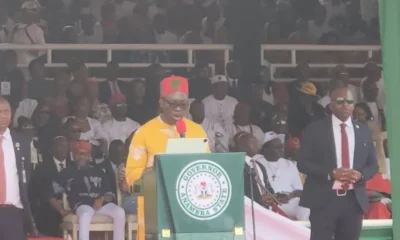
Peace is the foundation of every prosperous society and few Nigerian leaders have pursued it with the consistency and conviction of Senator Godswill Obot Akpabio, President of the Tenth Senate of the Federal Republic of Nigeria. From his earliest days in public service to his current national role, Akpabio has remained a firm believer in unity, dialogue and peaceful coexistence as the bedrock of progress.
His peace journey began in 2002 when Obong Victor Attah appointed him Commissioner in his administration. Even at that level, Akpabio stood out for his calm disposition, open door policy and passion for reconciliation. He reached across divides, built friendships that cut across ethnicity, religion and politics. Those who worked closely with him remember his favourite saying: “Akwa Ibom is one family.” That simple phrase would later become the defining philosophy of his leadership.
When Akpabio became Governor of Akwa Ibom State in 2007, he met a people divided by politics and ethnic bigotries. Rather than deepen the fault lines, he chose to heal them. One of his earliest gestures was reconciliation with those who had opposed him during the elections. He personally reached out to them, offered partnership and inclusion in his vision for a greater Akwa Ibom. This magnanimity surprised many and set a new tone of political tolerance in the state.
During his administration, Akpabio demonstrated that peace could not thrive without justice, fairness and opportunity. When violent cult clashes erupted in Uyo, Eket and Ikot Ekpene between 2008 and 2009, he responded not just with security action but also with empathy. He introduced a rehabilitation and reorientation programme for repentant youths and provided them with education, vocational training and employment. Many of those who embraced the programme later became responsible members of society which was a testament to his conviction that reconciliation and empowerment are stronger than retribution.
Akpabio also understood that development itself is a powerful instrument of peace. Under his Uncommon Transformation Agenda, he deliberately spread projects across all parts of the state so that no community felt neglected. Roads, bridges, hospitals, schools and industries were established from Oro Nation to Ini and from Ikot Ekpene to Eket. The message was clear that Akwa Ibom belongs to everyone and progress must be shared by all.
In 2011, when ethnic sentiments again threatened the stability of the state, Akpabio convened a Grand Unity Meeting in Uyo. The gathering brought together political leaders, traditional rulers, clergy, youths and women from every Senatorial District to reaffirm their commitment to unity. In his address that day, he reminded the people that no development could thrive in an atmosphere of bitterness. His words, firm yet conciliatory, calmed tensions and restored a sense of common purpose.
Years after leaving office, Akpabio has continued to champion peace and harmony in Akwa Ibom State. As political tensions and rivalry began to re-emerge in recent times, he once again rose to the occasion to demonstrate that true leadership does not retire. In continuation of his peace mission, the Senate President recently visited the Oku Ibom Ibibio and President General of the Akwa Ibom State Traditional Rulers Council, His Eminence Ntenyin Solomon Etuk, where he delivered a powerful message that resonated across the state.
Akpabio reminded the royal fathers that the most costly peace is still better than the cheapest war. He called on all traditional rulers and leaders of thought to join hands in pushing the message of peace to every nook and cranny of Akwa Ibom. His message that peace is a collective responsibility and its preservation must be the concern of every citizen, was simple, yet profound.
The lesson from this visit is clear. Leaders at all levels — be it political, traditional, religious and community — should emulate the example of Senator Akpabio. They must make peace the focus of their leadership because when peace reigns in our communities, it becomes easier to achieve stability and progress in the nation. The elusive dream of national peace can only be realised when leaders across the country choose dialogue over division and reconciliation over rivalry.
Today, as President of the Tenth Senate, Akpabio has continued to exemplify diplomacy and maturity in his dealings. He engages colleagues across party lines with respect and understanding by always seeking common ground for the collective good. His leadership style reflects his long held belief that peace is not a strategy but a duty.
Through his actions, Senator Godswill Obot Akpabio has shown that true greatness is not measured by power or wealth but by the ability to unite people and inspire harmony. From his early days as Commissioner to his years as Governor and now as Senate President, his life has remained a testimony to the power of peace.
Wherever he stands, peace follows. And as Akwa Ibom continues to grow and Nigeria strives for unity, Akpabio’s message that the most costly peace is still better than the cheapest war remains timeless.
■ Ken Harries Esq is a lawyer and an Abuja- based Development Communication Specialist.

Chief (Sir) Nse Ntuen, an Akwa Ibom elder and former member, Akwa Ibom State House of Assembly and has known Senator Godswill Akpabio for over 50 years, has strongly condemned and unequivocally dismissed the recent wave of unfounded allegations and tirade of abuse directed at the President of the Senate.
In a detailed statement issued in Uyo, Chief Ntuen, the Honorary Adviser to the Governor of Akwa Ibom State, His Excellency Pastor Umo Eno, described the claims circulated by Akpabio’s sister-in-law, Mrs Patience Ibanga Akpabio, as baseless, malicious, and inconsistent with both the character and public record of Senator Godswill Akpabio.
Ntuen, a former Chairman of Essien Udim Local Government Area — from which Akpabio hails — noted that, “the allegations, which have no basis in fact or common sense, are steeped in personal bitterness and deliberate mischief rather than in any verifiable fact or credible grievance.”
Ntuen stated that such behaviour demeans public discourse and disrespects the values of decency for which Akwa Ibom people are known.
“We must never allow a culture of reckless falsehood to replace dialogue and truth. These claims are not merely offensive; they represent a conscious attempt to erode the dignity of honest leadership and to sow unnecessary discord among a people united by shared history and respect,” he said.
He aligned himself with the recent resolution of the Greater Akpabio Family, which unanimously expressed confidence in the Senate President and reaffirmed the family’s unbroken unity.
Ntuen added that the statement by the family, being the most authoritative voice on domestic matters of this nature, has settled the issue firmly and should be respected as such.
“These spurious attacks are not only affronts to Senator Akpabio’s person but also to the collective reputation of Essien Udim and, by extension, Akwa Ibom State,” Ntuen noted.
He said: “At a time when the Senate President is fully engaged with His Excellency President Bola Ahmed Tinubu, GCFR, in charting legislative frameworks for economic recovery and national renewal, it is disappointing that anyone would choose to distract public attention with malicious fiction and self aggrandisement
“The public is therefore advised to disregard such falsehoods, which serve no purpose other than to inflame passions and divert focus from meaningful governance.”
Ntuen lauded Senator Akpabio’s dignified silence and self-restraint in the face of provocation, describing it as evidence of both personal strength and political maturity.
He observed that in an age where instant reaction often replaces reflection, the Senate President has shown that quiet focus remains the highest form of leadership.
“Leadership is not theatre; it is service. Senator Akpabio’s calm disposition and tireless work at the helm of the 10th Senate have continued to produce tangible results for Nigeria. His commitment to legislative efficiency and intergovernmental harmony demonstrates that the surest response to malice is progress,” he added.
Ntuen also noted that public office carries a sacred responsibility and that those who have been privileged to serve must guard the dignity of governance from reckless commentary.
He urged all citizens, especially those in public life, to be mindful of their words and the example they set for younger generations.
“When we reduce serious national conversations to gossip and innuendo, we weaken the very fabric of democracy.
“What Nigeria needs today are builders and not destroyers; thinkers and not rumour peddlers. Senator Akpabio has chosen to be a builder, and history will vindicate that choice,” he said.
Ntuen, a former ALGON chairman in Akwa Ibom State appealed for restraint and unity among Akwa Ibom citizens, emphasising that personal grievances should never be allowed to cloud collective progress.
He reaffirmed his loyalty to Governor Umo Eno’s vision of peace and inclusive governance and his continued support for Senator Akpabio as a son of Akwa Ibom, who represents the state with distinction at the national level.
“We stand with our leader, our brother, and our pride. Those who traffic in falsehood will find that truth is patient but enduring. The focus now must remain on the great task of nation-building, to which Senator Akpabio continues to dedicate himself with calmness, clarity, and conviction,” Chief Ntuen concluded.

Former Delta State Governor, Chief James Ibori, expressed deep sorrow over the death of Olorogun Oscar Ibru, a prominent businessman and philanthropist.
Ibru, the chairman of the Ibru Organisation and eldest son of the late industrialist Michael Ibru, passed away on Wednesday, September 24, 2025, at age 67 after a brief illness.
READ ALSO: Breaking: Family announces death of ex-agriculture minister Audu Ogbeh
Born on August 11, 1958, he was a key figure in Nigeria’s business and philanthropy sectors.
In a heartfelt social media post, Ibori referred to Ibru as a “dear brother” and prayed for his soul’s repose. He wrote, “Skidoo!!! So long my dear brother! Sleep well in the Lord. Tode Olorogun Oscar Ibru. Igbruuuuuuuuuu!!!”.





Amaechi laments: Tinubu abysmally incompetent! *Nigerians dying like flies!

BREAKING! No Way! Senegal protests loss of AFCON title, heads to CAS

Who will feed my family? *Maiduguri blast victims cry out in distress!



-

 News4 weeks ago
BREAKING: Dokpesi’s family at war! Battle over AIT goes to court!
-

 News4 weeks ago
Applauding Professor Iwe’s five years of landmark achievements in MOUA, Umudike
-

 News4 weeks ago
Don’t sign new electoral act, ex-INEC commissioner tells Tinubu
-

 News4 weeks ago
BREAKING: Blackout in FCT, as residents vote! *We’re sorry – TCN
-

 News2 weeks ago
You advised Buhari to reject electronic transmission, Wike trolls Amaechi
-

 News4 weeks ago
BREAKING: Tinubu signs new electoral act into law, 24 hours after
-

 News4 weeks ago
Wike can’t exert absolute powers over FCT affairs – Kingibe
-

 News4 weeks ago
NCDMB demands prompt one percent mandatory remittances from oil, gas stakeholders