
News
Rivers assembly to receive fresh commissioner nominees


Rivers State Governor Siminalayi Fubara will forward an updated list of potential commissioners to the State House of Assembly, aiming to rebuild his executive team after the conclusion of the emergency governance period in the state.
This move follows his choice to keep eight commissioners untouched by a recent Supreme Court ruling that validated Martin Amaewhule as the legitimate Speaker of the Rivers State House of Assembly.


READ ALSO: Fubara dismisses commissioners following supreme court ruling
Upon restoring normal executive operations, after the six-month emergency phase declared by President Bola Tinubu came to an end, Fubara had previously disbanded his cabinet.
A trusted insider from the Government House in Port Harcourt, who requested anonymity due to lacking permission to comment publicly, shared the identities of the kept commissioners with Punch on Sunday.
The insider listed them as: Dr Adaeze Oreh (Health); Charles Amadi (Chieftaincy Affairs); Christopher Green (Sports); Joe Johnson (Information and Communications); Chisom Gbali (Youth Development); Victor Kii (Agriculture); Dr Roseline Uranta (Women Affairs); and Nwafor Maximus (Energy and Natural Resources).
The insider mentioned that slight adjustments could occur, potentially shifting some to different departments.
“The governor told them himself that there will be a reshuffle and asked them to prepare,” the source said. “The only person whose portfolio is confirmed for now is the Commissioner for Health, Dr Adaeze Oreh, who has proven to be one of the best health commissioners so far.”
Regarding the timeline for submitting the new nominees to the Assembly for vetting and approval, the insider indicated it would start promptly.
“That will happen soon because the governor wants to fully constitute his cabinet,” he said. “Don’t forget that the governor has reconciled with the Assembly, and they are expecting his list of nominees.
“As part of the peace deal reached after the meeting between the governor and the Assembly, some loyalists of the FCT Minister, Nyesom Wike, may be accommodated in the new cabinet to ensure inclusiveness and sustain the current peace in the state.”
On a recent assembly organized by Rivers elders, attended by Wike and lawmakers, the insider noted that Fubara exercised his authority appropriately and maintains strong oversight of state matters.
“Governor Fubara is the elected leader of Rivers State and knows what is best for the state,” the source added. “Nobody should complain about the meeting or his decisions. Even those affected by the Supreme Court judgment have accepted the reality on the ground and are now on the same page with him.
“What is important is that peace has returned to Rivers State. In the next couple of weeks, many positive developments will begin to unfold for the good of the state,” the source added.



“He is running in contempt of the court. Justice Lifu should be arrested because he is acting in contempt of the court which is a criminal act,” were the exact words with which the African Democratic Congress (ADC), demonstrated its angst over the court ruling on Monday, ordering its de-registration as a political party in Nigeria.
A furious Bolaji Abdullahi, spokesman of the party, told his host while appearing as a guest on Monday’s edition of Politics Today, a public affairs programme on Channels Television that the judge of the Abuja Federal High Court who gave the order was actually playing with fire because of the consequences.
Directly accusing him of playing the script of the All Progressives Congress (APC), to ensure that President Bola Tinubu emerged the sole candidate for the 2027 presidential election, the party spokesman, was emphatic that the plan would not work, as head or tail, ADC must be on the ballot in all the elections.
Hear him: “There is a Court of Appeal order saying don’t hear this case until October 27. So, on what basis? You can’t place something on nothing. The Court of Appeal said don’t act on this until I hear it on October 27. So, on what basis did he deliver the judgement
“So, for us in the African Democratic Congress, what we’re convinced and they know is what they have done has no leg to stand on legally. What they want to do is to create doubts in the minds of the people that this ADC has too many legal cases, can we actually run on this? And to distract us. But we’re not distracted.
“We’re very clear. It was in spite of all they have done since ADC came on board that we ran one of the best and one of the most comprehensive direct primaries in the history of democracy in Nigeria. So, we are strong enough to withstand this. And that’s why I’m saying that we are going to contest in 2027. We’re ADC. We don’t buckle before dictatorship.”
Stressing on the implication of the judgement, which also affected Accord Party (AP), Action Peoples Party (APP), Action Alliance (AA), and Zenith Labour Party (ZLP) for allegedly failing to meet constitutional and electoral performance requirements, following a suit by the National Forum of Former Legislators, he said it portended grave danger.
He added: “We are not surprised. We know that the Nigerian people believe that there is a problem with the judiciary, but what we did not expect is the level of judicial rascality that was demonstrated today.
“What we are saying is that we reject it in its totality, and we are saying that the people behind this are playing with fire. Hundreds, if not thousands, have obtained nomination forms and contested elections and emerged as candidates on the platform of the ADC.”
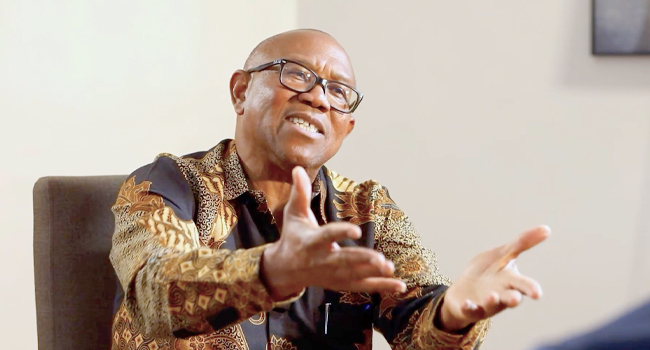
Peter Obi, candidate of the Nigerian Democratic Congress (NDC), in the 2027 presidential election, is peeved at the decision of the Federal High Court, Abuja, ordering the de-registration of the African Democratic Congress (ADC), saying the move is a heavy blow and dangerous to Nigeria’s democracy.
Justice Peter Lifu, who made the order, based on an action brought by National Forum of Former Legislators, agreed that the parties, including Accord Party (AP), Action Peoples Party (APP), Action Alliance (AA), and Zenith Labour Party (ZLP), failed to meet the requirement for continued existence in Nigeria.
But Obi, who left the ADC coalition to join the NDC, incidentally, based on what he explained resulted from the multiple court cases hanging on its neck, expressed his disenchantment, in a statement by the Peter Obi Media Reach (POMR), on Monday.
Signed by Ibrahim Umar, its spokesman, the group quoted the former Governor of Anambra State as decrying the growing damage to the nation’s sacred institutions on the altar of politics.
Stressing that the rise of nations depended on stronger institutions devoid of political influences, the 2023 Labour Party presidential candidate, wrote on his X platform: “When the controversy surrounding the removal of the former Chief Justice of Nigeria, Walter Onnoghen, unfolded, I expressed a concern to a friend: that the greatest damage might not be immediate, but the message it sends about the sanctity and independence of our institutions to the world.
“Strong economies are built on trust. Investors can manage security risks, policy risks, and even market risks. What they fear most is uncertainty in the rule of law and a judiciary that is perceived to be vulnerable to political pressure.
“Today, many Nigerians have lost confidence in systems that should protect them. Businesses increasingly request that their contracts be governed by foreign jurisdictions because they have greater confidence in those institutions than in our own. That should concern every patriot.
“We must never sacrifice our sacred institutions on the altar of politics. Nations rise when institutions are stronger than individuals. The Federal High Court judgment ordering the deregistration of the ADC and other political parties is just one of those activities that further reduces the common man’s trust in our legal systems. It should be reversed.
“I pledge that we will restore the dignity, independence, and integrity of the judiciary. The common man must have a voice. The business community must be protected from legal uncertainty and intimidation. Justice must be impartial, accessible, and respected by all. To our judges, legal luminaries, senior advocates, and lawyers: this is your moment. Rise, defend the rule of law, take back your country! A new Nigeria is POssible.”
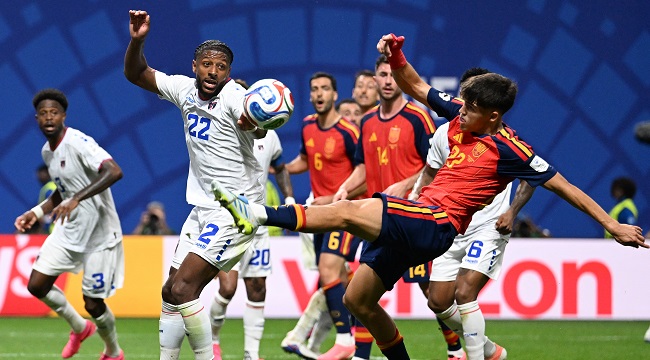
Not even Lamine Yamal’s second half introduction could help Spain break through the defence of debutants, Cape Verde, in their first ever meeting, as the ongoing World Cup event produced another one of the stunning results on Monday.
Yamal, the Barcelona superstar just recovering from a near two-month hamstring injury, was brought into the game in the second half to zest up the one-time world champion, but failed to break down the Cape Verde’s dogged defence.
Spain’s in the game played in Atlanta, one of the cities hosting the three-nation Mundial, displayed the same dismal outing, which saw them offering far less than the quality, which saw them lifting the trophy for the first time in 2010.
The European champions, which have not won a knockout game ever since, failed to dominate the African side, replicating their less than impressing outings and their eventual exit in 2018 and 2022 editions, even with the claims of coach Luis de la Fuente that the squad was the best in the competition, Spain were considered among the pre-tournament.
Neither Yamal nor Nico Williams, who also was hit by an injury-disrupted season at Athletic Bilbao and was not introduced until the 87th minute, were able to rise to the occasion against the 500,000 people African side, ranked 67 in the world, which is making their debut on the global stage.
In stark contrast to the searing temperatures faced by some other sides, Atlanta’s state-of-the-art air conditioned stadium meant there was no excuses for the slow tempo of Spain’s build-up.
Indeed the mid-half hydration break was met by boos with fans frustrated at the break in play despite the cool conditions.
The only serious move from the European champions only came at the sixth minute to half-time, when Marc Cucurella, fresh for sealing his move from Chelsea to Real Madrid, sent over a teasing cross that Ferran Torres turned onto the crossbar and Cabo Verde goalkeeper Vozinha got back on his feet to turn Mikel Oyarzabal’s looping header over the bar.
Even after the break, the Blue Sharks, were also able to hold back from the onslaught as they did in the first half, where Vozinho, managed to make another superlative save against Aymeric Laporte’s header just before half-time.
Despite the excitement from the crowd after he was introduced, Yamal, billed as one of the stars of the tournament, failed to create any magic with his first touch being the set-up of a decent opening for fellow substitute Mikel Merino which was too close to Vozinha.
In fact, Cabo Verde billed to take on Uruguay in Miami, nearly snatched a famous victory in the final minute of the 90 when Dani Borges planted a header too close to Unai Simon, who saved the occasion, to prevent the former world champions, billed to face Saudi Arabia in Atlanta on Sunday from humiliation.



-

 News4 weeks ago
BREAKING: US-Nigeria troops slaughter 175 ISWAP fighters
-

 Columns4 weeks ago
Dear General Gowon: That apology you’re running from is your nemesis
-

 News2 weeks ago
BREAKING: Terrorists strike Ibadan again! Abduct ex-Minister’s sister, twin children
-

 News4 weeks ago
BREAKING: Wait over! Arsenal are CHAMPIONS! Win EPL after 22 years hiatus
-

 Columns3 weeks ago
See Tinubu’s terrible damage on Option A4 and its precious memories
-

 News4 weeks ago
BREAKING: Jonathan emerges presidential candidate *Gets automatic PDP ticket!
-

 News4 weeks ago
Presidency: Obi met all requirements – NDC *Cleared to contest primaries
-

 News2 weeks ago
Emeka Ike: I’ll make example of Lere Olayinka for prying into my privacy