

News
CJN replies critics: Nigerian judiciary is clean! *We all know we’ll face God


Only a few bad eggs in the Nigerian judiciary are contaminating its temple of justice with bad behaviour, Kudirat Kekere-Ekun, Chief Justice of Nigeria, has said, putting a lie to the widespread insinuations within and outside that the institution is about one of the most corrupt in the country.
Kekere-Ekun, the second woman to attain the top judicial office in Nigeria, told her audience in Lagos at the weekend that the body actually had a lot of upright knowledgeable, hardworking and courageous judges, but regretted that the few bad eggs had done so much in tarnishing its reputation.

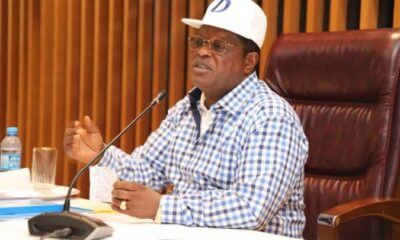
At a public discourse in Lagos in honour of Justice Habeed Abiru recently elevated to the Supreme Court, the CJN, who was the Chairman reminded such officers with bad reputation of the inevitability of man’s end, adding: “Individuals, each person is accountable to his or herself and to God”
Stressing her position at the event, titled: Ethics, Morality And The Law Kekere-Ekun, stressed fundamental principles, the need for clarity, stability and independence of the judiciary, as well as the fair exercise of authority by law enforcement, were necessary ingredients for the populace to trust the law.
Adding that the perspective of the ordinary citizen, who observes and assesses the extent to which ethics, morality and the law coexist harmoniously in society must be taken into consideration, the CJN, submitted that the foundations of justice the people relied upon today, were influenced by the Abrahamic faith prevalent in the society, hinged on both Islam and Christianity preaching morality uprightness and righteousness.
She said: “The role of the legal practitioner within this framework, merits particular attention. The lawyer, often seen as both antagonist and protagonist in the pursuit of justice, must navigate a terrain, where law, ethics and morality intersect.
“This dual role requires balancing the scriptures and the law with ethical constitutions, often containing with moral and legal questions that may seem at odds. As a minister in the temple of justice, the lawyer’s commitment to justice involves upholding legal standards, while advancing principles that follow society’s ethical expectations.
“The essence of the students is indeed the study of this relationship between morality, ethics and the law, especially when considering the historical distinction between courts of law and courts of equity, which reflects humanity’s ongoing quest to balance justice with fairness.
“The degree to which this alignment is achieved influences public trust in the judiciary and the law, affirming that our legal system should not only administer justice, but also resonate with the community’s moral convictions.
“It is essential, however, to recognize for societal advancement, law cannot be supplanted by moral or ethical indications alone, given the diversity of moral and ethical perspectives. The assertive nature of the law is therefore indispensable for peace, order and security, goals that cannot be reliably achieved through ethics and morality alone.
“Public acceptance of the law also hinges on its alignment with fundamental principles, the need for clarity, stability and independence of the judiciary, as well as the fair exercise of authority by law enforcement.”











Anyone can pay the N25,000 wrong packing penalty slammed on Peter Obi, candidate of the Nigeria Democratic Congress by Festus Keyamo, Minister of Aviation and Aerospace Development, last week.
This was the angle introduced by the Minister, on Friday, when he acceded to the request of one Nnaemeka Ikerionwu, who volunteered to pick up the tab against the former Governor of Anambra State and candidate of the Labour (LP), in the 2023 presidential election.
Keyamo, who directed to the volunteer to liaise with the Federal Airports Authority of Nigeria (FAAN), on the payment process, had last Friday, Keyamo, in a statement posted on his X handle, demanded that Obi tendered a public apology to airport officials and pay a N25,000 fine.
Though the minister’s latest response suggests that government is willing to accept payment of the fine through a third party, he was however silent on whether his earlier demand that Obi tender a public apology to airport officials had been waived.
The new twist came as a consequence of what the Minister said was his investigation after the former governor cried out about alleged harassment by the Federal Government, citing the clamping of his car by airport staff during one of his use of the facility as an example.
The Minister had released as part of the investigation, a Close Circuit Television (CCTV) footage, to prove that Obi’s vehicle was parked unattended in a restricted area, prompting airport security personnel to clamp its tyres.
Keyamo said Obi arrived at the domestic wing of the Nnamdi Azikiwe International Airport, Abuja, on July 4, 2026, and left the vehicle after being dropped off by a police driver.
Meanwhile, in a post on his X handle, the Minister responded to Ikerionwu’s offer to settle the fine on Obi’s behalf by asking him to meet with FAAN’s Director of Commercial and Business Development for guidance on the payment process.
He wrote: “Thank you for bringing this to my attention. Please, Mr Nnaemeka Ikerionwu should proceed to see the Director of Commercial and Business Development for the Federal Airports Authority of Nigeria (FAAN), and he will be directed on the mode of payment of the fine for the offender.
“Now that we have burst his bubble, next time, Peter Obi should think twice before making outlandish claims of being targeted at our airports or anywhere for that matter in order to get ‘sympathy votes’.”

Abubakar Malami, is going upstairs to get the Court of Appeal quash the judgement of the Federal High Court, Abuja, empowering the Federal Government to seize 40 properties allegedly linked to him.
Justice Joyce Abdulmalik of the Federal High Court, Abuja, had ordered the forfeiture of the properties valued at N212.8billion, after the Economic and Financial Crimes Commission (EFCC), convinced him that they were obtained through illegal means by the former AGF-MoJ.
Before delivering the substantive judgment, the judge dismissed several applications, motions on notice and applications to show cause filed by Malami, his family members, and some companies linked to the properties, describing them as “wanting in merit”.
She held that the issue before the court was not “who owns the property, but how legitimate are the funds used to acquire the properties, adding that Malami, had “not dislodged the reasonable suspicion that the property was acquired by unlawful activities.”
But the ex-AGF-MoJ, in a statement conveyed through Bello Doka, his spokesman on Friday, stated that he respectfully disagreed with aspects of the judgment, though he remained fully committed to the rule of law and the independence of the judiciary.
He said he had instructed his legal team to immediately challenge the decision at the Court of Appeal, in line with his fundamental rights, adding that the judgement of the lower court was not the final stamp on the matter.
“The appellate process exists to ensure that every legal issue is thoroughly examined, and Mr. Malami is confident that justice will ultimately prevail,” he said, urging the public and the media to avoid premature conclusions while the judicial process runs its full course. Respect for due process remains the cornerstone of every democratic society.
Expressing his sincere appreciation of the prayers, goodwill, and steadfast support of the people of Kebbi State and Nigerians across the country, over the matter, he assured them that the development would not distract him from his unwavering commitment to serving the people and advancing his vision for a peaceful, secure, and prosperous Kebbi State.
“Supporters are encouraged to remain calm, peaceful, and law-abiding while allowing the courts to perform their constitutional role,” he said.

Adeniyi Adeyemi, controversial Director General of the Presidential Foreign Intervention Promotion Council (PFIPC), is to cough out a whopping N15billion, should he be found guilty of defaming Femi Gbajabiamila, Chief of Staff (CoS) to President Bola Tinubu.
The former Speaker of the House of Representatives, has approached the Federal Capital Territory (FCT) High Court, Abuja, Gbajabiamila, with a suit to compel the payment after flatly denying the allegation of the embattled DG, having ignored his earlier demand of N10billion and an apology from Adeyemi as the only option to stop the legal action.
Adeyemi, who was on Tuesday, arrested by the police in Osun State, barely hours after Justice Mohammed Umar of a Federal High Court in Abuja issued a warrant for that purpose, had publicly accused Gbajabiamila during a press conference on June 25, 2026, of demanding a 48 per cent kickback from a N27.3 billion take-off grant, after receiving an initial N400 million through a proxy, and demanded an additional N200 million balance.
Gbajabiamila, who handed him a 72-hour ultimatum to retract the allegation and tender a public apology or face legal action, in the suit filed on Thursday is seeking N10 billion as general damages, N5 billion as aggravated damages, N200 million as cost of the action, and an order compelling Adeyemi to publish a full retraction and apology in five national newspapers.
He is also asking the court to direct the defendant to pin the apology on all social media platforms and online channels where the alleged defamatory statements were published for 30 days.
The Chief of Staff, through his legal team from Pinheiro LP led by Kemi Pinheiro, SAN, described the allegations as false, malicious and defamatory.
In the statement of claim, Gbajabiamila denied ever meeting or communicating with Adeyemi or authorising anyone to act on his behalf.
Adeyemi, who had alleged at a press conference that a disagreement arose after Gbajabiamila purportedly demanded a 48 per cent kickback from the agency’s N27.3 billion take-off grant, had also claimed that N400 million had already been paid through a proxy on behalf of the Chief of Staff, while an additional N200 million was required to secure presidential approvals.
“The claimant has never met the defendant, never held any meeting with him and has never authorised any intermediary, representative, agent or proxy to demand or receive money on his behalf,” the court filing stated.
The suit also referred to Adeyemi’s claims regarding the alleged mysterious death of an intermediary, Mr. Babatunde Tanimola, whom he claimed served as the link between himself and the Chief of Staff.
Adeyemi alleged that Tanimola died in a suspicious hotel fire in Utako, Abuja, on October 22, 2025, a day after Gbajabiamila allegedly petitioned the police.
He further claimed that he narrowly escaped an assassination attempt along the Abuja-Kaduna Expressway in September 2025, and alleged that a “directive from above” instructed the Department of State Services, DSS, and the Nigeria Police Force to discontinue efforts to recover his stolen mobile phones, which he claimed contained crucial evidence.



-

 News1 week ago
BREAKING: Mystery death! *Female student dies a day after arriving Umahi’s home!
-

 News1 week ago
Don’t jump to conclusion! *Umahi speaks on mysterious death of female students!
-

 News3 weeks ago
BREAKING: Court sentences Nigerien, two others to death over terrorism
-
 News2 weeks ago
BREAKING: EX-SSG mowed down by gunmen! *He resisted being kidnapped – driver
-

 News4 weeks ago
Two hours after Igboho’s ‘red-eyes’ to ‘Fulani’ leaders, gunmen free kidnap victims!
-

 News3 days ago
BREAKING: Terrorists strikes another school! *Kidnap principal, students, NECO official!
-

 News4 weeks ago
Abductors of Oyo teachers panicking, freedom coming for victims soon!
-
 News4 weeks ago
Chicagogate: Nigerians return to court! *Move to stop Tinubu from 2027 polls