
Columns
APC-effect: Oh NLC! Oh Ajaero! Now the dog has lost its teeth!


Anyone that has pity, should direct it to the Nigeria Labour Congress (NLC). They need right now, more than they need the public microphones and loudspeakers – the tools of their trade, which have followed them over the years like a second clothing – their visible accoutrements in the past when men were men and did not live in mortal fear. How are the mighty fallen!
Specifically, please donate your pity to Joe Ajaero, the President of the union for the junior elements in the Nigerian workforce. Have you seen him lately? Didn’t you see what he has been reduced to? The once boisterous Joe, who was the terror itself to the Ministers of Power, who handled the privatisation of the electricity sector under former President Goodluck Jonathan, now seems a shadow of himself.

I should know who Joe was, because, more than many Nigerians, I was right there in the locus in quo, when the transformation in the sector was going on and had more than a passing knowledge of who Joe was to the big ogas at the apex of the top echelon of that building at the Federal Secretariat in the Central Business District (CBD), in the heart of Abuja, the Federal Capital Territory (FCT).
Joe was a name that was mentioned in whispers lest it struck the wrong chord and the walls echoed the sound into the wrong ears. That was when he was the General Secretary of the National Union of Electricity Employees (NUEE), a position from which he moved into his present office in 2023, after first failing to clinch it at first in March, 2015, when he lost out to Ayuba Wabba, his predecessor.
Today, all that is gone! Gone are the energy, the vibrancy, the audaciousness – the strong, bold and authoritative roars, now replaced with nothing more than the faint, almost inaudible and insipid sound – no more than the whimpering of a death-threatened lion facing the last days of an agonising fate.
What has led to this sudden transition? Well, I’ll tell you – right away. It is the APC-effect. You’ll ask further, what is this one? And I’ll answer – APC-effect is a disorder that the sufferer gets by simply breathing-in a special preparation the All Progressives Congress, the party that came into power in Nigeria in 2015 released into the firmament, which creates immediate mental numbness and inability to articulate or project critical thinking.
You may have heard of Stockholm Syndrome – that coping mechanism to a captive or abusive situation – that makes a victim develop positive feelings toward their captors or abusers over time! More like it. But this variant – the APC-effect is even deeper and more complex. It was developed by the masters in the game – crafts-men adept in the use of all the local ingredients and tools replete in Nigeria to achieve their purpose.
Let me illustrate. There is this local story about oturupopo – the woodpecker – the bird that uses its beak to design and even cut down trees. It once boasted that the day its mother would die, all the trees in the forest would be brought down to celebrate her. Now, on the fateful day, when the mother died, fate played a big one, as the woodpecker developed a huge boil on its beak, rendering its tool and capacity useless.
I explain! Every keen observer in the country and beyond, knows that God, the all-knowing creator, handed a special gift to every segment of Nigeria. The Igbo man has a special gift for business and transforming his environment. Failure stares you in the face if you try to engage or compete with the Igbo in any sort of business – from selling biscuits to importing heavy-duty equipment. You can only try.
Your land remains fallow and underdeveloped because the Igbo man has not discovered it. Once he comes around that mundane, banal and unused environment is electrified and enlivened. Mud houses soon transform to storey-buildings and items, hitherto termed useless, become valuable and sources of income. See, in Lagos alone, how Alaba International Market, Trade-Fair Complex, Ago Palace Way, places, which only yesterday, were completely uninhabitable lands, some of them complete swamps have become thriving entities.
On the other hand, a large percentage of Nigerians will go hungry and many yet battle with protein deficiencies the day agricultural items from the North cease coming into the South. From cows to rams, chickens to fish, grains of all kinds, potatoes to yams, onions to peppers – rice, yams, groundnuts, apples, mangoes and oranges many Nigerians look up to that part of the country for sustenance.
The Yoruba are the voice of Nigeria. Outside having their fair share in other areas of the economy, the Yoruba views on any issue, in the main, more or less influence national views if not represent them. What they lack in the features the other two represent in Nigeria, the rest lack in shaping public opinion or setting national agenda. Their inputs in this regard are either complementary or playing catch-up.
That the media are today dominated by the Yoruba, takes root from this tendency. The bulk of social crusading and civil society activism are embedded and expressed through the voices of prominent Yoruba, past and present. Right from the heydays of Nigeria’s political build-up outside the historic activities of the founding fathers, the names of Fumilayo Raansome Kuti, Wole Soyinka, Tai Solarin and Gani Faweihinmi, ring louder than many of their contemporaries.
The likes of Segun Okeowo, who led the famous Ali Must Go protest, Fela Anikulapo Kuti, who through his music became the conscience of the nation, Alao Aka-Bashorun, of the Nigeria Bar Association (NBA), era who fought the military fearlessly, alongside Patricia Kuye, the female activist and lawyer who came after, Femi Falana, Beko Ransome-Kuti among others, had led the pack.
Even Bola Ahmed Tinubu, today’s President of Nigeria alongside other leaders of the National Democratic Coalition (NADECO) like Adekunle Ajasin, Abraham Adesanya, Ayo Adebanjo, Ayo Opadokun, Alani Akirinade and the rest who practically confronted the Ibrahim Babangida-Sani Abacha juntas, had played individual and collective roles in this regard.
There-in lies the koko, as we say here. Remember the case of Ali Bongo – yes – the Gabonese President? I’m sure that picture of him sitting helplessly in his palatial building is now replaying in your head. Quite pitiable, if you ask me. He had pled with his countrymen to – go and make noise? Did anyone listen to him? No! His pleas – very passionate – came to naught, because, those that were supposed to “make noise,” were his captors.
Same with Brother Ajaero! Those to make his noise are his captors – the APC! That’s the boil on the beak of the oturupopo. Yesterday, he would have simply run to Bourdillon and the din from the emitting noise therefrom, would have deafened even the whales in the Atlantic Ocean. But pitiably, Bourdillon has moved to Aso Rock. Would a kingdom battle against itself? Never! Didn’t the bible say so?
Yes! Bourdillon became Aso Rock since 2015 when the APC moved in. And in there are many rooms with large beds where insider has found luxury. Who would blame them for settling down, relaxing and sleeping comfortably? Ayuba Wabba, never pretended. As an insider himself, he knew any attempt to hero-act would be futile. He simply found his own room, went to bed and slept for eight years.
Now, see where Ajaero’s heroic attempt landed him. The other day, he was pumelled to a pulp in Owerri, despite being nwa-afor – son of the soil. The baptism of fire was delivered by the APC iron hand. And nobody said piim! I’m sure he might still be undergoing some Ogwuma and Aboniki therapy till date. Even the privilege of travelling out to enjoy the cool breeze of Oyibo land, where his predecessors went to unwind occasionally, has also been denied. There APC machinery is making sure of that.
Just imagine the Nigerian firmament of today, had Bourdillon maintained its original address! Just picture! If your memory is no longer that sharp – I know you have a lot befuddling your head right now – Google will help you. Just type in Ojota Protest and refresh your memory. Don’t bother about the faces you see there. Don’t ask where they are. They are still here with us – alive, well and kicking.
They have each found their own beds in the Aso Rock mansion. Many of them have discovered the hidden nectars of life and cannot savour its sweetness enough. Some have even found new interests – like hunting games in the bush, while others, having lost out in filling Room Number 16, have now concentrated in their business of winning souls – if you say misleading souls, na you sabi. Some, yes, you still see them on television – their voices still strident and their passions, virulent yet, but their fancies are now different.
So, to whom does Ajaero turn? Is it to his brothers in the East, who are busy on phone negotiating for the next container of goods, which he knows he would sell – because whether the soap lathers or not, ladies must have their bath – or to his fatalistic friends in the North, who have been told where power derives and what happens to anyone challenging authority?
Does he look beyond the shores to his friends abroad? No dice! They will not help, because they are the beneficiaries. My people say when the streets are empty of hoodlums, it means hunger for the harlots, because the loots they get from their victims end up the brothels. The ugliness here is the reason for his friends in Europe and America to enjoy the best things of life.
For all you care, pity the antelope in the vice grip of the lion, grit your teeth at its pains as the lion’s claws dig into its flesh, but remember the death of that lion is nigh if it shows mercy and allows it listens to you and allows its victim to go. Who will fill the vaults of their banks to enable them lend at almost zero per cent that would recreate the Bill Gates, Mark Zuckerbergs or Elon Musks? Who will come with sacks full of raw cash to buy a whole street in London or Atlanta? Who would wash his hands with champagne in the pub with glittering lights and naked women?
So, you see why you must pity Brother Joe and his NLC? The situation that created Ojota, has multiplied a thousand times over. Like joke, fuel moved from N68 to N142. Then, we the victims were told its over. It is now fully deregulated. We adjusted. Then they returned and we wondered why. Didn’t you tell us you no longer have a hand? We were greeted with silence as it moved to N189. We resigned to hope and prayer. After all, the wise one is coming.
With the brain of Socrates, Aristotle and even Einstein put together the Bourdillon of our time would change everything with Renewed Hope, they had boasted. After all, wasn’t Bourdillon the creator of Lagos – a fallow wasteland infested with wild animals and dangerous reptiles – now transformed to a mega city that makes Luxembourg ugly.
But Bourdillon came! Now, the money the poor man was saving to buy fan, cannot even buy the blade. Just like Fela Anikulapo Kuti predicted in his song, his hope of enjoying cool breeze has evaporated. Enjoyment can never come his way. From N187, fuel moved to N550, then N580, N600, N617, N870 and now N1,300!
Now, Ajaero, seems wiser. He seems to have understood how hot water kills the tortoise! His now feeble voice of protest, seems to betray that much. I’m sure his people must have spoken to him in that tone that reflects the obvious – nwokem baa n’uno. Go inside and rest. But does he need to be told? Nobody in Nigeria today needs be told that the situation is worse than the dreaded period of Sani Abacha, reputed to be the most despotic in the history of Nigeria.
Worse still, unlike Festus Usifo, his counterpart in the Trade Union Congress (TUC), who apart from being a somewhat collaborator – I heard him the other day defending why fuel must cost so much – is not only an insider, but qualifies for a room in the Aso Rock mansion, Ajaero does not enjoy the same status.
Reason? He is an Igbo man. APC has a special place for Ndigbo. No Igbo man has a room in Aso Rock mansion. None has equal status in APC as the other ethnic groups in Nigeria. Never mind those prancing about – whether governors, lawmakers or party faithful – they merely pretending. They all know they’re simply enjoying senior jokes and when the chips are down, would be shown where they belong.
That of course would be outside the mansion, somewhere in the scotching son, where they will be cleaning their brows with their hands as they sweat it out under the inclement weather. That is what he must also contend with. It will even be a miracle if he survives the NLC job. For that is also a privilege. So, for my Brother Joe, you have my pity! Let others donate theirs too!
My name is Sunny Igboanugo, I’m The Tiny Voice!







By MAX AMUCHIE | The Sunday Stew
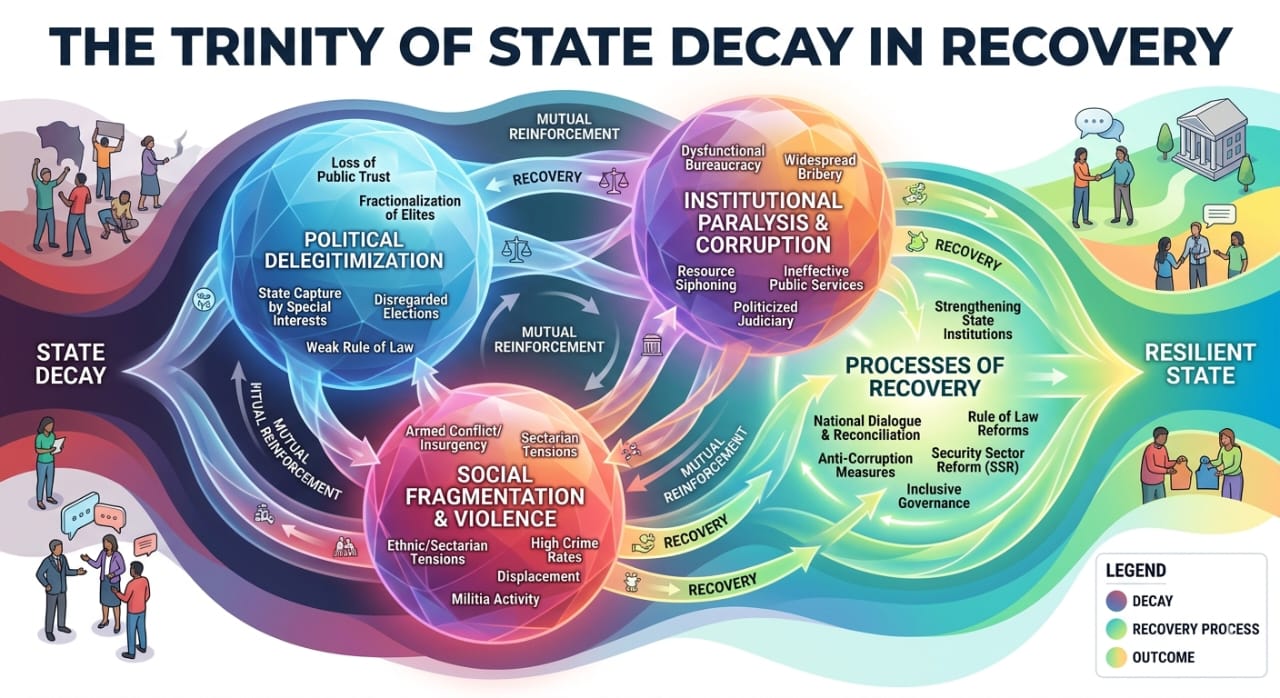
In the last two weeks, Parts One and Two diagnosed a structural mutation in the Nigerian state: a dual sovereignty system in which the Institutional Mirage performs authority while the Shadow Order exercises it, sustained by The Insecurity Triad as a mechanism of mutual reproduction.
What remains is the hardest question in political theory: not what is happening, but whether it can be reversed.
The answer is yes—but not through reform.
Systems that reproduce decay cannot be repaired within their own logic. They must be structurally interrupted.
The Trinity does not collapse. It is displaced.
From Ritual Governance to Peripheral Presence
The first reversal targets the geography of illusion.
The Institutional Mirage is concentrated in the symbolic centre—where governance is performed through summits, communiqués, and administrative ceremony—while dissolving at the periphery where authority is actually tested.
This produces a distorted state: visible in Abuja, absent in the borderlands.
To reverse the Trinity, the state must abandon Ritual Governance—the substitution of performance for presence—and return to the empirical occupation of territory.
This is not military occupation. It is administrative presence as sovereignty.
A state exists not when it speaks in the capital, but when:
a child attends a functioning school without paying a parallel tax of fear;
a farmer harvests without negotiating with non-state authority;
a dispute is resolved by a recognised court faster than an armed intermediary.
Governance is not restored by declaration. It is restored by continuity.
Where state presence becomes routine, the Shadow loses its monopoly on predictability.
From Pacification Bargaining to Sovereign Integrity
The second reversal confronts a deeper failure: negotiated sovereignty.
The state has increasingly drifted into a system of Negotiated Sovereignty sustained through what may be described as Pacification Bargaining—the purchase of temporary calm from rival authority structures through ransom logic, amnesty arrangements, protection payments, or informal accommodation.
This is not strategy. It is dependency disguised as pragmatism.
Every bargain strengthens The Insecurity Triad by:
monetising abduction economies;
legitimising territorial extraction;
reinforcing the Shadow’s role as a negotiating sovereign.
The result is a system of self-financing violence in which each concession funds the next cycle of coercion.
Pacification Bargaining does not resolve insecurity. It institutionalises it.
Each transaction deepens the perception that coercion is profitable, territorial pressure is negotiable, and sovereign authority is conditional rather than absolute.
Sovereign recovery therefore requires rupture in this economy.
The state must reassert a non-negotiable monopoly over:
taxation;
adjudication;
legitimate force.
Integrity, in this context, is not moral posture. It is institutional refusal to participate in markets of coercion.
A state that bargains over its coercive authority is not managing insecurity—it is outsourcing sovereignty.
The Critical Break: Dismantling the Insecurity Triad
To dismantle The Insecurity Triad is to break the loop between performed sovereignty and enforced sovereignty.
This cannot be achieved through security operations alone, though coercive force remains an essential and non-negotiable instrument of restoring empirical sovereignty. It requires something deeper: the reconstruction of institutional credibility in the very spaces the Institutional Mirage has abandoned.
It requires the state to stop performing governance and start delivering it. To stop negotiating the terms of its own authority and start enforcing them.
To recover the map—not in abstraction, but in detail: name by name, community by community—that armed actors are actively redrawing through coercion, taxation, and enforced renaming.
Dismantling the Triad is therefore not only a security task. It is a reversal of political geography itself.
The Cartographic Re-occupation of the Republic
The Shadow Order does not only occupy land. It reorganises meaning.
Through what may be understood as Constitutional Erasure, it renames territories, restructures local identity, and replaces the symbolic map through which authority is recognised.
Once this occurs, sovereignty is no longer contested physically alone—it is contested cognitively.
Cartographic Re-occupation is therefore not symbolic politics. It is structural restoration.
It requires three coordinated acts.
First, administrative re-anchoring: the immediate restoration of functioning institutions—schools, clinics, courts, and local administration—under continuous state presence.
Second, symbolic restoration: the reassertion of original geographic and civic identities through formal public renaming and constitutional recognition.
Third, cognitive consolidation: governance must cease to appear as intervention and become the default condition of life.
The state is not restored when it returns to territory. It is restored when territory returns to the state’s cognitive map.
Intellectual Closure: The State After Fragmentation
The deeper insight of this architecture is that sovereignty in Nigeria is no longer singular.
What has emerged is a fragmented order in which authority is distributed between competing logics of governance—one performed, one enforced, both partially functional, neither complete.
This is where African political thought clarifies the structure beneath the surface.
The logic of adaptive survival described by Jean-François Bayart explains why the state persists even as it weakens. Achille Mbembe explains how survival itself becomes managed rather than guaranteed.
Together, they clarify the central claim of the Trinity: this is not collapse. It is reorganisation.
Closing Movement
Nigeria does not face a singular collapse of authority. It faces a structured competition between performed sovereignty and functional sovereignty.
The Mirage still speaks in the language of the state.
The Shadow still governs in the language of necessity.
Between them, society survives by navigating two competing logics of order.
The question is no longer who governs.
It is whether governance itself can be reassembled into a single coherent structure.
The Reversal Condition: Sequential Sovereignty Restoration
The Trinity is reversible, but only in sequence.
Protection must be restored before compliance can shift.
Compliance must shift before territorial credibility stabilises.
Territorial credibility must stabilise before institutional authority can move from performance to function.
Any inversion of this order produces relapse.
The system is not resistant to reform. It is resistant to mis-sequencing.
The Trinity reverses only when sovereignty becomes empirically enforceable again through the sequential reconstitution of protection, compliance, and territorial credibility, thereby disrupting the mutual reproduction loop between the Institutional Mirage and the Shadow Order sustained by The Insecurity Triad.
Where this sequence fails, the loop does not weaken. It adapts.
The Social Contract Is Not Broken — It Is Being Replaced
There can be no social contract in a state where the sovereign performs authority it does not possess, negotiates with rivals it cannot defeat, and watches—from the polished corridors of Abuja—as the names of its own communities are erased from the landscape it claims to govern.
The conventional framing of Nigeria’s crisis describes a broken social contract: the state has failed its obligations, and the people are paying the price.
That framing is not wrong. But it is insufficient.
A broken contract implies a single agreement that has lapsed—and the possibility, in principle, of renegotiation and restoration.
What the Trinity of State Decay reveals is something more structural.
The social contract is not merely broken. It is being replaced.
In the spaces where the Institutional Mirage does not reach—in the northwest, northeast, and Middle Belt, in renamed villages and abandoned farmlands—a rival contract is being written.
On rival terms. Under rival authority. With rival consequences for those who refuse to sign.
The Shadow Order does not offer freedom. It offers a different captivity—one organised around extraction, fear, and the brutal clarity of power that does not pretend to be something it is not.
Within its own logic, it is internally consistent and therefore predictable.
And in conditions where protection becomes uncertain and uneven, predictability itself begins to function as a substitute for legitimacy—not as consent, but as adaptation under constraint.
The Institutional Mirage, by contrast, sustains a different form of instability: the unpredictability of protection, the inconsistency of enforcement, and the performance of authority that does not reliably translate into outcomes.
It is this asymmetry—between predictable coercion and unpredictable protection—that accelerates the silent transfer of compliance from formal sovereignty to rival order.
Conventional state failure frameworks assume a linear erosion of capacity.
The Trinity departs from this by demonstrating a dual-state condition in which formal and rival sovereignties coexist, interact, and reinforce decay.
Nigeria is not a failed state.
It is a state in the grip of a Trinity.
The Definition
Drawing on the full architecture of the foregoing analysis, I now offer a formulation of the Trinity of State Decay theory:
The Trinity of State Decay is the decoupling of a state into rival sovereignties: the Institutional Mirage, which performs authority without fully possessing it, and the Shadow Order—or competing Shadow Orders—which exercises de facto authority in spaces the Mirage has vacated, both sustained by The Insecurity Triad as the mechanism of their mutual reproduction.
The Trinity intensifies where the Mirage fragments into competing centres of performed authority, accelerating the transfer of empirical sovereignty to rival structures.
The Trinity reverses only when sovereignty becomes empirically enforceable again as a stable condition of governance.
This condition is not defined by the mere presence of the state, but by the alignment of three realities: protection must be enforceable, compliance must orient toward the state, and territorial authority must remain continuous.
Where these diverge, sovereignty fragments.
Where they converge, sovereignty reconstitutes.
Recovery is not repair or return. It is the production of a new equilibrium in which the Mirage collapses into function, the Shadow is displaced, and The Insecurity Triad loses its organising role.
This condition is produced through sequence: protection must precede compliance, compliance must precede territorial credibility, and territorial credibility must precede institutional function. Any inversion produces relapse; where the sequence holds, the loop breaks.
While derived from the Nigerian case, the Trinity offers a generalisable framework for analysing state decay in contexts where formal sovereignty persists alongside entrenched systems of rival governance.
Stay seasoned.
•Concluded
•Dr. Max Amuchie is the CEO of Sundiata Post and architect of The Insecurity Triad Analytical Framework, and the Trinity of State Decay theory. He writes The Sunday Stew, a weekly syndicated column on faith, character, and the forces that shape society, with a focus on Nigeria and Africa in a global context.
X — @MaxAmuchie | Email: max.a@sundiatapost.com | Tel: +234(0)8053069436
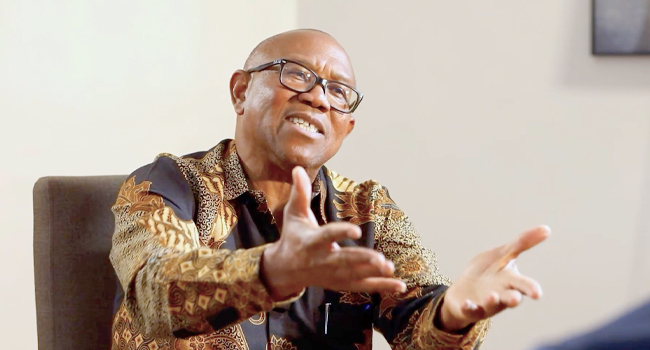
Godwin Obaseki, former Governor of Edo State was the first to raise the alarm. He rang the bell in the most dramatic manner in that video that went viral on the heels of the 2023 presidential election. It was about the impending tsunami confronting the Nigerian political space – the Peter Obi phenomenon!
The forum the ex-governor spoke was supposed to be a family meeting – a kitchen cabinet affair, where he interacted with the inner caucus of his Peoples Democratic Party (PDP) in his state. But he ended up not only alerting the nation, but passing the message about the new reality in the must pungent, direct and unobtrusive manner – something new has come – Peter Obi.
Whether it was meant to be a warning, an admonition or simply a subject of amusement – as the governor seemed tickled while delivering it – Obaseki’s words in that outing hit the right spot in national consciousness across board. The young, the old, the healthy and the infirm, all heard it clearly. Now whatever they did individually remains a different kettle of fish.
In that encounter, Obaseki had told his audience how, despite being a governor and the engine room of the PDP in the state, his own family had turned against him with all children and other young members enlisting into the Obidient Movement and how that was true of every other family in Nigeria.
Now, was Obaseki’s depiction false? Didn’t it come to pass on February 25, 2023, when Nigerians went to the polls? If Yakubu Mahmoud and his INEC had not contrived that technical glitches arrangement to abjure the mandate of the people in line with the grab, snatch and run philosophy of the present beneficiary of that obvious heist, Obi certainly would have been Nigerian President.
Had that happened, Obi’s would have been not only a clean and wholesome mandate, untainted by the paintbrush of rigging or other electoral infamies bespattering previous efforts, it would have been a national mandate – delivered by the people of Nigeria – likened only to Moshood Abiola’s June 12, 1993 presidential election victory.
In fact, so pan-Nigerian was the Peter Obi effort that Nigerians of all ethnic and religious persuasions came together and on their own, in clusters, within housing estates, in villages and communities, contributed money to fund their individual campaigns to promote the project of getting him to the Aso Rock Villa for the nation’s number one job.
Nigerians abroad – Yoruba – Hausa – Ibibio – Jukun – Igala – Tiv – Kalabari – Igbo – Edo – made special arrangements to return home with the sole purpose of not only promoting the agenda, but actually making the idea a reality by casting their votes for him.
Obi was the only one out of the lot that contested the election in 2023 that secured the endorsement of virtually all the ethic organisations across Nigeria.
Afenifere – the pan-Yoruba socio-cultural organisation – the Middle-Belt Forum (MBF) from the North Central – Pan-Niger Delta Forum PANDEF – for the South South region and Ohanaeze – their South East counterpart – all came together to declare their support for his presidential ambition.
Now this is the same person that some naysayers are labouring too hard, day and night to closet inside the straightjacket of ethnicity and religion. From Reno Omokri to Daniel Bwala to Bayo Onanuga and others controlling working from the Presidency to their counterparts at the Blantyre Plaza APC secretariat in Abuja – they continue to trumpet the spurious, bogus and fake narrative of Obi’s ambition being steeped in some sort of Igbo agenda.
Ironically, out of the entire lot, the selfsame Obi, is the only one who came out to boldly declare that nobody should cast a vote for him because he is Igbo, rather, they should do so because they are convinced about his ability to deliver on a new Nigeria of their dreams. No other had the courage to make such a bold declaration.
Surprisingly, even Wole Soyinka, one of Nigeria’s most iconic figures – a central voice in national and international affairs – Nigeria’s man of the century – the Kongi himself – who had hitherto shot himself to a position of a super being – of immortality – beyond reproach – without any credible reason even by his own conjecture – called the Obi ambition – an IPOB agenda.
That underscores the seriousness of the entire scenario. But interestingly, no matter how they try to trumpet it, their efforts have continued to mimic a snake striking at the shell of the tortoise with the aim of infusing its killer poison.
Their frustration not only hinges on this apparent failure but their current desperation too! The Obi brand has continued to soar beyond comprehension. So, when you hear the echoes of ethnic baiting, religious smears or other primordial sentiments, just know they are trying to increase the tempo of the din! Such a frustrating task!
My name is Sunny Igboanugo, I’m The Tiny Voice!

“This is Lagos!”
How many of you have seen this sign that introduces you into Lagos? Whoever coined that expression is highly ingenious because the essence of those three words ensconces a lot within its bowels.
It could mean that Lagos is a land of opportunities, where a man who started off as a truck loader at Iddo Motor Park, could discover opportunities to become the next billionaire around. There is a surfeit of examples.
It could also be introducing you to Nigeria’s Centre of Excellence and the pride of the nation where high-stake activities from the signing of multi-billion-dollar transactions conducted in the penthouses of Ikoyi and Victoria Island and the beautiful ambiances of the Victoria Garden City (VGC), Lekki, Banana Island and other high-brow places mimic other big cities across the globe.
Yet, it could also be a warning to the new entrants to the fact that Lagos is not for the faint-hearted, the indolent and imprudent. In other words, Lagos is not a place to loose-guard, as it is said in the local parlance, but a city where street-wisdom is as important as existence itself being the major factor and fine line between success and failure.
For me, the third example is the most relevant and essential here, because it is quite germane to the matter at hand – the current political scenario in Nigeria – regarding Peter Obi and Atiku Abubakar. Obi’s defection from the African Democratic Congress (ADC) to the Nigerian Democratic Congress (NDC), is a demonstrable example of street-wisdom at play and an emphatic message of its potency!
Since Sunday when it came to the fore that Obi had dumped the ADC and moved to the new party alongside Rabiu Kwankwaso, his new-found ally, the Atiku camp has remained on the offensive, raising the battle-cry – BETRAYAL!
They say Obi abandoning the ADC ship and porting to the NDC represents a betrayal of not only Atiku and the coalition arrangement but the battle to end the calamitous governance President Bola Tinubu – its main goal. How laughable!
Dino Melaye – Obi detests the heat of a kitchen and prefers an air-conditioned one. If he couldn’t face party primaries, having not participated in any right from his APGA days, how would he face the presidential election?
Dele Momodu – I would have wished that Obi would have waited to test his popularity in ADC…Obi did not leave because of Atiku, he left because he knew he lacked the capacity to take on Atiku.”
Even Babachir Lawal – a hitherto Obi supporter, fired his own arrow – Obi is shifty! A politician who fears elections, have no business being one. He doesn’t want to participate in primaries. He prefers a consensus candidate and that consensus must be him!
All the well-choreographed mantra, you hear from these guys, bespeak more of lamentations at missed plot to capture Obi into Atiku’s inextricable ADC web than reality of Obi lacking the sturdiness, durability and gusto to face tough battles.
In fact, Obi has nothing to prove in terms of his ability to fight. He proved this in the 2023. So by this outing alone the pale, trembling coward image they’re trying to sell to the world through this desperate narrative, falls flat on its face. But there’s more!
Talking about battles and the heat of the kitchen, this was the same Obi that stood through the courts to snatch his stolen mandate after it was snatched by the hounds in the 2003 governorship elections in his home Anambra.
This was the same Obi that sacked Chris Ngige in 2006 to retrieve his mandate and Andy Uba in 2027 in the tenure interpretation case – two seating governors in a space of one year. Who else has achieved this? This was the same Obi, who fought and returned to office after he was impeached from office as a governor.
Isn’t it laughable that it is the same man they claim is afraid to fight? What Obi is afraid of is his name being soiled in any way. It was for the reason of maintaining a clean name that he would rather yield to the pain of impeachment than offer bribes to the members of then Anambra State House of Assembly to spare his job.
Obi simply showed the hounds in ADC the import of that inscription – This is Lagos. It showed how much he understood its implication in terms of street-wisdom. How could Atiku and his men believe they could outwit Obi in that manner?
It’s like urging Ishi-Udene, my village dibia to sit at a beautiful table underneath which you buried a drum of boiling oil. He would have seen the danger in his divinity pot long before you concluded the plot.
Obi, fighting for the ADC ticket is akin to that dapper-looking bank manager, decked in designer suits, alighting from his sleek automobile and engaging those red-eyed, broken-tooted, scared faces at Mushin, Agege or Ajegunle bus stops, just to prove his toughness. What’s the use?
Now, picture this! You ran into a crowd and out of curiosity, went to observe, only to discover your spouse, clothes off, drenched in mud, broken bottles in hand, in roforofo fight at Oshodi bus stop!
Would you excuse your spouse even if provoked into that fight or celebrate the outcome, assuming the opponent was beaten to a pulp and taught a lesson?
For Peter Obi to engage in the ADC battle, it would not only take energy and sweat, it would certainly take away INTEGRITY and CREDIBILITY – the two elements that give essence to the Obi brand.
That would mean committing suicide to polish an ego. That is foolhardiness! The last time I checked, recklessness is the opposite of wisdom. And Peter Gregory Obi is not foolish. He’s a wise man!
My name is Sunny Igboanugo, I’m The Tiny Voice!



-
 Columns4 weeks ago
Abike Dabiri: Did Obi raise a monster or you’re drunk on Tinubu’s poisoned chalice?
-
 News3 weeks ago
Jandor: Tinubu didn’t endorses Hamzat *I’ve briefed President on my ambition
-
 Columns4 weeks ago
Be the hero that saved Nigeria! Open letter to Alhaji Atiku Abubakar
-

 News2 weeks ago
BREAKING: Makinde, Turaki, lose! *S’Court affirms Wike’s PDP leadership
-
 Columns4 weeks ago
Now VDM has become Sowore’s nemesis, does Peter Obi need anther advocate?
-
 Features2 weeks ago
Jim Nwobodo: The Sun shines, thrills, at ‘The Vanguard Awards’
-
 News1 day ago
Tinubu to African leaders: Copy Nigeria, produce your way out of poverty
-
 News3 weeks ago
ADC: Fight, scatter them! *Presidency goads Kogi lawmaker on Mark’s leadership