
News
Builder, Stabiliser, Leader: The essence of Akpabio at 63


By Rt Hon Eseme Eyiboh mnipr

Nigeria is a country that produces noise faster than it produces true heroes. Politics here moves at a velocity that forgives very little and forgets even less. To survive is one thing. To matter is another. To matter for nearly two decades at the highest levels of public life is an achievement that demands more than charisma. It demands outcomes. It demands consistency. It demands a mind trained to govern in the morning and negotiate in the evening, without losing the delicate balance between ambition and humility.
On 9 December, 2025, Senator Godswill Akpabio GCON turned 63. The moment offered more than ceremonial cheer. It invited serious reflection on a figure whose trajectory captures both the turbulence and the possibilities of modern Nigerian leadership.
His journey from Commissioner in Akwa Ibom State to Governor, to Minister, and now President of the Senate is well known. What is less appreciated is the coherence that binds these roles together. It is a coherence built on transformation in one arena and stability in another. It is what one might call the Akpabio Synthesis.
This synthesis blends the force of developmental leadership with the finesse of legislative management. It combines the boldness of a builder with the restraint of an institutionalist. It reflects an understanding that countries rise not merely on the strength of ambition but on the quality of those who convert ambition into infrastructure, and infrastructure into institutional legitimacy.
A Governor Who Re-Imagined a People’s Possibilities
To appreciate Akpabio’s national weight, one must return to Akwa Ibom between 2007 and 2015. His governorship was not a routine tenure. It was a deliberate confrontation with underdevelopment. Where many states adopted incrementalism, he embraced transformation as a governing philosophy. That philosophy became the Uncommon Transformation Agenda.
Education was the anchor. Free and compulsory schooling from primary to senior secondary levels—regardless of state of origin or religion—backed by the construction of over 700 model classrooms, ensured that children from the poorest homes could begin life with a fairer chance. Teacher training colleges were revived, curricula modernised, and enrolment surged. The message was simple: education is the foundation of citizenship.
Healthcare followed the same logic. The state constructed 22 hospitals, expanded primary healthcare access, and built the Ibom Specialist Hospital as a hub for advanced medical treatment. Free maternal and child delivery services reduced mortality and reinforced the dignity of families across rural communities. In a country where the journey to a clinic can mean the difference between life and loss, such interventions carry moral weight beyond statistics.
Infrastructure was the battlefield on which Akpabio waged his most visible campaign. Uyo transformed from a quiet local government capital into a modern urban centre. Flyovers, wide boulevards, dualised highways, and interconnected rural roads rewrote the physical map of the state. The Ibom International Airport became a node of commerce and mobility, while the Ibom Power Plant strengthened the state’s energy backbone. Water schemes across all 31 local government areas expanded public utility access. Industrial parks and sporting facilities, including the world-class stadium in Uyo, broadened the state’s profile from obscurity to emerging economic relevance.
Naturally, some critics whispered about cost. But history answers critics better than rhetoric. The infrastructure still exists. The hospitals still stand. The schools still function. The airport still operates. The power plant is running. The roads connect.
To be clear, a leader is ultimately judged by whether he leaves his people better than he met them. On this metric, Akpabio’s record is a matter of physical evidence—res ipsa loquitur: the facts speak for themselves.
Beyond concrete, however, he rebuilt confidence. He governed with moral clarity, grounded in a constant invocation of divine grace. This is not a footnote to his story. In Nigeria’s cultural context, where public life is interpreted through both the material and the spiritual, his emphasis on grace conveyed humility and cultural legitimacy. It elevated his leadership beyond performance and connected it to a deeper communal belief in providence.
A Senate President Who Prioritises Stability Over Spectacle
If the governorship was Akpabio’s era of bulldozing underdevelopment, the Senate Presidency has been his era of consensus-building. These are different competencies. One is muscular; the other diplomatic. One pushes; the other persuades. Yet both require a disciplined understanding of how to move a society from inertia to progress.
When the 10th Senate elected him President in 2023, Nigeria was navigating economic strain, political tension, and public impatience. The legislature—often prone to theatrics—required steadying. Akpabio brought equilibrium to a chamber of 109 competing ambitions. He restored rhythm to legislative work. He presides with firmness but without unnecessary heat. He prioritises national objectives over political brinkmanship.
Under his gavel, productivity rose. More than 96 bills were passed within two years, with about 58 assented to. These are not random numbers. They reflect a legislature aligned with the national reform agenda while maintaining its constitutional oversight role.
Major economic legislation emerged, including tax harmonisation frameworks designed to improve revenue predictability. Social sector reforms expanded access to tertiary education through a revitalised student loan system. Regional development commissions received renewed momentum, fostering equity across geopolitical zones. Security-related laws strengthened military and policing capacity. Anti-corruption and public finance legislation reinforced transparency and accountability.
These outcomes were not accidental. They required a Senate President capable of managing egos without humiliating them, negotiating with the executive without surrendering institutional integrity, and maintaining national focus without stoking unnecessary conflict. The skill was not in shouting. The skill was in steering.
The Senate Presidency under Akpabio has been a study in calm and strategic leadership. It has shown that stability is not the enemy of progress. It is its thermostat—the quiet force that prevents governance from overheating and ensures reforms endure.
A Statesman Formed by Grace and Tempered by Experience
What, then, is the essence of Akpabio at 63? It is a man who has moved from executive power to legislative authority without losing balance. It is a leader who understands that Nigeria needs both builders and statesmen. It is a public figure who views leadership as a covenant with the people, shaped by faith, experience, and service.
His story is not without controversy. No consequential leader escapes scrutiny. Yet when the balance sheet of contribution is examined honestly, the conclusion is unmistakable. He has built. He has stabilised. He has led with purpose.
He embodies, perhaps more than many of his contemporaries, the idea that Nigeria’s future lies in leaders who combine conviction with competence, vision with execution, and spirituality with responsibility.
A Birthday in the Service of the Republic
As Nigeria marks Godswill Akpabio at 63, the nation salutes not merely the man but his journey. It salutes the governor who transformed a state. It salutes the Senate President who steadied the legislature. It salutes a life that has become a reference point in the debate about what genuine leadership can achieve in Nigeria.
His story reminds us that the work of nation-building is neither linear nor effortless. It is sustained labour undertaken by those willing to think boldly, act decisively, and serve faithfully. Nigeria’s next decade demands such leaders—leaders who can build new infrastructure and strengthen existing institutions, inspire hope without losing discipline, and understand that grace, in the quiet hours of power, is both a calling and a responsibility.
At 63, Godswill Akpabio stands as one such leader. The chapters of his life remain open. The responsibilities before him remain weighty. But the foundation he has laid—in concrete and in law, in state and in nation—secures his place in Nigeria’s unfolding story.
May the grace you invoke continue to strengthen the work you do for a country still striving to become the best version of itself. In the biography of our time, you will remain a model and a source of inspiration to many.
Happy birthday, Mr President of the Senate.
Happy birthday, the uncommon statesman.
Happy birthday, Uko Akwa Ibom.
•Rt Hon Eseme Eyiboh mnipr is the Special Adviser on Media/Publicity and Official Spokesperson to the President of the Senate





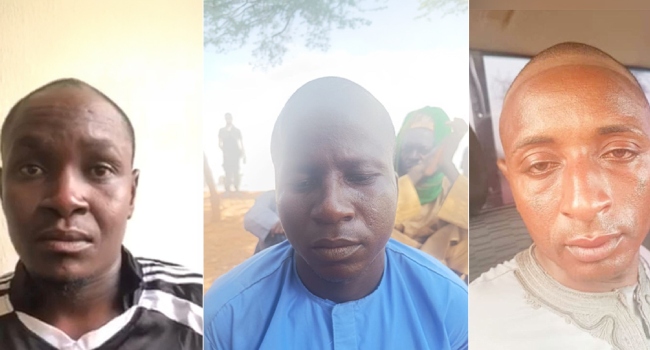
Justice Muhammad Nuraddeen Bello of High Court sitting in Sokoto State has sentenced three men, including a foreign national, to death by hanging, after convicting them on charges bordering on terrorism and arms proliferation.
The convicts, Yusuf Muhammad (alias Sallau), a Nigerien; Jabbi Alhaji Yalle; and Kabiru Muhammad, were apprehended on 13th June, 2025, by the Department of State Services (DSS) Counter Terrorism Unit in connection with cross-border criminal activities bordering on arms trafficking and terrorism.
Bello, who found all three defendants guilty as charged and sentenced them to death by hanging, while also ordering the forfeiture of all monetary exhibits recovered from the convicts to the Federal Government, said: “The conviction is the latest in a series of successful prosecutions by the DSS in its sustained operations against terrorism and organised cross-border criminal networks across Nigeria.”
The sentencing is coming about two weeks after the Federal High Court sitting in Abuja sentenced each of the five suspects arrested on May 31, 2026, by the DSS for their involvement in the November 21, 2025, attack on St Mary’s Catholic School, Papiri, Niger State, to 25 years’ imprisonment.
Justice Binta Nyako, had handed down the judgment after the men, including two Nigeriens, pleaded guilty to all four terrorism-related charges, bordering on support for the commission of an act of terrorism, breaching both Section 16 of the Terrorism (Prevention and Prohibition) Act, 2022, and the Firearms Act, were pressed against them.
According to Count One, the men were accused of jointly conspiring to assist a terrorist by agreeing and intentionally playing various roles towards conveying 15 AK 103 rifles as well as about 1,434 rounds of 7.62mm live ammunition from the Diffa region, Republic of Niger, to one Malam Ahmad, a member of the Boko Haram terrorist group based in Borgu, Niger State, and thereby committed an offence contrary to Section 26(1) of the Terrorism (Prevention and Prohibition) Act, 2022.
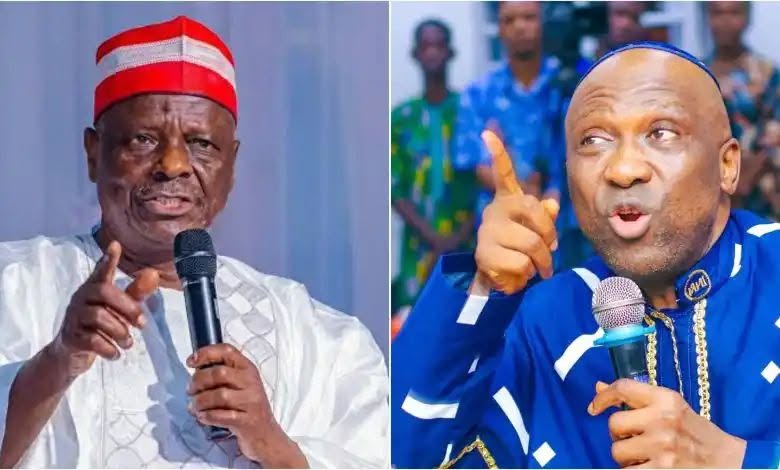
Primate Elijah Ayodele, is on the verge of coughing out a whopping N10billion, if he fails to offer unrestrained apology to Rabiu Musa Kwankwaso, former Governor of Kano State within the next 24 hours, and retract his claim that the former Minister of Defence is bidding his time to betray Peter Obi, to whom he is to contest the 2027 presidential election as a running mate.
Without doing so, the controversial cleric, should be ready for a major court battle with the vice-presidential candidate of the Nigeria Democratic Congress (NDC), the platform on which the pair is to contest the election.
In a letter indicating a legal action against Ayodele of the INRI Evangelical Spiritual Church over defamatory remarks, Kwankwaso, through Magaji Mato Ibrahim, SAN & Co., his lawyers demanded an immediate retraction and apology from the cleric over the allegations.
Details of the letter, dated June 11, and unveiled through the X platform of the legal team, was based on a viral video recorded during a live-streamed church service, where the preacher made allegations targeting Kwankwaso’s integrity as Peter Obi’s running mate under the NDC.
Quoting the cleric as stating: “KWANKWASO IS A FAKE TO OBI, KWANKWASO WILL BETRAY YOU. KWANKWASO HAS BEEN PAID TO BE VICE PRESIDENT TO OBI AMONG OTHER LIBELOUS COMMENTS WHILE PRETENDING TO BE A PREACHER,” the former governor said the comments were unprovoked, grossly unfounded, and carefully designed to create a rift within the ranks of the political party and its supporters.
Handing Ayodele a 24-hour ultimatum to publish a full and unequivocal retraction across all social media platforms and news outlets with the same prominence as the original video, they also demanded a written undertaking that he would cease and desist from making any further malicious statements against their client, warning that failure to comply, would lead to full legal actions.
The letter stated: “We shall claim substantial damages to the tune of Ten Billion Naira and cost of the action on a full indemnity basis amongst other reliefs.”

President Bola Ahmed Tinubu on Tuesday demanded the immediate end to the exportation of minerals from countries in Africa in their raw forms, which he said had led to massive exploitation of the continent.
The President, told member countries of the African Minerals Strategy Group (AMSG), a forum of Ministers in charge of Mining and Solid Minerals on the continent to speak with one voice to promote, collective interests, ensure value addition, and prevent the continent from becoming merely a source of raw materials for the rest of the world.
As the Grand Patron of the group, chaired by Dele Alake, Nigeria’s Minister of Solid Minerals Development, gave the charge while receiving a delegation of AMSG in the State House, Tinubu told the delegation that the group had a critical role to play in strengthening Africa’s bargaining power in the global mineral market and ensuring that the continent derives maximum value from its natural resources.
His words: “ What we should do is avoid bureaucracy and deceit; we must put an end to exploitation. The rest of the world won’t mind if your country is a cesspit of dams and rubbish and excavates your raw materials without giving value.
“It is our responsibility to collaborate and cooperate to ensure that these metals and minerals bring value to us, bring technology to us, and we can do it. It is how much each country will put into the research, development and refinery. I don’t see reasons we cannot demand centralisation of that conversation somewhere on the continent. So why not utilise that in our research and development and knowledge-based economy to enhance the quality of life and bring prosperity to our people.”
Emphasising that Africa possessed enormous mineral wealth that should be strategically harnessed to drive industrialisation, create jobs and accelerate economic transformation across the continent, the President, said the era of exporting raw minerals without local processing and beneficiation must give way to a new model that encourages investment in local industries, technology transfer and the development of value chains that retain wealth within Africa.
Alake, who had earlier expressed gratitude to the President for his exemplary leadership under the Renewed Hope Agenda, said the gesture had shown support for Nigeria’s mineral sector, especially in the local value-addition and economic diversification drive, where artisanal miners are empowered.
He told the President: “You encouraged us to look at the focal point of the establishment of this group, which is to ensure that the African natural resources, especially with regards to minerals, critical matters, are localised, the beneficiation coming directly to Africans generally.
“You charged us that we should set our sails very high and ensure that local value addition is a pivot around which all the objectives of this organisation should revolve.
“So, sir, we have gone implemented your charge and we are quitted that today local value addition is reverberating all over Africa.”
He added that some member countries have gone ahead to ban the export of raw minerals.
He explained members of the body were in Abuja for the Fifth edition of the African Natural Resources and Energy Investment Summit (AFNIS 2026), to push for a new continental approach to resource management and industrial development.



-
 News3 weeks ago
BREAKING: Terrorists strike Ibadan again! Abduct ex-Minister’s sister, twin children
-
 News2 weeks ago
BREAKING: Troops rescue wife of kidnapped General! *Terrorists flee scene
-

 News3 weeks ago
Emeka Ike: I’ll make example of Lere Olayinka for prying into my privacy
-
 News2 weeks ago
BREAKING: Count me out, Okonkwo tells Atiku *Amaechi VP’s choice an insult to Ndigbo
-
 News2 weeks ago
Dickson: Obi, a big asset to NDC, we’re working together … but!
-
 News3 days ago
BREAKING: Court sentences Nigerien, two others to death over terrorism
-
 Columns4 weeks ago
Atiku-Amaechi tag-team: An indication of ADC’s hideous plan for Obi
-
 News2 weeks ago
Ovia, ex-Zenith Bank boss swings into luxury apartments *Flats hit $2.8million price tag