
Business
New CBN Limit: PoS agents can’t withdraw past N1.2m daily


The Central Bank of Nigeria (CBN) has imposed a daily cash withdrawal ceiling of N1.2 million for Point of Sale (POS) agents and N100,000 for individual users.
This measure is part of fresh directives aimed at overseeing agent banking activities throughout the nation.

The document, endorsed by Musa Jimoh, Director of the Payments System Policy Department, was sent to all banks handling deposits, other financial entities, and payment providers.
READ ALSO: TUC threatens nationwide protest, demands reversal of proposed 5% petroleum tax
The updated rules apply right away, except for those concerning agent sites and exclusivity, which will start on April 1, 2026.
“POS agents are restricted to a maximum of N1.2 million per day. Individual customers are limited to N100,000 in daily transactions.
“These limits are intended to curb misuse, enhance financial integrity, and protect consumers within the agent banking framework,” it stated.
The directives also indicate that “CBN may vary or amend the transaction limits specified from time to time for each service in line with the extant CBN Guide to Charges for Banks and Other Financial Institutions in Nigeria.”
Under the revised system, every agent banking activity must occur via a specific account or wallet held by the main financial entity, and using unauthorized accounts for these operations is now banned, with penalties for breaches.
Agents involved in scams, improper behavior, or similar issues will be held accountable and could lose their status or end up on a sector blacklist.
Financial organizations, known as “principals,” must make public and periodically refresh their agent rosters on their websites and in branch displays.
Super agents, permitted only to oversee other agents, need to handle at least 50 agents distributed across Nigeria’s six geopolitical regions to broaden financial access in remote and neglected communities.
Agents cannot move, hand over, or shut down their operations without prior written consent from their principals or super agents, and any change announcement must be prominently shown at the site for a minimum of 30 days to inform clients.
The CBN required all agent devices to be geo-fenced, limiting use to approved spots only.
This follows a CBN instruction from August 25 mandating geo-tagging for all POS devices within 60 days, starting August 26, 2025, with a deadline of October 20, 2025.
The CBN cited increasing POS fraud incidents as the reason for this step.
Geo-tagging involves attaching location details, like coordinates, to media such as images, clips, sites, and texts. This location info helps map content and link it to other place-related data, allowing location searches, asset monitoring, or simple sharing of positions.
These changes represent a major reinforcement of Nigeria’s agent banking system, shifting emphasis from just tracking deals to ensuring the reliability of frontline operators in expanding financial access.
Individuals or groups with overdue loans from any financial body in the past year cannot serve as agents. The CBN will check credit via approved bureaus to block those with poor records from operating POS.
Also excluded are people with flagged BVNs or those banned for financial wrongdoing. Those convicted of serious crimes, deceit, or similar violations are prohibited.
Bankrupts or insolvent firms are likewise ineligible, underscoring the regulator’s demand for dependable and solvent participants.
To qualify, applicants must prove they can handle allowed tasks like deposits, cash-outs, and utility payments. They need to submit all required CBN data, get needed permissions, and for personal applicants, be over 18 and mentally competent.
Principals—including banks, super agents, and approved payment firms—must perform thorough checks before onboarding, covering credit checks, legal history, fund origins, site verification, and any risky ties.



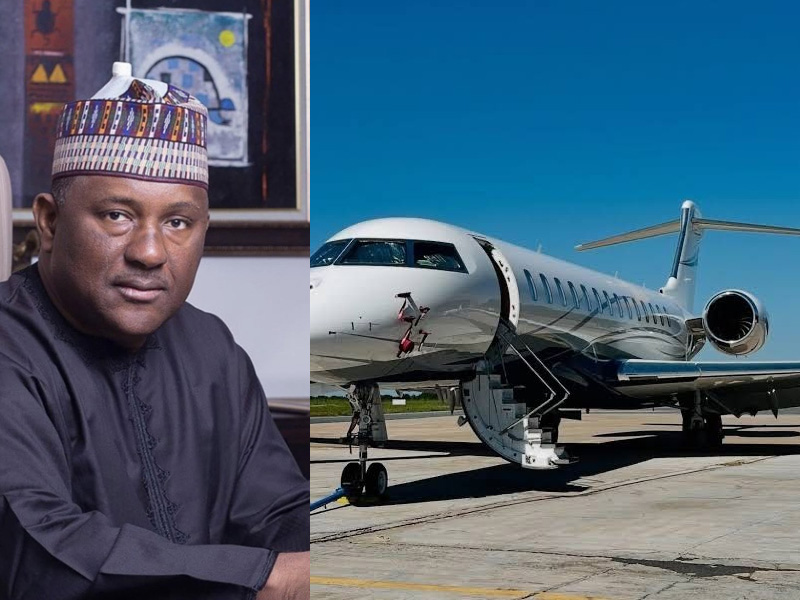
Abdul Samad Rabiu, Chairman of BUA Group, has joined the first group of Africans to own the Bombardier Global 8000 private jet valued, after splashing a whopping $81 million – ₦111.52 billion, to take delivery of the luxury flying bird.
The group said the latest addition meant to swell the company’s growing fleet, was acquired through an agreement reached in late 2025 and was recently delivered, according to information shared on Rabiu’s Instagram page.
Before enlisting among the first business figures in Africa linked to ownership of the aircraft, said to be Bombardier’s latest ultra-long-range business jet, designed for long-distance travel with the capacity to carry up to 19 passengers, the conglomerate had boasted of other aircraft in its fleet.
The delivery is said to be coming as companies within the BUA Group continue to post strong financial results, with the BUA Cement, one of its biggest assets, and BUA Foods reporting increases in profit in its first-quarter 2026 performance.
The report said the recent wealth estimate placed the net worth of the business magnate, reputed to be the Second Richest Man in Africa (SRMIA) worth at $11.2 billion, reflecting growth in the value of his business interests across several sectors of the economy.
But it added: “This treats the delivery of the jet as the actual news, rather than making the story mainly about his wealth ranking or business expansion. The wealth information is pushed to the background where it belongs.”
“When lives are lost, and communities are destroyed, governance itself is put on trial. No amount of rhetoric can silence the verdict that comes from the suffering of the people.”
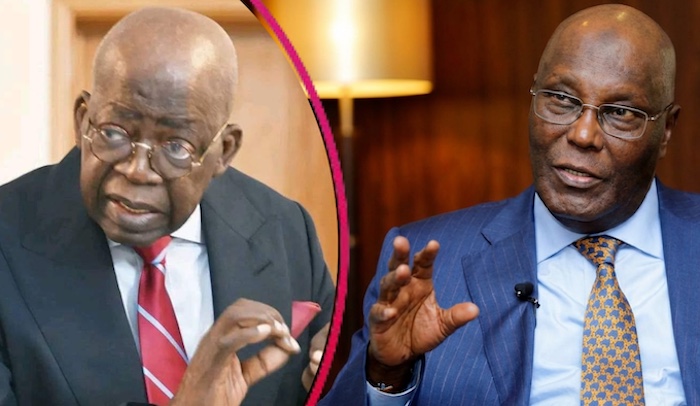
These were the exact words of Atiku Abubakar, former Vice President with which he chastised President Bola on Friday over the latter’s claim that the escalating wave of insecurity and killings in Nigeria were aimed at getting him out of power.
Tinubu, while speaking to members of the Inter-party Advisory Council (IAC), on Wednesday, at the State House, had told his audience that the move was to oust him out of power, adding however that he was not afraid, as he remained a “stubborn politician.”
Hear him: “You are playing into the hands of agents, including my own enemies, who want to use insecurity to get rid of me. I’m a very stubborn politician. I just refuse to go. And I will campaign for my second term.”
But in a quick riposte Atiku, presidential candidate of the Peoples Democratic Party in the 2019 and 2023 presidential elections, clapped back at the President, describing his apparent reduction of the import of the development as “troubling.”
Palpably incensed by the President’s interpretation of the situation in the country, Atiku riposted: “It is not political opponents who will judge this administration; it is the blood of innocent Nigerians being shed daily across our land. That blood cries out louder than any declaration of political resolve.
“It is horrifying that the memories of innocent citizens slain due to the failure of the government to provide adequate security would be so casually reduced to political rhetoric.
“It is disturbing that such a heinous incident has yet to attract the empathy or acknowledgement it deserves from the highest levels of government, while the loss of lives is instead framed as a political game.
“No amount of deflection or intimidation can rewrite the lived reality of Nigerians. Ultimately, the people will decide, and they will do so based on the evidence before them. At a time like this, Nigerians do not need bravado; they need protection. They do not need declarations of staying power; they need proof of leadership.”

Mr. Taiwo Oyedele, chairman of the Presidential Fiscal Policy and Tax Reforms Committee, has forecast that Nigerian states may collect over N4 trillion yearly beginning in 2026 following the implementation of revised Value Added Tax regulations.
During Tuesday’s presentation of the BudgIT State of States 2025 Report in Abuja, where he delivered the primary address, Oyedele shared this projection.
The occasion also commemorated the program’s tenth anniversary.
“With VAT reforms kicking in from 2026, states’ share will rise to 55 per cent. That could amount to over N4 tn in 2026. The question is: will this money be spent, or will it be invested?” he said.
READ ALSO: Atiku toTinubu: You’re not only incompetent, you’re insensitive *Condemns ‘private’ Paris trip
The fiscal reform specialist observed that despite recent policy changes more than doubling Federation Account Allocation Committee distributions—from N5.4 trillion in 2023 to N11.4 trillion in 2024—most citizens have experienced minimal tangible benefits.
He noted that while government revenues have increased substantially, household purchasing power continues declining.
“States are receiving more money than ever before. But there is a paradox: while governments have more naira, ordinary Nigerians have less disposable income in their pockets,” he said, encouraging state administrators to direct additional funds toward initiatives that meaningfully enhance quality of life.
The BudgIT analysis revealed that twenty-one states continue depending on federal transfers for more than 70 percent of their income, which Oyedele characterized as concerning.
Nevertheless, he referenced positive developments, citing Enugu’s 381 percent increase in internally generated revenue alongside Bayelsa’s 174 percent improvement.
According to him, upcoming tax legislation—which assigns complete electronic money transfer levy proceeds to states and removes taxation from state government bonds—will help lower borrowing expenses and generate financial flexibility.
“This is a unique opportunity for states to build resilience, close existing tax gaps, and invest in infrastructure,” he stressed.
His remarks also addressed the disconnect between expenditure levels and actual results. Oyedele recognized that capital spending had exceeded recurrent costs for the first time in years.
However, he cautioned that execution in essential sectors remained inadequate.
“States implemented only two-thirds of their education budgets, spending less than N7,000 per citizen. In health, implementation was even lower, at just N3,500 per citizen,” he observed.
Regarding indebtedness, he mentioned a N2 trillion decrease in domestic liabilities and a $200 million reduction in external borrowing, with thirty-one states reducing their domestic debt levels.
Despite this, states maintain outstanding arrears exceeding N1.2 trillion owed to retirees, suppliers, and employees.
“Borrowing is not the problem; unproductive application of debt is,” he cautioned.
The 2025 performance rankings placed Anambra first, succeeded by Lagos, Kwara, Abia, and Edo. Cross River experienced a sharp decline from fifth position in 2024 to twenty-ninth in 2025, prompting questions about administrative decisions.
Oyedele encouraged state leadership to capitalize on forthcoming reforms to progress beyond mere survival toward achieving widespread economic well-being.
Additionally, Dr. Muhammad Abdullahi, the Central Bank of Nigeria’s Deputy Governor overseeing Economic Policy, urged states to establish fiscal responsibility and openness as revenue increases under current reforms.
He characterized the BudgIT assessment as an annual benchmark that has “distilled hard fiscal truths, benchmarked performance, and re-centred conversations on capital investment, social outcomes, and fiscal credibility.”
He acknowledged that while 2024 and 2025 reforms expanded revenues and elevated capital expenditure above recurring costs, states must avoid reverting to overhead-dominated budgets.
“The challenge is to lock in this fiscal discipline permanently,” he said.
The CBN official recommended that states digitize revenue collection systems, complete Treasury Single Account implementation, and enhance capital planning processes.
He further advocated for improved execution rates in education and health allocations, demanding implementation exceed 80 percent.
Abdullahi cautioned that subnational entities face significant foreign currency vulnerability. He revealed that the CBN is creating financial instruments to assist them with hedging exposure and revenue optimization.
Examining the wider economic landscape, Abdullahi explained that Nigeria inherited substantial imbalances, including multiple exchange rates, excessive deficit financing through Ways and Means, and depleting reserves.
The central bank’s strategy involved returning to conventional monetary policy, normalizing currency markets, and rebuilding confidence.
He concluded that states prioritizing discipline and capital investment over simply depending on increased revenues would accomplish lasting transformation.
Representing the Nigerian Governors’ Forum Director-General, Dr. Abdulateef Shittu, Razaq Fatai—Head of Economic Intelligence—described the State of States report as instrumental in guiding administration and advancing fiscal responsibility nationwide.
He clarified that the NGF has functioned as a technical collaborator in developing the report throughout the past decade, ensuring governors utilize findings for enhanced policy decisions.
“The essence of State of States is to help guide governance and ensure that governors at different levels take the information provided and make sure it reaches their people,” he said.
Fatai mentioned that programs like the State Fiscal Transparency, Accountability and Sustainability initiative have reinforced budget reliability and debt openness, while the ongoing State Action on Business Enabling Reforms program encourages states to enhance business conditions.
He stated that the NGF will maintain its role facilitating collaborative learning and cooperation to establish transparency and accountability at subnational levels.
BudgIT Co-founder and Global Director Oluseun Onigbinde earlier remarked that the State of States report functions as a reflection of subnational government decisions.
Onigbinde observed that what started as an effort to track public spending has developed into an accountability instrument embraced by both administrators and citizens.
“This report began with a simple belief, that every kobo meant for citizens should be traceable, justified, and used to improve lives,” he said.
He noted that transparency has become advantageous among states, with more governors publishing budgets and citizens utilizing data for accountability demands.
Nevertheless, Onigbinde cautioned that Nigeria faces critical challenges, with increasing inflation, mounting debt, and excessive dependence on federal allocations preventing many states from developing sustainable local economies.
He encouraged states to prioritize education, healthcare, and infrastructure while using transparency to build public confidence and attract investment.



-

 News5 days ago
BREAKING: Mystery death! *Female student dies a day after arriving Umahi’s home!
-

 News5 days ago
Don’t jump to conclusion! *Umahi speaks on mysterious death of female students!
-

 News3 weeks ago
BREAKING: Court sentences Nigerien, two others to death over terrorism
-
 News2 weeks ago
BREAKING: EX-SSG mowed down by gunmen! *He resisted being kidnapped – driver
-

 News4 weeks ago
Two hours after Igboho’s ‘red-eyes’ to ‘Fulani’ leaders, gunmen free kidnap victims!
-

 News3 weeks ago
Abductors of Oyo teachers panicking, freedom coming for victims soon!
-
 News3 weeks ago
Chicagogate: Nigerians return to court! *Move to stop Tinubu from 2027 polls
-

 News14 hours ago
BREAKING: Terrorists strikes another school! *Kidnap principal, students, NECO official!