
Connect with us

News

Emilokan, propaganda economics and the gathering storm

Published

on

By Ifeanyi Izeze
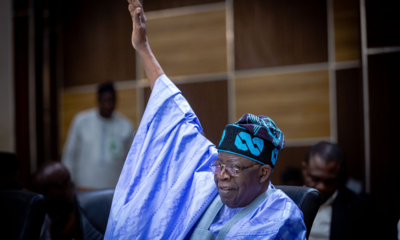
It is easier to talk if you don’t think, but if you think you will think thoroughly before talking, and when you talk, you will work. By now, if they have been thinking, it should be clear to  President Bola Tinubu and operators of his government that ‘Emilokan’ (it’s my turn) is not an economic policy.
They claimed to understand the problem at hand, and the President himself told us not to sympathise with him: “don’t sympathise with me, don’t pity me. I know what I am getting into.”
It is tragic that government officials and their media surrogates have amplified only one soundbite from remarks, where Dr. Okonjo-Iweala credited the administration for “stabilising the economy,” while deliberately ignoring her more serious call for urgent measures to grow the economy and establish social safety nets for millions of Nigerian families suffering the negative impacts of the government’s reforms.
Okonjo-Iweala’s recent comments on President Tinubu and the Nigerian economy “have been seized upon by government officials and their media allies as if their scandalous implementation of hard reforms, which have condemned the majority of Nigerians to absolute poverty and destroyed millions of jobs, had received endorsement by the oracle herself. This is not correct.”
How do you reconcile a government flaunting wholesale outdated economic theories based on dogmatic declarations, whilst procuring endorsements of foreign experts to re-echo and applaud same regardless of the naked extremely contradictory worsening economic situation on ground starring everyone in the face?
Headline inflation remains unyielding, sitting at 22.22 percent as of June, with food inflation at 21.97 percent, meaning that millions of Nigerians are paying more, not less. Petrol prices now average N1,037.66 per litre, still a significant burden on households and small businesses.
The naira trades at around N1,530 to the dollar at the official window — drastically weaker than President Tinubu’s pre-reform levels of N460 — eroding purchasing power across the board.
It should be clear to the government that it is the Tinubu administration’s policy choices — irrational fuel-subsidy removal, naira devaluation, tariff hikes on electricity and transport  and almost every other goods and services — that have triggered this distress and made social safety nets not optional but essential. Yet these social programs have either been administered haphazardly or rather dishonestly, suspended, or had negligible impact.
So when the African Democratic Congress (ADC) recently called on President Tinubu to fully confront the economic challenges facing Nigerians instead of “cherry-picking” comments made by World Trade Organization (WTO) Director-General, Dr. Ngozi Okonjo-Iweala, to score political points, those who are naïve took it as another opposition criticism. No, it is not at all, it was a clarion call for all it means.
That the federal government chose to ignore the real message in the comments by Okonjo-Iweala on the state of the Nigerian economy, instead prefering to celebrate the headlines is nothing but dodging to take responsibility for its actions or more aptly inactions.
It is very unfortunate that the Tinubu administration is more interested in “external validation” rather than taking responsibility for policies that have worsened living conditions.
Dr. Okonjo-Iweala knows that a stable economy is one that is growing in real terms, led by jobs and productivity. She knows that a stable economy is one that is able to guarantee minimum standards of living for the people.
How come the government chose to ignore what she is really saying that the economy is not growing, jobs are not being created, and too many people are suffering as a direct consequence of President Tinubu’s ill-conceived and badly implemented reforms?
The government seem to be deliberately ignoring that part of her message and celebrating only the superficial aspects that at best sounds like “propaganda economics” or more aptly another ‘Emilokan economic policy.’
Nigeria’s Gross Domestic Product (GDP) grew by 3.13 percent in the first quarter of 2025 and just above 3 percent in the second quarter, figures that could best be described as unimpressive compared to the administration’s promises of very strong recovery.
Are these numbers abstracts, no. They translate directly into hunger, joblessness, and despair for millions of Nigerians. The Tinubu administration’s policy choices, fuel subsidy removal, naira devaluation, tariff hikes on electricity and transport have unleashed untold hardship on Nigerians.
Every well-meaning Nigerian knows that celebrating the mere appearance of ‘stability’ is pyrrhic. Such candour from a global economic leader like Dr. Okonjo-Iweala underscores the urgent need for federal government policies that go beyond rhetoric and propaganda but addresses the daily harsh realities of millions of Nigerians under the APC-led Tinubu’s government.
Look at the CBN Governor, he thinks if he keeps raising interest rates he can fight inflation. What Cardoso is doing in CBN makes no sense as several economic experts have warned because what’s driving inflation in the country is factor cost and not the availability of credit.
The problem they have with the economy is that they went and devalued the currency and have the illusion of money in which case you will say at FAAC we used to share two trillion but now we share ten trillion but they failed to acknowledge that the present value of ten trillion is not up to the value when you were sharing two trillion simply because of the gross devaluation of the Naira.
As rightly said by a concerned Nigerian, they are simply not running the country, they’re doing business. They are business people and they don’t see us as citizens, they see us as their customers. So their mercantile approach prompts them to always see their customers and think how they can make more money from them and that’s why you see them taxing everything needed for life and basic living.
They are not willing to comply with Chapter Two of the Nigerian Constitution which stipulates how governance should be done in the country. What’s the responsibility of government? Call anybody in government, they are not responsible for anything. The minister of Water Resources is not responsible for whether you have water or not, the minister of Education is not responsible for education outcome whether the students pass or fail WAEC/NECO or Jamb. The minister of Health is not responsible for live expectancy or medical outcomes. We have people who are in power but they are not in government because they are not governing.
According to a recent report by the National Bureau of Statistics, FDI to Nigeria sharply declined by about 70 per cent in the first quarter of 2025, falling to only $126.29 million from $421.8 million in the last quarter of 2024. Of the total capital importation of about $5.64 billion in the first quarter of 2025, FDI accounted for only about 2.24 per cent, compared to 8.2 per cent in Q4 2024.
Of course how do you expect sustainable economic growth and development to be achieved under the current poor leadership and weak governance structure -problems that are clearly reflected in declining FDI and our poor performance in key governance indicators.
To further illustrate our precarious situation, capital flows to the manufacturing sector declined exponentially by 32.1 per cent, dropping to only $129.92 million in Q1 2025 from $191.92 million in the same quarter of 2023. There is no better confirmation of the lack of trust in this government, whose reforms remain uncoordinated and largely reactive.
Available statistics show that in 2024, while global FDI flows declined, FDI to Africa significantly increased to $97 billion — a rise of about 75 per cent compared to 2023. Europe, the United States, and China were the main sources of this FDI. Egypt attracted the highest share in Africa, with $46.58 billion. Other top recipients included Ethiopia ($3.98 billion), Côte d’Ivoire ($3.80 billion), Mozambique ($3.55 billion), Uganda ($3.30 billion), Democratic Republic of Congo ($3.11 billion), South Africa ($2.47 billion), Namibia ($2.06 billion), Senegal ($2.02 billion), Guinea ($1.83 billion), and Morocco ($1.64 billion).
Most disappointingly, our dear nation, Nigeria — the so-called “Giant of Africa” — received only $1.08 billion, about 1 per cent of Africa’s total FDI, representing a decline of about 42 per cent from 2023. Worse still, after this 42 per cent drop between 2023 and 2024, FDI to Nigeria has further declined by 75 per cent between Q4 2024 and Q1 2025.
Whether anybody wants to hear it or not, we cannot achieve sustainable growth and development with ineffective leadership and a weak government. This is the truth, the whole truth and nothing but the truth. God bless Nigeria!
Ifeanyi Izeze writes from Abuja and can be reached via email iizeze@yahoo.com or phone +2348033043009.

Share this story:

News

Clampdown on distillers: Six million job-loss looming! *NAFDAC sabotaging Tinubu – workers

Published

on

Close to six million Nigerians are set to lose their jobs due to the decision of the National Agency for Food, Drug Administration and Control (NAFDAC) to commence the enforcement of the ban on alcohols sold in sachet in the country.

The alarm was raised by members of the Food, Beverages and Tobacco Senior Staff Association (FOBTOB) and the National Union of Food, Beverages and Tobacco Employees (NUFBTE), who warned that the enforcement would displace no fewer than 5.5 million Nigerians from their jobs.

At the Lagos office of the agency, where they converged to register their grievances, the two unions, affiliates of the Trade Union Congress (TUC) and the Nigeria Labour Congress (NLC), warned about the consequences of throwing such a huge number of Nigerians in the job market.

Arguing that such a move was not only counter-productive, but antithetical to the objectives of the Renewed Hope Agenda of President Bola Tinubu not only to curb the massive unemployment in the country but to boost the Nigerian economy, as well as reduce hunger, the members called for a rethink, especially as the government had already intervened on the matter.

Advertisement

The protest came on the heels of announcement of the agency that it had commenced enforcing the ban on the production and sale of alcohol in sachets and PET bottles below 200ml, a plan it unveiled on November 11, 2025, with commencement date initially fixed for December 2025, in line with a directive from the Senate.

Reports say, the Federal Government, had actually halted the mover through the Office of the Secretary to the Government of the Federation (OSGF), which called for an immediate suspension of all actions and measures related to the proposed ban, pending consultations and a final directive.

Apparently ignoring the SGF, Mojisola Adeyeye, NAFDAC Director-General, had told reporters on Wednesday, that it received a matching order from the Red Chamber of NASS to proceed and that enforcement had already commenced.

But railing against the move Solomon Adebosin, Executive Secretary of FOBTOB, while alerting that the enforcement would displace no fewer than 5.5 million direct and indirect jobs, stressed that the policy undermined Tinubu’s Renewed Hope Agenda, seeking to attract investment into the country.

Debunking the agency’s claims that sachet alcohol and PET drinks were accessible to minors and children, he said there was no credible information to back it up and it lacked empirical facts.

Advertisement

His words: “We are here today to protest the sudden seizure of our companies in the distillery sector by NAFDAC concerning the issue of sachet drinks and PET bottles that are less than 200ml.

“We have 500,000 Nigerians working directly in this sector and over five million working indirectly, and they are going to be affected. Access and control are what we should be talking about. Let us be able to put control on these things such that children and minors do not have access to them. We have continued to invest in advocacy and sensitisation to prevent unqualified persons from consuming their products.”

Echoing the position, Azeez Razaq Head of Department, Brewery and Tobacco, of the NUFBTE, stressed that the actions of NAFDAC, depicted deliberate sabotage of the growth of indigenous manufacturers and a violation of the Federal Government’s directive.

Emphasising that the ban would lead to shutting down the companies, concomitant job losses, and ultimately worsen insecurity in Nigeria, he said it would not augur well for Nigeria for anyone to think of creating more troubles for Tinubu.

Anthony Oyagha, a member of FOBTOB, while presenting details of the union’s demands, insisted that NAFDAC must toe the line of Tinubu’s policies of creating jobs for Nigerians and boosting the economy in addition to boosting local production.

Advertisement

His words: “We call on the Presidency to urgently intervene to ensure that NAFDAC aligns its actions with government policy, legislative oversight, and the broader national interest.

“Local manufacturers deserve honour, protection, and partnership, not punitive measures that destroy investments, livelihoods, and confidence in Nigeria’s business environment.

“We respectfully urge Mr President to act decisively to safeguard indigenous industries, protect jobs, and ensure that regulatory agencies serve the Nigerian people and not external interests.”

Advertisement
Share this story:
Continue Reading

News

Three tax laws in circulation – Reps *Say, alterations, executive rascality  

Published

on

Executive rascality cannot be discountenanced in the alteration of the new tax laws passed by the National Assembly last year, the House of Representatives, said on Friday, as it claims that there are at least three versions of the document currently in circulation.

Victor Afam Ogene, spokesman of the House Minority Caucus, who initially unveiled the discovery of “illegal” alterations in the gazetted copies of the tax reform laws, earlier in the day, upped the ante later in the night, attributing the move to “overzealousness and executive rascality.”

A guest on News Night, a late night programme on ARISE NEWS Television, told his host that there were actually three versions of the document as a result of the decision of some people in the executive branch of government to tamper with the clean copy passed by the National Assembly.

Hear him: “You can easily point to overzealousness by some officials on the executive side, which in summary you could tag as executive rascality. A lot of times people think that when you bring executive bills, the bills should return to you as was sent.

Advertisement

“Then we should simply be – I don’t want to use rubberstamp – we cannot be garbage in garbage out. That is why 360 of us sit in that assembly, and there are processes in law-making – first reading – second reading – public hearings – then it comes back to the committee of the whole and then harmonisation between the House and the Senate and then the Clerk of the House prepares a clean-copy that is sent to the President.

“In doing so, ensure that it is what is passed by the National Assembly. This tax law went through all these processes. It is the duty of the executive to publish the gazzetted law. The Nigerian Printing Press is under the Federal Ministry of Information. So, it is their remit to publish the laws.”

Ogene, Chairman of the seven-member committee set up by the caucus to probe the alleged alterations, had initially raised the alarm about the alteration while submitting the interim report based on an initial signal by Abdussamad Dasuki, a member of the House on December 17, last year to that effect.

On December 17, Abdussamad Dasuki, a member of the lower legislative chamber, alleged that there are differences between the tax laws passed by parliament and the gazetted copy available to the public.

The alleged alteration sparked public outrage, with some Nigerians calling for a suspension of the implementation of the laws.

Advertisement

On December 16, the leadership of the senate and house of representatives directed Kamoru Ogunlana, clerk of the national assembly, to work with relevant agencies in the executive branch in a bid to re-gazette the tax laws. 

The tax laws are the Nigeria Tax Act, 2025; the Nigeria Tax Administration Act, 2025; the Joint Revenue Board of Nigeria (Establishment) Act, 2025; and the Nigeria Revenue Service (Establishment) Act, 2025.

On January 3, the green chamber released the gazetted copy of the tax laws for public scrutiny.

‘ILLEGAL ALTERATIONS’ 

Ogene said the directive of the leadership of the red and green chambers to the clerk to “take steps to align” the Acts passed by the parliament with the federal government printing press to ensure accuracy, conformity, and uniformity is a “clear indication that there were some procedural anomalies in the previously gazetted version that illegally encroached on the core mandate of the national assembly”.

Advertisement

The lawmaker said Kingsley Chinda, minority leader of the house, constituted a committee on January 2 to thoroughly investigate the “scandal.”

He said the committee comprises lawmakers from the six geopolitical zones — Aliyu Garu (Bauchi), Stanley Adedeji (Oyo), Ibe Osonwa (Abia), Marie Ebikake (Bayelsa), Shehu Fagge (Kano), and Gaza Jonathan (Nasarawa).

Ogene said preliminary findings, based on a comparison of the certified true copies (CTCs) released by the house and the gazetted copies, indicated that the laws were altered.

“There were three different versions of the documents in circulation, particularly the Nigeria Tax Administration Act, 2025,” the statement reads.

“The Nigeria Tax Administration Act (NTAA), 2025, has a number of discrepancies from the version passed by the National Assembly and the version earlier published in the official gazette. These discrepancies are obvious, going by the released Certified True Copies (CTCs) by the House referenced earlier.”

Advertisement

Advertisement

He said under section 29(1), the version certified by the national assembly set the tax compliance reporting threshold at N50 million for individuals and N100 million for companies, but the gazetted copy lowered the threshold for individuals to N25 million and altered the threshold for companies.

“This is a clear case of the executive undermining legislative powers by illegally altering an already passed law to drag more taxpayers into the net,” the legislator said.

In section 41, Ogene said the gazetted version introduced new subsections 41(8) and 41(9), which require taxpayers to deposit 20 percent of the disputed tax amount as a condition for appealing decisions of the tax appeal tribunal to the high court.

Ogene said the provisions were not included in the version passed by the national assembly.

Advertisement

He said in section 64, the gazetted law “illegally increased the powers of the tax authority to include the power to arrest individuals suspected of tax violations through law enforcement agencies, and allowed for the sale of seized assets without a court order”.

Ogene said in section 3(1)(b), the version certified by the national assembly defined federal taxes to include income tax, petroleum income tax, stamp duties, and VAT, but the gazetted copy removed petroleum income tax and VAT from the definition of taxes administered by the federal government.

“We consider this an affront to the exclusive powers of the national assembly to make laws,” he said.

The lawmaker said section 39(3) of the gazetted law was “illegally altered” to mandate that tax computations for petroleum operations be carried out in US dollars, contrary to the version passed by the national assembly, which provided that tax calculations be done in the currency of the transaction.

In sections 30(1)(d) and 30(3) of the National Revenue Service (Establishment) Act, Ogene said the version passed by the national assembly empowered lawmakers to summon officials, demand reports, and enforce accountability in line with their constitutional oversight role.

Advertisement

The lawmaker said the gazetted version deleted the provisions requiring quarterly and annual reports to parliament, describing it as a disregard for the national assembly and the doctrine of checks and balances.

“Given the anomalies, illegalities, and impunity observed, which clearly undermine the national assembly’s constitutional powers and democracy, the committee finds the current evidence sufficient to warrant a deeper investigation,” Ogene said.

“This will ensure accountability for the affront against the legislature. To achieve this, the Committee respectfully requests an extension to conduct a more thorough examination of the matter.”

Advertisement
Share this story:
Continue Reading

News

Again Fubara’s impeachment suffers fresh setback, as court halts move again!

Published

on

An Oyigbo High Court of Rivers State in Port Harcourt has adjourned indefinitely the suit filed by Governor Siminalayi Fubara and his deputy, Ngozi Odu, challenging the impeachment process initiated against them by the Rivers State House of Assembly.

Justice Florence Fiberesima of the Oyigbo High Court took the decision after being informed that two separate appeals had been entered in respect of the matter. The adjournment, the court held, would allow the Court of Appeal to first determine the issues before it.

At the resumed hearing, counsel to the Speaker of the House, Martin Amaewhule, and 27 lawmakers, S.I. Amen, (SAN), notified the court of the pending appeals and applied orally for a stay of proceedings.

The application was not opposed by counsel to the claimants, Paul Orikoro (SAN) nor by Lawrence Oko-Jaja (SAN), who represents Victor Oko-Jumbo, Orubienimigha Timothy, and Sokari Goodboy, the other defendants in the suit.

Advertisement

Justice Fiberesima consequently adjourned the matter sine die, pending the outcome of the appeals.

The development comes amid an earlier interim injunction granted by the same Court, which restrained the Speaker, Martins Amaewhule, several lawmakers, the Clerk of the House, and the Chief Judge of the state from taking further steps toward the impeachment of the governor and his deputy.

The injunction barred the forwarding or consideration of impeachment notices or related documents for the purpose of constituting an investigative panel over alleged gross misconduct.

Rivers CJ Declines Assembly’s Request

Meanwhile, the Chief Judge of Rivers State, Justice Simeon C. Amadi, has declined a request by the Rivers State House of Assembly to constitute a seven-man investigative panel to probe allegations of gross misconduct against Governor Siminalayi Fubara and his deputy, Ngozi Nma-Odu, citing subsisting court orders and a pending appeal.

Advertisement

Justice Amadi’s position was conveyed in a formal letter addressed to the Speaker of the Rivers State House of Assembly, Martin Amaewhule, acknowledging receipt of two separate requests from the legislature dated January 16, 2026.

The requests were made pursuant to Sections 188(4) and 188(5) of the 1999 Constitution (as amended), following resolutions of the House to initiate impeachment proceedings against the governor and his deputy.

But he said, “By the doctrine of ‘lis pendens’, parties and the court have to await the outcome of the appeal,” the letter read in part.

“In view of the foregoing, my hand is fettered, as there are subsisting interim orders of injunction and appeal against the said orders. I am therefore legally disabled at this point from exercising my duties under Section 188(5) of the Constitution in the instant.”

According to the Chief Judge, the Assembly’s requests were accompanied by extensive documentation, including copies of the notice of allegations of gross misconduct, the Rivers State Impeachment Panel (Conduct of Investigations) Procedure, 2025, and relevant newspaper publications.

Advertisement

However, Justice Amadi disclosed that his office had earlier been served with two interim injunctions issued by the Rivers State High Court sitting in Oyigbo on January 16, 2026.

The suits—OYHC/6/CS/2026 filed by the Deputy Governor and OYHC/7/CS/2026 filed by Governor Siminalayi Fubara—listed the Speaker and 32 others as defendants, with the Chief Judge named as the 32nd defendant.
The interim orders expressly restrain the Chief Judge from “receiving, forwarding, considering or howsoever acting on any request, resolution, articles of impeachment or other communication” from the House of Assembly in relation to the impeachment process for a period of seven days. Certified true copies of the court orders were attached to the correspondence.


Advertisement
Share this story:
Continue Reading

Trending