Connect with us

News

Akpabio’s triumph in Geneva lights the global stage

Published

on

By Ken Harries Esq
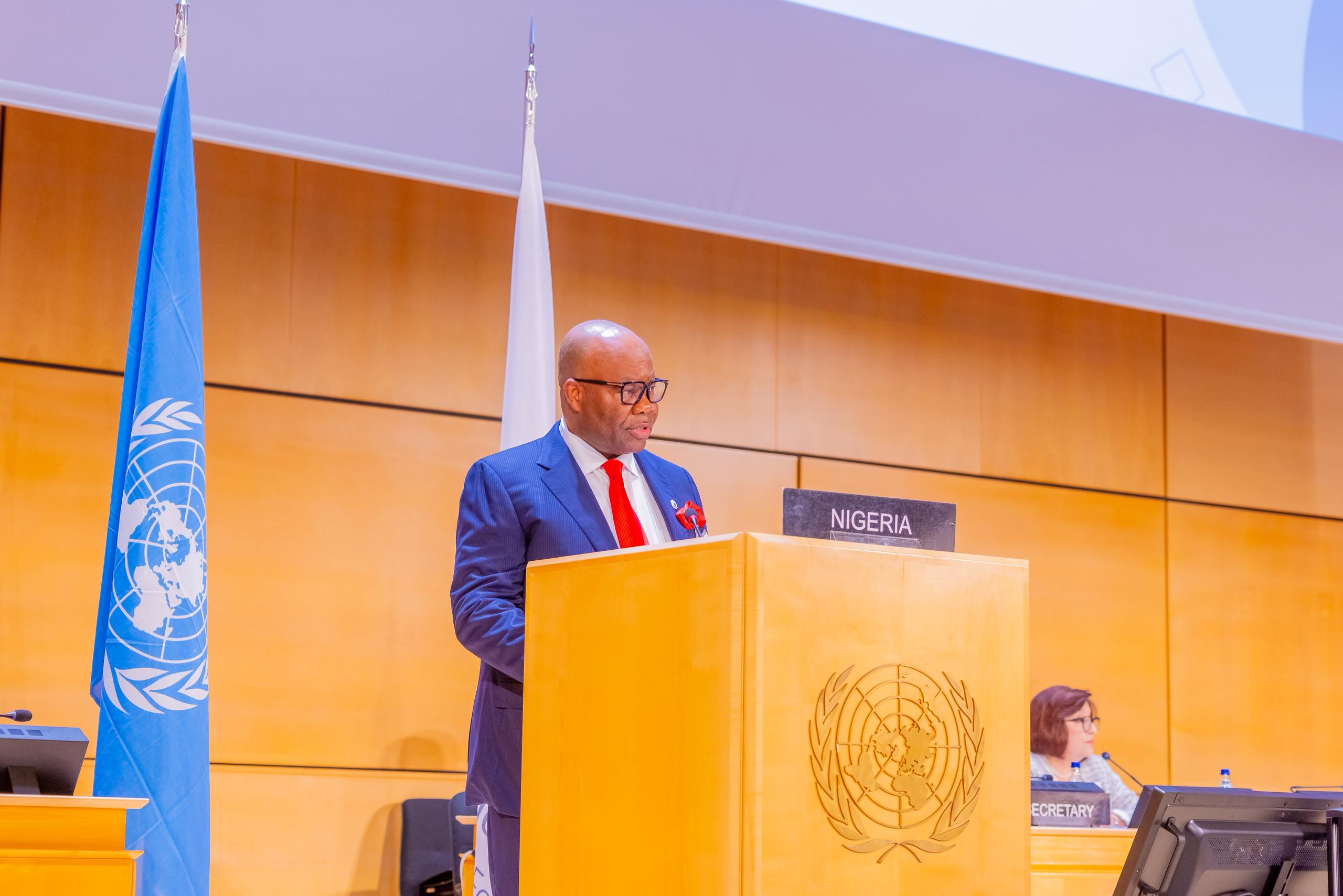
In the majestic halls of the Palais des Nations in Geneva, where the world’s parliamentary leaders gathered to wrestle with crises that threaten the very fabric of humanity, Nigeria’s Senate President, Godswill Akpabio, strode onto the podium with the composure of a man forged in storms and determined to chart a new course. At the Sixth World Conference of Speakers of Parliaments, convened by the Inter-Parliamentary Union (IPU) in partnership with the United Nations from 29 to 31 July 2025, Senator Akpabio delivered an address entitled “Courage to Legislate, Will to Lead.”
To be clear, this was no ordinary speech. It was a manifesto of resilience, a call to parliaments to transform turbulence into resolve, and a clear signal that Nigeria intends to play a more assertive role in shaping global governance. Akpabio’s words reverberated far beyond the stately walls of the United Nations complex, echoing across continents as a clarion call for parliaments to rise as architects of peace, justice, and shared prosperity.
For Nigeria, it was more than just another address by the number three citizen in the pecking order of the country’s political leadership. It was a declaration of resilience, a proclamation of leadership, and a bold announcement that Africa’s largest democracy is ready to help shape the global agenda. With his trademark blend of eloquence, Nigerian pragmatism, and the warmth of a village elder, Senate President Akpabio cemented Nigeria’s place as a beacon of legislative courage in an age of uncertainty.
Legislating in the Furnace: Nigeria’s case for courage:
Akpabio began with imagery that captured both Nigeria’s trials and its triumphs. “I come from a nation that has endured fire and risen from ashes,” he told the gathering, his voice imbued with the conviction of lived experience. He spoke of a people who “find clarity in confusion and keep sailing through storms and rough weather,” words that drew knowing nods from delegations representing nations equally buffeted by conflict, climate change, and economic instability.
Far from a lament, it was a bold framing of adversity as opportunity. “We are not defined by what we face, but by how we rise,” Akpabio declared, striking a chord with an audience searching for hope in an age of turmoil. He then laid out Nigeria’s legislative record as proof that courage is more than rhetoric.
The Control of Small Arms and Light Weapons Act and the Terrorism Prevention and Prohibition Act were highlighted as bulwarks against insecurity. These were not isolated measures but, as Senator Akpabio argued, the very foundation of development. Terrorists, he noted, exploit poverty and displacement. To address this, Nigeria’s Senate has paired security legislation with social reforms such as the Out-of-School Children Education Act, designed to ensure the country’s vast youth population, numbering over 130 million, becomes an asset rather than a liability.
His refrain, “We legislate in the storm, reform in the furnace, and lead with courage,” became the heartbeat of his address.
Beyond security, the Senate President championed innovation and inclusion. The 10-Year National Digital Strategy and the Start-Up Act are unlocking what he called “potential long caged by poverty,” offering expanded credit, digital training, and opportunities to a generation that might otherwise be left behind. “Our youth are not a liability but a lifeline,” he proclaimed, drawing applause from delegations across Africa and Asia.
Inclusion, he stressed, is no longer negotiable. The Not Too Young To Run Act has flung open Nigeria’s political space to a new generation, while proposed gender quotas promise to move women and persons with disabilities from the periphery to the centre of decision-making. “Inclusion, not exclusion, must be our standard,” Akpabio insisted, aligning Nigeria with the IPU’s global mission to close the democracy gap. At a conference where the 15th Summit of Women Speakers of Parliament had just concluded, this commitment carried particular resonance.
A Call to Action: Reimagining Multilateralism for Global Progress:
If the first half of Akpabio’s speech celebrated Nigeria’s domestic resilience, the second half challenged the global order to act with equal courage.
With the conference theme, “A World in Turmoil: Multilateralism for Peace, Justice and Prosperity for All,” setting the tone, he cut through the familiar fog of diplomatic platitudes with startling clarity. “Multilateralism must not become a rhetoric. It must rise as a movement of resolve,” he said, his words sharp as a blade.
Akpabio urged parliaments to step beyond ceremonial roles and become “peace architects” who “command, not just convene.” He laid out three pillars for reimagining multilateralism.
First, solutions must be locally rooted yet globally relevant. Nigeria’s regional security summits, which bring together governors, traditional rulers, and security agencies, were cited as a model for addressing arms trafficking, banditry, and separatist agitation through bottom-up intelligence rather than distant policy papers.
Second, the Sustainable Development Goals must be treated as binding legislative contracts. Nigeria’s efforts, from tax reforms and cash transfers for the poorest households to education loans and vocational training, were presented not as domestic footnotes but as global commitments honoured in practice.
Third, Akpabio evoked what he called the tapestry principle: “When one corner of humanity is torn by conflict or injustice, the whole fabric is weakened.”
It was a poetic flourish that transcended borders, reminding the assembly that climate change, arms flows, and youth unemployment cannot be solved by nations acting in isolation. His call for legislators to “bind our futures not only in treaties, but in tenacity” drew rousing applause. It was a challenge to move beyond drafting resolutions that gather dust and instead to become paragons of purpose in a world starved of decisive leadership.
Showcasing Nigeria’s legislative achievements on the global stage:
Beneath the soaring rhetoric lay a strategic subtext. Nigeria was not content to participate; it was ready to lead. By showcasing legislative achievements in the face of terrorism, poverty, and economic volatility, Akpabio positioned Nigeria as a thought leader for the Global South. His appeal for “justice for all” carried a pointed critique of unequal resource flows and arms exports that fuel conflicts in developing nations, a diplomatic challenge to Western powers delivered with grace rather than rancour.
The symbolism of the moment was unmistakable. Nigeria had returned to the IPU Executive Committee in 2023 after nearly six decades, and Akpabio now serves among the twenty members of the Preparatory Committee shaping its future. Observers rightly see his well-received Geneva outing as a résumé enhancement for even greater international roles. As one delegate remarked, “Akpabio did not just speak for Nigeria. He spoke for every nation struggling to turn chaos into progress.”
His Nigerian ethos, resilience laced with charm, gave the speech a unique flavour. His greeting “from the Senate and the resilient people of Nigeria” was less a protocol and more a proud declaration of a nation unbowed even when troubles abound. His metaphors of rising from “ashes” and sailing through “rough weather” evoked the spirit of the Lagos trader or Kano farmer: adaptable, unyielding, and never without hope. That relatability ensured his words resonated not only with Geneva’s polished delegates but also with citizens in Maiduguri, Port Harcourt, and Onitsha, who saw in him a reflection of their own struggle and determination.
As the conference closed, one question lingered: Would the world’s parliaments heed his call or remain, as he warned, “scribes of the status quo”?
For Nigeria, Senator Akpabio’s Geneva triumph is more than symbolic. It is a milestone in the country’s ascent as a voice of consequence in global governance. For the Senate President himself, it was a legacy moment, cementing his stature as both a parliamentary diplomat and a statesman of continental consequence.
And as he reminded the world with unwavering conviction: “We legislate in the storm, reform in the furnace, and lead with courage.”
•Ken Harries Esq is a development Communication Specialist

Share this story:

News

NCDMB, Seplat firm up plans for take-off of Centre of Excellence at DELSU

Published

on

Key Management staff of the Nigerian Content Development and Monitoring Board (NCDMB) and Seplat Energy Plc met with principal officers of the Delta State University (DELSU), at Abraka, Delta State, on Monday to deliberate on critical processes toward the take-off of a Centre of Excellence in Gas Development, approved for the institution by the Board in 2024.

The project, which is the latest among similar ones at Niger Delta University, Amassoma, Federal University of Technology, Minna, Federal University of Technology, Akure, Federal University of Technology, Owerri, Modibbo Adama University of Technology, Yola, and Usman Danfodio University, Sokoto, is the outcome of an NCDMB-commissioned research undertaken by PricewaterhouseCoopers (PwC) to provide a 10-year road map for research and development (R&D) for the Nigerian oil and gas industry.

Speaking at the event, the Director, Corporate Services, of the NCDMB, Dr. Abdulmalik Halilu, who represented the Board’s Executive Secretary, Engr. Felix Omatsola Ogbe, recalled that personnel of the Board and Seplat have held a series of engagements since 2024 to ensure they achieved a scope that clearly outlined the essence of what a centre of excellence is supposed to deliver in terms of infrastructure, equipment, capacity development, research policy and most importantly, sustainability of the project.

He disclosed that the Managements of NCDMB and Seplat Energy have endorsed the scope and were ready for the take-off of the project, with a team of technical experts already assembled to manage the entire process. He reiterated that the Standing Committee of the Board that has been managing the project since conception has been further reinforced with the inclusion of new personnel of general manager cadre to ensure that expectations of the project are met.

Advertisement

“We wish to reassure you,” Dr. Halilu declared, that “the Executive Secretary is fully committed to the project, not just at the project development phase but even during execution,” and has accordingly deployed the full complement of staff covering quality assurance, research and development, and related operational units to achieve the best results.

In his own remarks, the Nigerian Content Manager of Seplat Energy, Mr. Simeon Ogari, said his company, which operates the 300 million standard cubic feet per day (MMscfd) ANOH Gas Processing Plant, a 50/50 Joint Venture with the Nigerian Gas Infrastructure Company (NGIC), chose Delta State University, Abraka, for the Centre of Excellence project because of its proximity to his company’s major operational base.

While underlining the commitment of the company’s Management to timely completion and sustenance, he pointed out that the Research Centre in Gas Development would be beneficial not only to the institution but to the oil and gas industry and the country at large as a centre for advanced research and technology incubation.

He, however, emphasised the importance of collaboration, pointing out that “There is nothing as good as looking at the Triple Helix Model,” as every research centre in the world has government, institution, and the private sector working together in critically important roles. He said he expected same for the upcoming Centre.

Giving the background to the project, the Chief Executive Officer of GOSHEN, the management firm in charge of the project, Mr. Leonard Okafor, noted that the research work undertaken by PricewaterhouseCooper showed that Nigeria is “operating an enclave economy,” without adequate intersectoral linkages, and that “there was need for entrenched local content in the oil and gas industry.” The Research Centre, he explained, was one of a number of initiatives designed to address the deficits.

Advertisement

The PwC research, he stated, also identified five areas where R&D would enhance local participation in the oil and gas industry, namely, Collaboration, Infrastructure, Capability, Commercial/Legal Framework, and Funding. He emphasised that “Finding the right collaboration is critical,” noting that academics with sound research backgrounds and who are well-published are particularly required for a project of this nature.

Explaining further what he titled as “Standard Requirements from Host Institutions,” the management consultant listed availability of research staff for secondment to [the Research] Centre, availability of non-research/administrative staff for secondment to the Centre, essential policy documents (Existing MoU for any existing research centre/collaboration between DELSU and other parties], Research Policy, and Finance and Procurement Policy).

In his own response, the Vice Chancellor of the institution, Professor Samuel Oghenovo Asagba, thanked NCDMB and Seplat for the world-class research facility they have decided to build at DELSU, assuring them that he would do his best to meet all requirements for successful take-off.

In regard to collaboration, he said the University, which was rated by Times Higher Education in 2026 as “The best state-owned university in Nigeria,” has very competent academics, renowned for their research output, to fulfil the requirement of collaboration. “In science and engineering, DELSU has high-flyers,” he declared.

Also speaking, the General Manager, Quality Assurance, of the NCDMB, Mr. Chris Osuji, said his department was involved in the project to ensure top-notch finishing. According to him, “From inception to completion, NCDMB Quality Assurance is to be actively engaged,” he stated.

Advertisement

In a vote of thanks, the Director, Monitoring and Evaluation, of the NCDMB, Mr. Silas Ajimijaye, expressed appreciation to Seplat for providing the required funding, while urging the University Management to use the project to etch its name in gold.

In a similar vein, the Deputy Vice Chancellor, Research, Professor Douglason Omotor, thanked NCDMB and Seplat for the initiative, while assuring that the project executors would find technically competent academics and seasoned administrators to provide effective collaboration.

Share this story:
Continue Reading

News

NLNG concludes 2026 VIBES Pitch-a-Thon, disburses ₦250m in business grants  

Published

on

NLNG has disbursed a total of ₦250 million in grants to 51 entrepreneurs following the conclusion of its 2026 Vocational Innovation and Business Empowerment Scheme (VIBES), which commenced with the induction of 103 participants from its host communities in Rivers State.

The grants followed a competitive pitch-a-thon that brought the programme to a close, with participants presenting their business ideas and funding requirements before a panel of judges. Selections were based on the viability, scalability, and sustainability of each proposal.

Speaking at the event, NLNG’s General Manager, External Relations and Sustainable Development, Sophia Horsfall, said the grant component of VIBES is designed to ensure that participants are not left with just training, but are supported to take the next practical step in establishing their businesses.

“What we are doing with this funding is bridging the gap between learning and execution. Many small businesses struggle at that stage where they have the knowledge but lack the capital to move forward. Through VIBES, we are providing targeted support to help these entrepreneurs implement their ideas, stabilise their operations, and position their businesses for growth,” she said.

Advertisement

Horsfall added that the initiative reflects NLNG’s broader approach to sustainable community development, noting that combining capacity building with access to funding enables beneficiaries to make measurable progress, strengthen their businesses, and create real economic value within their communities. “It is about providing sustainable livelihoods”, she said.

In his remark, Manager, Community Relations and Sustainable Development, Yemi Adeyemi, commended participants for their dedication throughout the programme and the quality of ideas presented during the pitch-a-thon. He noted that the funding is intended to provide critical growth capital to enable beneficiaries expand operations, improve productivity, create jobs, and strengthen their market position.

He thanked all participants for their commitment and reaffirmed NLNG’s continued investment in enterprise development, and support for initiatives that build local capacity, promote entrepreneurship, and create sustainable economic opportunities in its host communities.

The pitch-a-thon marked the culmination of a four-week intensive business capacity-building programme, during which participants were equipped with practical skills in financial management, business strategy, marketing, and operations to strengthen their enterprises.

The programme, built on innovation, scalability, and sustainability, reinforces NLNG’s commitment to inclusive economic development, integrating capacity building with funding to help entrepreneurs grow, sustain their businesses, and drive long-term impact.

Advertisement

Share this story:
Continue Reading

Columns

Abike Dabiri: Did Obi raise a monster or you’re drunk on Tinubu’s poisoned chalice?

Published

on

I bet you didn’t know Abike Dabiri. Two factors will make this possible. Either you were not around in Nigeria in the golden era of our Nigerian television girls – the era when being a regular face on Nigerian Television Authority (NTA) gave you the golden key to open all doors – or you were somewhere in the villages very far and distant from civilization – many of us were – that included not having access to the television.

O! You didn’t know? You didn’t know a time was in this clime when seeing a television screen from a distance, was one of the biggest privileges one could get let alone watching it – that people clustered at the windows of homes with television sets to catch a glimpse of Village Headmaster, for instance.

You’re carrying shoulders because you probably met the time when carrying a Blackberry phone was all you needed to get that fine babe behind your sheets! Today, you thought that because you could now watch your matches on your phone – I watched all the AFCON matches on my phone, being on the road most times – there was no time men had to climb walls to turn television antennas to get some appreciable pictures. Chai! This changing world.

Bet you didn’t hear about Bimbo Roberts – later Bimbo Oloyede, Julie Coker and later Augusta Maduegbuna, Elizabeth Nze, Sienne Alwell-Brown, Ruth Benamesia-Opia, Eugenia Abu, Ronke Ayuba, Kehinde Young-Harry, Lola Alakija, in no particular order. No! You wouldn’t if you were not that privileged in the 1980s and even 1990s. They were the glamour of that era.

Advertisement

Glamour? Not in the sense of beauty – but glamour, because television made them so. For indeed, some of these television faces, were not that glamourous.

But beauty or no, Abike Dabiri was one of the discoveries of that era. Obviously not in competition with these others who were the newscasters on NTA News At Nine, she actually carved a niche for herself elsewhere on Newsline – the soft-sell edition of the station’s news programme aired every Sunday.

Abike Dabiri was a toast of that programme. She was a reporter’s reporter – traversing beyond the seven seas and seven wildernesses to bring to Nigerians those rare stories that either made Nigerians laugh their hearts out or cry their eyes out – a doyenne of human-interest reporting.

Then, suddenly – suddenly – suddenly – the serpent came with the forbidden fruit – the temptation of higher ground – the allure of high office – Tinubu’s tainted chalice that comes like glittering ornament but with hollow and rotten underbelly. She took, she ate and now everything scatter-scatter. Our dear Abike Dabiri accepted and ate the sour grape and now her teeth are set on edge! What a pity!

The breeze has blown to uncover the romp of the hen. Before now, whoever believed that our dear Abike Dabiri farts. But we now know that Abike Dabiri-Erewa not only farts, but her fart smells badly. At first, no one noticed the degeneration.

Advertisement

The time she was at the House of Representatives, was the golden era of Tinubu. That was when the Jagaban Borgu was the governor of Lagos State. She glowed along by tapping from glittering appeal of the Lagos show boy!

At that time, Tinubu was generally holding the golden trophy adorned with the beautiful calligraphy of democracy in Nigeria. That was before he drank from the poisoned chalice of Muhammadu Buhari, his predecessor by joining him in the hatred for the Igbo man – a phenomenon that becomes the nemesis of some Nigerian leaders – Buhari’s major insignia. Then the desperation! Then the degeneration! Now the albatross!

Now, whoever hates the Igbo and remains the same? None! That was what sealed Buhari’s fate. And surely the snake that bit that braindead archeological discovery – that museum piece – has definitely whipped Tinubu with its tail and the rest is now history. If not, compare a Tinubu as governor when he was all cozy with Ndigbo and now he has turned 360 degrees.

And as long as the darkness will give way to reveal the sun breaking from the East, the sting of the snake’s tail will reach everyone who toes that line. You know why, the dominant culture of the Igbo man is ofo n’ogu – justice, equity and fair-play! Have you watched an Igbo man pray with colanut.

He wakes up and with his cola in his hands, beckons on his chi with these words – ndu mmiri, ndu azu, mmiri atanaa, azu anwuna – the life of the river, the life of the fish – may the water not dry and may the fish not die! Egbe bere ugo bere, nke si ibeya ebena nku kwaa ya – let the kite perch and let the eagle perch – whichever says the other should not perch, may its wings whither. Which other people say the same or similar prayer elsewhere?

Advertisement

Now, because the kid-goat watches when the mother-goat is chewing the cud, hating the Igbo has become a fad among those who want to please Tinubu. Obviously, the totem through which this sentiment find expression is Peter Obi. He has become the tree standing by the roadside that receives the strokes of the machete. Obi has remained the hieroglyph for expressing real and imagined pro-Igbo angst.

So, in 2025, when Babajide Sanwo-Olu wanted to mend fences with Tinubu, after allegedly falling out of favour with his boss, he launched an unprovoked attack on Obi, using the latter’s Johns Hopkins University lecture as a pad. Reno Omokri, has since made himself Minister of Peter Obi Affairs. Daniel Bwala, Femi Fani-Kayode et al along this line never end a line without Obi getting a slash of their machete.

Enter our dear Abike Dabiri-Erewa. The little birds flying around whistle that her tenure as Chairman of Nigerians in Diaspora Commission (NiCOM) is coming to an end and she is eying a renewal or another job from the Jagaban. How else to go about it than the low-hanging fruit? – Peter Obi.

From nowhere, on Sunday, the media were suffused with the screaming headline – “Peter Obi has actually raised monsters.” As it were with syndicated stories, each of the medium used to transport the outing carried the same headline – well crafted – of course, using her journalism skill to make maximum impact.

After rambling some clearly obtuse and incoherent words in form of reasoning, she ended up with even more brainless, imbecilic and asinine submission – by the time it is Igbo turn to produce Nigerian President, Obidents – followers of Obi – would have destroyed his chances. Me paraphrasing. Chai!

Advertisement

Now, aunty Abike, whose turn is it now? Isn’t already the turn of Ndigbo and the selfsame Obi? Isn’t it part of the argument that the seat your Jagaban is occupying was stolen from Ndigbo? So, you know that Ndigbo also have a stake to it? Yes! You know. But now you have eaten Tinubu’s palm nuts, see how your teeth have all turned red.

But Ndigbo have another way of invoking justice – ochu nwa-okuko nwe ada ma nwa-okuko nwe nwenwe-oso! I won’t explain. Find an Igbo staff at NiMCOM – if there is one – because I hear you hate them so much that finding one near you might be impossible. But even a cleaner in your office could help or better still – ask your spare parts seller. He’s sure to be Igbo!

My name is Sunny Igboanugo, I’m The Tiny Voice!

Advertisement
Share this story:
Continue Reading

Trending