

News
BREAKING: More sorrow for Fubara! *S’Court nullifies Rivers polls, sacks LG bosses

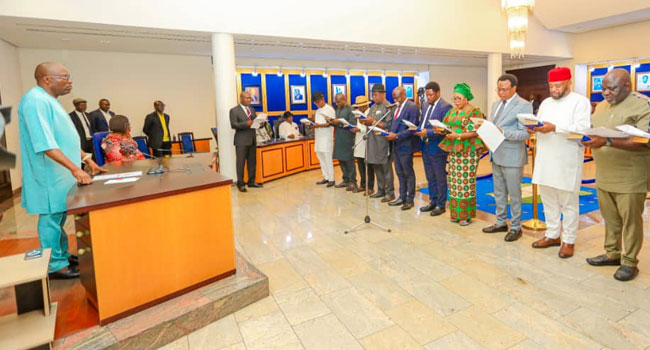
The atmosphere around Siminalayi Fubara, Governor of Rivers State, may certainly not be a happy one as the Supreme Court, has continued to hit hard on the foundation of his government, the latest being the nullification of the outcome of the Local Government Elections that were held in Rivers State on October 5, 2024.
The apex court on Friday, upheld an appeal brought before it by the All Progressives Congress (APC), questioning the integrity of the polls which produced 22 of the 23 council chairmen from the Action Peoples Party (APP), while the remaining council was won by Action Alliance (AA), in th 23 council structure.


Apart from the initial violence that trailed the events prior to the election, the state practically went into flames on Monday, October 7 after the inauguration of the executives by Fubara a day before as some of the headquarters of councils were torched by unknown assailants, sparking off accusations and counter accusations by the forces loyal to the governor and those of Nyesom Wike, his predecessor.
About four months after, the Governor has been handed a verdict from the apex court that his efforts were in vain as he had no legal basis to carry out his actions, on the same day he also lost the bid to cling to the four-man faction of the House of Assembly after the same court held that the status of Martin Amaewhule Group of 27 House of Assembly members remained valid.
Justice Jamilu Tukur, who read a unanimous decision by a five-member panel of the apex court, vacated the November 21, 2024, judgement of the Abuja Division of the Court of Appeal, which validated the elections.
In doing so, the court held that there was no evidence to establish that the conditions precedent stipulated by section 150(3) of the Electoral Act, 2010, was met before the election was conducted by the Rivers State Independent Electoral Commissioners (RSIEC).
Having demolished the position of the Court of Appeal, the apex court restored the verdict of the Federal High Court in Abuja, which barred the Independent National Electoral Commission (INEC), from releasing voters’ register to the RSIEC for the conduct of the LG polls.
It will be recalled that a special panel of the Court of Appeal led by Justice Onyekachi Otisi held that the high court lacked the jurisdiction to entertain suit against the Rivers State LG elections.
The appellate court equally faulted the trial court for barring security agencies from providing security during the elections.
According to the appellate court, section 28 of the Electoral Act does not cover elections conducted by states but only federal elections, governorship and Area Council Elections in the Federal Capital Territory.
It held that Justice Peter Lifu of the Federal High Court in Abuja, who had on the strength of a suit that was filed by the APC, stopped the conduct of the Rivers State LG elections, acted outside his jurisdiction.
Justice Lifu had based his judgement on the fact that the RSIEC erred by fixing date for the conduct of polls in the 23 local government areas of the state without strict compliance with relevant laws guiding such election.
Justice Lifu held that the RSIEC failed to publish the 90-day mandatory notice before it scheduled the election.
More so, he held that the update and revision of voters’ register to be used for the election ought to have been concluded before any valid date could be fixed for the polls.
Consequently, he ordered INEC not to make the certified voters’ register available to RSIEC, pending when the relevant laws were complied with.
He further barred RSIEC from accepting any voter register from INEC or using same for the purpose of the LG polls, a decision that was upheld by the Supreme Court on Friday.











Abdulrahman Bello, must die for the murder, Hafsoh Yetunde Lawal, a final-year student of the Kwara State College of Education, Ilorin, the Court of Appeal has insisted, rebuffing the attempt of the self-acclaimed Islamic cleric, to upturn the verdict of an Ilorin High Court.
Affirming the earlier death sentence imposed on cleric for the murder of the female student, said to be his lover, on February 10, 2025, at the Olunlade area of Ilorin, which attracted widespread public outrage across Kwara State and beyond, the appellate court said it found no reason to upturn the earlier verdict of the lower court.
Bello, who was one of the five people arraigned on charges bordering on conspiracy, murder, unlawful removal and possession of human parts and blood, also faced a rape charge, of which he was eventually acquitted by the trial court.
Justice Gabriel Omoniyi Kolawole, who led a three-man panel of the appellate court, while dismissing his appeal, held that the prosecution proved beyond reasonable doubt that he murdered the victim and was unlawfully in possession of human parts.
The appellate court consequently upheld the judgment of the Kwara State High Court, which sentenced Bello to death by hanging and imposed an additional 10-year jail term over his conviction for unlawful possession of human parts.
The court held that there was no merit in the appeal and consequently affirmed both the conviction and the sentence imposed by the trial court.
According to the appellate court, the trial court properly evaluated the evidence before it and rightly concluded that the prosecution established the offences beyond reasonable doubt.
The appellate court said it believed the position of Ibrahim Sulyman, Kwara State Attorney General and Commissioner for Justice, Issa Zakari, Chief State Counsel, and B.L. Abdulsalam, Assistant Chief State Counsel, who led the prosecution.
Hailing the judgment as another significant milestone in the state’s criminal justice administration, Sulyman, said in a statement: “The judgment underscores the commitment of the Kwara State Ministry of Justice and the judiciary to ensuring that criminal cases are determined strictly in accordance with the law and the evidence presented before the courts.
“It also reaffirms the principle that persons found guilty of grave offences, after a fair trial, will be held accountable under the law. The appellate court’s decision would strengthen public confidence in the justice system.
“The affirmation of the conviction and sentence represents another milestone in the administration of criminal justice and reinforces public confidence in the rule of law and the appellate process. The convict still retains any further rights of appeal available to him under the Constitution and other applicable laws.
Justice Hannah Ajayi of the Kwara State High Court, sitting at Ilorin, hand on July 2025 sentenced Bello to death after finding him guilty of murdering and dismembering Lawal, after describing his act as “the highest degree of human wickedness, and a premeditated and cold-blooded act.”
Dismissing Bello’s claims that he loved the deceased and intended to marry her as merely an afterthought designed to deceive the court, Ajayi, also ruled the convict’s conduct after committing the crime and before his arrest suggested that it might not have been his first involvement in such an act, while a book on money-making charms recovered from his apartment further strengthened the prosecution’s case.
Justice Ajayi further held that the video and written confessional statements obtained by operatives of the Department of State Services and the police were lawfully admitted in evidence, dismissing Bello’s allegation that he was tortured into making the confessions.
While acquitting Bello of the rape charge, the trial court convicted him of murder and unlawful possession of human parts, sentencing him to death by hanging for the murder and imposing a 10-year prison term, with an option of a N100,000 fine, for the human parts offence.
The court also discharged and acquitted the four other defendants in the case — Ahmed Abdulwasiu, Suleiman Muhydeen, Jamiu Uthman and Abdulrahman Jamiu — after holding that the prosecution failed to establish their involvement in the offences.
Reacting to the High Court judgment at the time, the Emir of Ilorin and Chairman of the Kwara State Traditional Rulers Council, Ibrahim Sulu-Gambari, described the killing as tragic and commended the judiciary for ensuring justice.
“The gruesome murder of Hafsoh Yetunde Lawal was pathetic, unfortunate, regrettable and worrisome,” the monarch said in a statement issued by his Press Secretary, Abdulazeez Arowona.
“The judgment has further brightened the hope and trust of the people in the judiciary and security agencies. May Almighty Allah repose the soul of the late Hafsoh Lawal and comfort her family members.”
The monarch also urged parents and guardians to be vigilant and closely monitor the activities and movements of their children and wards to prevent a recurrence of such incidents.

By the time they discovered that were surrounded, and had no escape route, the terrorists were the ones now begging to be let off, but their pleas were rebuffed due to the determination of the operatives to finish the job once and for all.
This was part of the account of Chinedu Nnebeife, a Major General and the General Officer Commanding (GOC), 2 Division, Nigerian Army, who led the rescue operations to free the 44 pupils and teachers, victims of the kidnap incident in Oyo State, last weekend.
Hear him: “We went in with some hunters and local vigilantes, but nothing positive happened that day. By the grace of God, on the 10th of July, we successfully rescued 44 of them. I have always said we will never yield to terrorists’ demands. We will not, and we never will.
“At the last phase of the operation that we had, we were blocking their major logistic. We went to a town called Ashamu to block the place, and it finally put pressure on them, and it was now they were willing to release unconditionally. But we are not giving up on them.
“We said, no, it’s not about releasing. We must see to the end of the terrorists operating in that particular region, and of course, indeed, the whole part of the country, and the glory of God, we have them here.”
Giving some details that led to the successful operation, the GOC described how drones of the Nigerian Air Force (NAF), deployed to locate the actual spot the abducted victims were kept, failed because they could not penetrate through the thick canopy of the Old Oyo National Park.
Stating how the failure of aerial surveillance forced troops into a ground assault that claimed the lives of an officer and a soldier, Nnebeife told reporters, on Monday: “Because of the nature of the forest, how thick it is, we had drone teams, we have Nigerian Air Force following up, but in some of those areas, you can’t even see, if you are under that base, you can’t see the rays of sunlight from those places and the Air Force flew, they couldn’t see anything.
“The drone team also flew, we didn’t get anything from those things and that was how we insisted on ground operation. It has to be ground, we have to go deep into the forest, and it’s during one of these operations that we lost the officer and the soldier, that particular day, and some other ones who were wounded. One of them is actually serious because he has a broken arm due to gunshot wound.
“The operation continued and we had to like involve a lot of agents, and I had to take over the whole operation completely from the garrison commander because we had to now bring in troops and forces from different places, providing intelligence, and I had to coordinate all these teams together.”
The ordeal of the victims who spent 56 days in captivity after gunmen stormed three schools in the Ahoro-Esiele, Yawota and Alawusa communities on May 15 and took them away, raised a lot of dust within Nigeria and across the globe.
Speaking further on the ugly situation, the military top brass listed the units that took part in the operation to include the Office of the National Security Adviser (NSA), the National Counter-Terrorism Unit tactical team, and the Defence Headquarters Special Forces team made up of personnel from the Army, Navy, Air Force, Police, Department of State Services (DSS), National Security and Civil Defence Corps (NSCDC) and the National Intelligence Agency (NDA).
Stating how the Nigerian Police also deployed separately from the special forces, alongside a DSS team from Oyo State and an Air Force Tactical Operations Group unit drawn from Kainji with fighter aircraft support, while troops from Operation Savannah Shield in Gwara formed a blocking force on the northern flank of the state, he said the first attempt to reach the victims, carried out with hunters and local vigilantes soon after the abduction, also failed.

Words and acts of consolations, seem quite inadequate so far to assuage the deep sorrow of the family of Kingsley and Mercy Edu, a major victim in the torrential rain that caused havoc within Ikot Awatin community, Calabar municipality, Cross River State and environs at the weekend.
Four children from the family identified as Bright, 18; Godswill, 12; Daniel, 11; and Richard, 10, were reportedly buried alive alongside another identified, simply as Mr. Udo, a tanker driver attached to a fuel depot, in a mudslide that accompanied the rain.
The tragic incident occurred just three days after floodwaters claimed the life of a one-year-old child and destroyed property worth millions of naira along Mayne Avenue by Atu Street in Calabar South Local Government Area.
Attempts to save the victims, were said to have failed, as community youths, working through the night with bare hands and shovels, were too late by the time they finished digging through the rubble, as all five victims were recovered dead.
The mother of the children, popularly known within the community as Mama Uwana, was said to have taken her children to church for evening service, only for them to leave the service for home as the rain worsened, to beat the storm, while their father, a security officer, was away on official duty.
Unaware of the fate awaiting them, the children were said to have changed into dry clothes, and lay down to rest, unaware that the saturated earth above their home was already giving way, only for the soil to give way, trapping them beneath the caved earth.
Wailing uncontrollably, the distraught mother, said to be a waterleaf farmer who lost not just her children but everything she owned, could barely find words for her loss, loudly bewailed her fate.
Hear her: “Everything was buried in the landslide, taking my children and leaving us hopeless and homeless. Why me? Four out of seven are gone in one day. My husband never buys anything for himself because he wants his children to go to school, three boys and a girl, all gone.”
For her husband, his still silence, which contrasted sharply from his wife, betrayed his own deep emotions, as he stood at the scene speechless, while sympathisers and neighbours gathered around in almost futile attempts at consolation.
The four children were buried shortly after their bodies were recovered, while the remains of Mr. Udo were deposited in a morgue, with his family left to grapple with the sudden loss of a breadwinner who had simply been doing his job on a stormy night.
Residents and sympathisers who trooped to the scene were shocked by the scale of the devastation, calling on the Cross River State Government and well-meaning Nigerians to come to the aid of the Edu family, who in a single night lost four children and the roof over their heads.
Efa Nyong, Director General of the Cross River State Emergency Management Agency (CR-SEMA), led other agencies including Disaster Management Unit of the Nigerian Red Cross Society, conducted a three-hour, on-the-spot assessment of the site on Saturday.
The team, which included the Red Cross’s Disaster Management Officer, Agbor Okim, and CR-SEMA’s Head of Relief and Rehabilitation, Preye Obo, walked through the wreckage, spoke with grieving family members, and documented the extent of the destruction.
Nyong described the loss of the children as heartbreaking and conveyed the sympathy of the state government to the bereaved families, assuring residents that the government would work with relevant stakeholders to provide support.
Explaining that the assessment was designed to guide the government’s response, from immediate humanitarian intervention to longer-term measures aimed at reducing the risk of future disasters, he urged residents in landslide and erosion-prone communities to remain vigilant, to promptly report signs of soil movement or land cracks, and to cooperate with authorities when evacuation becomes necessary.
Bassey Patrick, who spoke on behalf of the deceased family, thanked the assessment team for responding promptly despite the difficult circumstances and called for more emergency assistance for survivors who, in his words, had lost loved ones and struggling to cope with the aftermath of the disaster.



-

 News3 days ago
BREAKING: Mystery death! *Female student dies a day after arriving Umahi’s home!
-
 News4 weeks ago
BREAKING: Troops rescue wife of kidnapped General! *Terrorists flee scene
-

 News3 days ago
Don’t jump to conclusion! *Umahi speaks on mysterious death of female students!
-

 News4 weeks ago
BREAKING: Count me out, Okonkwo tells Atiku *Amaechi VP’s choice an insult to Ndigbo
-
 News3 weeks ago
BREAKING: Court sentences Nigerien, two others to death over terrorism
-
 News2 weeks ago
BREAKING: EX-SSG mowed down by gunmen! *He resisted being kidnapped – driver
-

 News3 weeks ago
Two hours after Igboho’s ‘red-eyes’ to ‘Fulani’ leaders, gunmen free kidnap victims!
-

 News3 weeks ago
Abductors of Oyo teachers panicking, freedom coming for victims soon!