

News
Sanusi to Nigerian judges: Who will speak for you before God?


Lamido Sanusi Lamido, Emir of Kano, has a question for Nigerian judges in the practice of skewing justice to please those in authority or for other personal reasons – who will plead your case before God?
This is a question he said they must have in mind whenever they raise the gavel to strike their verdict on any issue before them, adding that the hammer of justice must never be based on personal relationships, but on the content of the law and morality.

Sanusi, former Governor of the Central Bank of Nigeria (CBN), made the call during a public discourse with the theme: Ethics, Morality And The Law, in honour of Justice Habeed Abiru who was recently elevated to the Supreme Court, charged the judges to remember that they are accountable to God.
Hear him: “Do not be an advocate for wrongdoers and do not be an advocate for those who deceive themselves, because Allah does not love sinful wrongdoers. When your friends come to you, when government comes to you, and you listen to them and you tilt judgement in their favour. Ask yourself, who will be your advocate before God, on the Day of Judgment?”
At the event organised by the Movement for Islamic Culture and Awareness (MICA), a non-profit Islamic faith-based organisation, Sanusi said working in such an environment is not an easy task, he said: “Let me start by saying that for all the judges in this room, please accept my sympathies. Being a judge in a dysfunctional Society is not an easy task.
“You are pushed left, right and center. There’s so many expectations from politicians, from the people, and frankly in every profession, just like in a large family of many good children, all you need is just one or two bad children and the entire family’s reputation is destroyed.
“And I think a bunch of what we hear about the judiciary is something that is about a very tiny minority of judges. I have so many judges in person and I must say that I have not personally met a bad judge.
“But the reality is that my lord, you have a big task because at the end of the day, you all have the fight to clean up the reputation… we have to make sure that we bring down the number of bad judges to zero.”
The former CBN boss, also canvassed substantive justice in favour of technicalities, saying: “We begin to fight for the independence of not just the judiciary but of law enforcement agencies. I think we all agree that there have been judgements that have been made that just fly in the face of commonness, fly in the face of justice and many of these judgements that we hear about happened because the judges decided that even though this is substantive justice, they are not going to go with it because of some technicality.”











The Greek biographer Plutarch, in the preamble to his “Life of Alexander”, observed: “I am writing biography, not history; and the most brilliant exploits do not always manifest a man’s virtue or vice so well as a slight thing, a word or a jest, which often tells us more of his character than a siege where ten thousand die.” He understood that greatness is often revealed not by monumental achievements but by seemingly insignificant habits and moments. Thus, in seeking to understand Alexander, he did not begin with his conquests but with the youthful prince taming the wild horse Bucephalus after discerning that the animal feared only its own shadow. It was a small incident that revealed an extraordinary mind.
The same approach is useful in understanding Mr. Peter Obi as he marks his sixty-fifth birthday. As I set out on this task, which I have rather rashly laid upon myself, I keep asking: Can this feeble brain that aches at a little calculus ever hope to comprehend the complex immensity of life that defines Obi? Much has been written about his public achievements, political journey, and philosophy of leadership. Yet the man is perhaps better understood, as Plutarch suggests, through his odd quirks – those quiet habits, amusing peculiarities, and seemingly trivial actions that illuminate his character far more vividly than speeches or public office. It is these little things, often overlooked, that reveal the principles by which he lives and the philosophy that has shaped both the man and the leader.
Those who know Obi only as the austere public figure of today may be surprised to learn that, as a young man, he embraced life with enthusiasm. He was reputed among his contemporaries to be one of the finest dancers at parties and clubs, and, like many of his peers, he also discovered the charms of women. Yet, even in those carefree years, one thing consistently took precedence over sentiment: business. The instinct to identify opportunities and seize them was already deeply ingrained. He began trading while still in primary school and has pursued it almost continuously ever since.
One story from those years illustrates this remarkably well. Obi was driving some friends, including his then-girlfriend, in his newly acquired Peugeot 505 when a group of admirers stopped to inspect the car and eventually asked whether it was for sale. Realising that the proceeds could finance a business venture he had been contemplating, Obi sold the car there and then. His astonished companions completed their journey by public transport, while Obi, within forty-eight hours, was on a flight to London to pursue the opportunity. When the venture succeeded, he simply bought himself a brand-new BMW. To him, an asset existed not to impress onlookers but to create greater value.
There is another memorable motoring episode. On one occasion, while attending the wedding of his cousin, Obi Uko, Obi was standing by the roadside trying to flag down a taxi to the wedding venue. As the convoy of the newlyweds passed by, it stopped out of respect to offer him a ride. Noticing that the vehicles were already full, he politely asked them to continue, assuring them that he would join them later. One of the young women in the convoy remarked that he looked like a poor man who probably did not appreciate their kind gesture. She was astonished when she later discovered that all three cars in the convoy actually belonged to him.
Feeling embarrassed by her earlier remark, the young lady later visited his hotel room, ostensibly to apologise for her indiscretion, though her real intention was to get to know him better – to woo him. Recalling the encounter years afterwards, Obi joked that her admiring gaze, the brandishing of deadly ogle, was enough “to melt even an unloving heart.” They subsequently became friends.
His long-time friend, Mr. Benji Uba, recalls another revealing episode from the 1980s when both of them travelled to London on business. They stayed with a family friend who would often give them money to run errands and ask them to keep the change as young men struggling to find their feet and yet to afford the luxury of staying in hotels. Then came the surprise. Very soon, in 1987, Obi stunned everyone by purchasing his first house in London outright, without a mortgage. Around the same period, he also began investing in both the London and Nigerian stock markets, laying financial foundations that politics neither created nor enlarged.
This deeply ingrained discipline persists today, often to the bewilderment of those who travel with him. To journey with Obi is to undergo an education in prudence. If a flight lands at nine in the morning and the hotel’s check-in time is noon, the typical dignitary simply pays the premium for early access. Not Obi. He quietly approaches the reception desk, presents his high-tier membership card and politely requests an early check-in which some of the cards guaranteed him. More often than not, the request is granted. Turning to his aides, he explains that no one with a proper sense of economy should pay extra for just two or three hours. “Why should we pay for such a short time?” he asks. “We are not going anywhere until three pm. Sit comfortably in the lobby, answer your emails and phone calls. The hours are not worth the dollars.”
The same philosophy governs departure. Rather than allow everyone to pay for a late check-out, Obi negotiates for only one room to remain available until the afternoon. He then instructs his entourage to vacate their rooms at the stipulated time and move their luggage into that single room, where they all wait until it is time to leave for the airport. At first, one may wonder why a man of his means and standing would go to such lengths over what appears to be a small expense. Travel with him long enough, however, and the wisdom begins to dawn on you. What initially seems excessive gradually becomes a lesson in disciplined stewardship of resources.
His philosophy of the buffet table is no less revealing. Whenever he travels, he prefers to eat buffet. However, he chooses it only when he is genuinely hungry. His reasoning is characteristically practical: if he is going to pay for a buffet, he believes he should derive full value from it. Watching me return with my usual modest plate, he often shakes his head in humorous mock despair and says, “Val, I regret paying for your buffet. You eat as if you ordered from the normal menu. You have ignored the juices, the pastries, the fruits and everything else. That is not the spirit of a buffet!”
I only hope Obi does not read this next revelation. He may never forgive me for exposing one of his best-kept travel habits. He knows, perhaps better than most frequent travellers, that hotels do not stock their minibars as an act of hospitality. Those attractive assortments of drinks and snacks are usually sold at prices many times magnified. Rather than patronise them, he would much rather buy whatever he needs from a supermarket or nearby shop. He invariably warns those travelling with him not to touch the hotel’s minibar unless they are prepared to pay the premium.
I learnt this lesson the hard way during my first trip to Italy with him in 2007. Out of curiosity, I opened the minibar, took out several drinks to examine them, and carefully returned them, unaware that in many hotels simply removing an item automatically registers it against the room bill. At checkout, those drinks appeared on my bill. Obi immediately refused to let the charge pass without question. He insisted that if I had consumed the drinks, I should pay for them from my own pocket. Fortunately, it was eventually confirmed that the drinks had been returned untouched, and the charges were reversed. Curiously, Obi seemed even more relieved than I was. I still remember Fr. Cosmas Ebebe, who was then studying in Rome, visiting us at the hotel and jokingly asking Mrs. Margaret Peter-Obi, “How have you managed Peter’s strange ideas?” I laughed because Fr. Cosmas himself may not realise that he, too, is full of even stranger ideas – a convergence of greatness!
Behind such amusing episodes lies a remarkably consistent philosophy of consumption. Peter Obi is neither a miser nor a spendthrift. Once he concludes that an expenditure is justified, he believes it should be fully utilised. What he cannot abide is paying unnecessarily for convenience or wasting resources that could be put to better use. In his moral economy, waste is almost an offence against prudence. Resources, however abundant, are meant to be managed responsibly rather than consumed carelessly.
Another episode, which occurred on 6 July 2018 in Awka, illustrates this trait even more vividly. Obi had just arrived through Enugu Airport and asked me to buy bananas before joining him in Awka. Knowing that Agulu is renowned for selling some of the finest bananas in the country, I contemplated driving there to buy them before returning to Awka. When I casually mentioned my plan to him, he immediately stopped me.
When I eventually joined him, he spent the better part of thirty minutes lecturing me on the economics of the needless journey I had contemplated. How much fuel would be consumed driving from Awka to Agulu and back? How much time would be wasted? What exactly justified such an expense? “Why would anyone drive from Awka to Agulu because of bananas?” he asked. “Unless a doctor says that only Agulu bananas can save life, such a journey is sheer wastefulness.”
Then, in his characteristic style, he made the point even more practical. “Have you not noticed that I buy Agulu bananas only when I am passing through Agulu? If I am in Onitsha, I eat Onitsha bananas. Val, even if the President was coming and insisted on eating something close to bananas, go to the supermarket and buy “kpekele” (fried plantain) for him. You do not burn fuel and time chasing bananas.”It was vintage Obi. What began as a simple request for fruit became an enduring lesson on opportunity cost, prudent spending and the avoidance of needless waste.
When he ascended to the governorship of Anambra State, this private philosophy of economy naturally became public policy. He famously startled the political class by declaring that Government House was “not a restaurant.” At a time when Government Houses had become synonymous with endless banquets, the daily slaughtering of cows and extravagant entertainment, official residences dined like Lucullus. Readers may still remember the story of Lucius Licinius Lucullus, which I recounted in a “ThisDay” newspaper article I wrote in 2004 entitled, “My Colleague, My Friend and Our Profession.”
“Lucius Lucullus was noted for his dinners, which were culinary events of the Roman year. Cicero once sought to discover how Lucullus ate when alone. He asked Lucullus to invite him and a few friends to dinner that evening, with the condition that he should not send any warning to his servants. Lucullus agreed, merely stipulating that he be allowed to notify his servants that he would dine in the ‘Apollo Room’. When Cicero and the others arrived, they found a lavish banquet awaiting them. Lucullus had several dining rooms in his city palace, each designated according to the splendour of the feast to be served. The Apollo Room was reserved for meals costing the equivalent of over ₦300,000.”That was in 2004. Today, such a banquet would undoubtedly cost several millions of naira. By a strange odyssey that characterises philology, to dine “Lucullanly” has entered the lexicon of classics.
Obi was determined that Government House should cease to be a Nigerian version of Lucullus’ palace. He drastically reduced the number of habitual guests, insisting that public funds were meant for public service, not private hospitality. I recall hearing how some people joked that, during previous administrations, they freely drank some of the most expensive wines in Government House. Under Obi, they lamented, the finest they could hope for were “Four Cousins” and “Two Oceans.” The remark was made in jest, but it aptly captured the dramatic shift in attitude towards public expenditure.
The same philosophy informed his decision regarding government guest houses. Upon discovering that the state maintained about fifteen guest houses scattered across different parts of Anambra, he questioned the rationale for such an arrangement. What, exactly, were those guest houses maintained for? He eventually closed them, arguing that governors and other senior public officials should complete the day’s work and return to the warmth of their homes and families rather than maintain an expensive network of official residences. Government, in his view, exists to serve the people, not to provide unnecessary comforts for those in public office. This is why he remains one of the few governors whose tenure was not marked by scandals involving gallantry, intrigues, or liaisons. Every avoidable expenditure, he believed, represented resources that could instead have been invested in schools, hospitals, and other pressing needs of the people. The could be connected with his attitude towards birthdays.
Peter Obi’s attitude towards birthdays has always reflected his philosophy that life should be measured not by the years one has lived, but by the value one has added to society. Unlike many public figures who mark birthdays with lavish celebrations, he has consistently preferred quiet reflection and service. During his tenure as Governor of Anambra State, numerous institutions, associations and groups sought to celebrate his birthdays with receptions and ceremonies. More often than not, he politely declined, urging them instead to channel the funds into projects that would benefit the public.
As a result, many schools built libraries, equipped science laboratories, purchased computers, renovated classrooms and provided scholarships, while health institutions acquired medical equipment and improved their facilities. In Obi’s view, a birthday should leave behind a legacy rather than memories of a feast. To him, the greatest birthday gift is not praise or presents, but the knowledge that another year of life has inspired investments that improve education, strengthen healthcare and positively transform the lives of others.
He does not dress to impress anyone. His guiding principle is simple: let the clothes fit well and always be neat. He has little interest in fashion trends or designer labels. Indeed, he can sew five outfits in exactly the same senator style without the slightest concern that they all look alike. For him, clothing is meant to serve a purpose—to provide decency, comfort, and dignity—not to advertise wealth or social status.
What is the true value of a wristwatch? What is the real worth of a pair of shoes? These are the questions Peter Obi quietly compels those around him to ask. To him, the value of such possessions lies not in the prestige of the brand or the price paid for them, but in the purpose they serve. Once a wristwatch tells time accurately or a pair of shoes provides comfort and durability, their essential function has been fulfilled. That philosophy explains why, for years, he has been content with owning just one wristwatch and only two pairs of shoes at any given time.
Material possessions are, in his view, transient; they neither define character nor leave an enduring legacy. Unfortunately, many shallow-minded observers continue to debate the simplicity of his lifestyle without grasping the deeper philosophy behind it. They see only the watch and the shoes, missing the principle that resources are better invested in educating children, equipping hospitals, creating opportunities, and improving lives than in accumulating possessions that are ultimately fleeting and serve no lasting purpose beyond momentary gratification.
His simplicity in travel became almost legendary among the political elite accustomed to the privileges of office. He travelled light, often carrying his own bags, and for a man of considerable private means, many found it curious that he would frequently choose economy class, even when his wife was seated in business class on the same aircraft. Whenever questioned about this, he would laugh and ask his critics to calculate the difference in cost for a journey lasting barely forty minutes. After hearing the amount, he would pose a simple question: what meaningful comfort could justify such a premium for such a brief period? His conclusion was always the same – the savings were better directed towards something more enduring, such as supporting a school, a hospital or a person in need.
The attitude of many Nigerians who fly business class further illustrates the distinction Obi makes between utility and vanity. For some, the attraction lies not necessarily in the additional comfort but in the recognition that comes from being seen there. They often glance around the cabin, their eyes moving hither and thither, almost to ensure that economy-class passengers making their way to their seats notice them, because the privilege itself must be seen. Their satisfaction is sometimes derived less from the comfort of the seat than from the social message they think it conveys.
Obi’s approach is entirely different. He does not reject comfort; he rejects comfort pursued merely for display. To him, a seat on an aircraft is a means to an end, not a badge of importance. What matters is not where one sits on the plane, but what value is created after the plane lands. Yet this was never an obsession with discomfort or an exhibition of austerity. Obi understands the difference between necessity and vanity. On long and demanding intercontinental journeys, where proper rest is essential for effective engagements upon arrival, he has no hesitation travelling business or first class. For him, comfort has value when it serves a practical purpose; it becomes wasteful when it exists merely to satisfy status.
What makes this philosophy even more remarkable is that he did not impose on others the privileges he denied himself. His commissioners and senior officials were not permitted to fly business class on official assignments, regardless of the destination. His argument was straightforward: public office is a call to service, not an opportunity for personal comfort. If government could save on unnecessary privileges enjoyed by officials, those resources could be redirected towards education, healthcare and other areas that directly improve the lives of the people.
Obi is wisdom personified. His practical, ethical and political insights have made him, in many respects, the very definition of a sage. He represents a form of practical, worldly wisdom – one shaped not merely by books and theories but by experience, observation and a deep understanding of human behaviour. His influence on Nigerian political thought and governance rests on this triumph of reason. The same wisdom, and indeed the same economy of effort that governs his approach to resources, also defines his encounters with political adversaries. Where others respond with lengthy diatribes and emotional exchanges, Obi prefers the short, sharp rapier of wit. He does not expend energy where a carefully chosen sentence can achieve the desired effect.
When Professor Charles Soludo launched a lengthy academic critique against him, Obi brought the matter to a close with a single memorable observation. He noted that while he had done the work of a mere “trader” in Anambra, it was now left for Soludo to do the work of a “professor.” The people, he added, would ultimately be the final judges. It was a typically Obi response – brief, pointed and leaving the verdict where he believed it belonged.
When Engr. Dave Umahi, a man driven by an insatiable desire to appropriate credit and often unwilling to allow broader humanitarian considerations to temper his actions, repeatedly sought to draw him into public exchanges over road infrastructure, Obi again refused to engage in a prolonged argument. Having patriotically pointed out a road that required urgent attention, and with Umahi subsequently acting by fixing it, Obi considered the matter/debate concluded. Any further debate, he remarked, would require the participants to be “qualified” for it – a subtle yet devastating observation that, as far as Nigerians were concerned, effectively brought the exchange to an end. Umahi, however, has continued to revisit the issue, bringing to mind the Igbo proverb: “Na ofeke amaghi mgbe ekeru nku ukwa” – the foolish person does not know when enough has been said.
Whether dealing with the combative rhetoric of Nyesom Wike, whose pertinacity in clinging to youthful romanticism baffles; or the persistent and puerile criticisms of Reno Omokri, the fountainhead of sycophancy; Bayo Onanuga, an instructive study in the senile aftermath of quality journalism; Kenneth Onuku Okonkwo, the double-mouthed hypocrite; Femi Fani-Kayode, the Agadi ekwe nka of the tribe, who, like Odysseus of old, can hardly speak without lying or act without treachery; or the recently added Dr. Joel Chukwudi Kpontus Okafor, the youthful Omasi-born sexual pervert of the “homosexual” category, Obi rarely raises his voice or allows himself to be drawn into endless battles. He delivers his responses almost in passing, but with remorseless logic, leaving his opponents to expend their energy against his calmness. His silence is not weakness; it is the quiet confidence of a man who understands that not every provocation deserves a war, and that sometimes the most powerful answer is the one delivered without noise.
While he argues for institutional efficiency and a more effective use of public resources, what he often encounters are attacks from those who seem unable to appreciate the deeper philosophy behind his approach. These “little demons without respect for holy water,” as one might humorously describe them, continue their assaults without pause. Yet, beneath the controversies lies a consistent principle: Obi’s preference is always for systems and institutions that have demonstrated the capacity to deliver results.
Nowhere is his aversion to waste more visible than in his preference for institutional efficiency. He often illustrates this with a characteristic comparison: if a sum of money is given directly to voluntary agencies to build a school or hospital, the project could already be at the roofing stage, while the same amount passing through government machinery might still be trapped at the foundation stage, with officials debating variations, procedures and, sometimes, the hidden interests that slow down execution.
His closeness to faith-based institutions is therefore not merely a product of personal piety. It is also rooted in a practical, managerial calculation. He sees many of these institutions as effective channels through which resources can reach the people directly, bypassing some of the inefficiencies, delays and leakages often associated with state bureaucracy. For Obi, the central question is not who delivers the service, but who can deliver it most efficiently, transparently and with the greatest benefit to the people.
To Obi, wealth is never a trophy to be displayed but a tool to be utilised. He has little patience for the ostentatious exhibitions of affluence that have come to define success in modern society. He does not measure prosperity by the size of a man’s garage, the number of houses he owns or the brands he displays, but by the number of lives lifted from hardship and the positive difference his resources create in the world. This philosophy naturally leads to what may be called the final expression of his simplicity.
On one occasion, we attended a funeral ceremony where more than thirty bishops were present. As often happens in our society, such gatherings can become occasions for displaying influence, social standing and the number of important people one commands. To many, the grandeur of one’s funeral becomes a final statement of one’s importance. Obi has always viewed such matters differently. During that occasion, he quietly confided in me that when his own earthly pilgrimage comes to an end, he would be perfectly content if only his parish priest officiated at his burial Mass. Indeed, if necessary, he would make his wishes known clearly beforehand.
To a society accustomed to elaborate funerals, endless tributes and posthumous displays of grandeur, such a request may appear almost unimaginable. Yet it is entirely consistent with the man. Just as he has repeatedly rejected unnecessary display in life, he intends to reject it even in death.
For Peter Obi, whether in the management of a state, the choice of a hotel room, the utilisation of public resources, or the final transition of the soul, the philosophy remains the same: reduce waste, maximise value, and allow one’s life to speak for itself. It is a philosophy rooted in discipline and the quiet satisfaction of doing what is right. This is why he has been able to achieve a tranquillity born of self-control – a serenity that neither praise inflates nor criticism diminishes.
History may record the great campaigns, electoral contests, and public achievements, the president he will soon become, but, as Plutarch understood, it is often in the quiet habits, the seemingly insignificant decisions, and the stubborn peculiarities that the true measure of a person is revealed. Long after the noise of politics has faded and the passions of the moment have subsided, it is these small, consistent acts that endure as the clearest testimony to character. They reveal the invisible principles by which a person lives and the moral compass that guides his choices when no audience is watching.
If future generations seek to understand Peter Obi, they will certainly study his speeches, policies, and public service. They may consult preserved written and spoken words of the likes of Prof. Chinyere Stella Okunna, Prof. Patrick Obi, Prof. Okey Ikechukwu, Barr. Joe-martins Uzodike and this humble writer and get their perspectives. Yet they may learn even more from his odd quirks, for it is through these seemingly insignificant habits that he demonstrates the importance of choosing simplicity over extravagance, prudence over waste, and virtues over vices. In the end, a life is measured not merely by the offices it occupies or the honours it accumulates, but by the values it embodies and the example it leaves behind. That, perhaps, is the enduring lesson of Peter Obi at sixty-five.
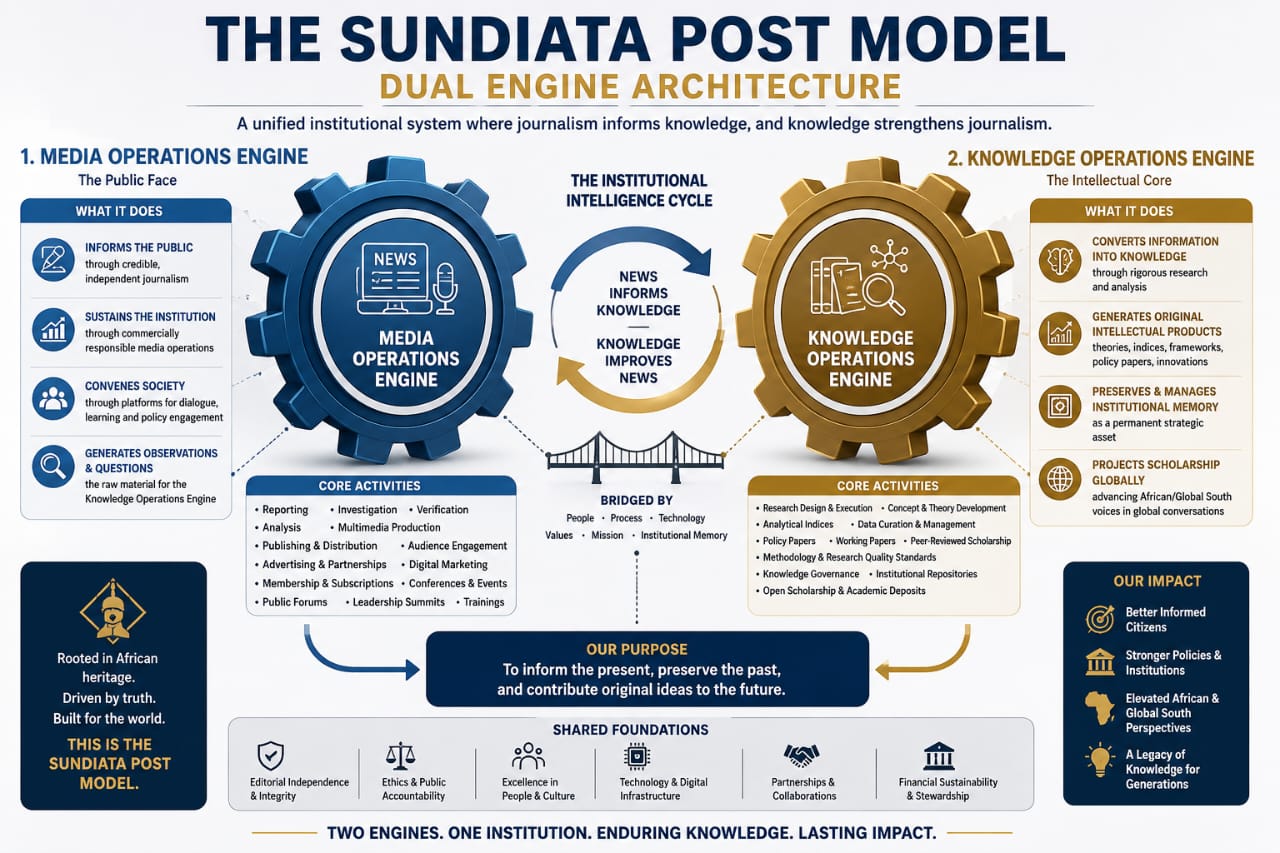

In the 7 June 2026 article which marked the formal unveiling of the Decoupling Sovereignty Index (DSI), I articulated a defining institutional proposition. The launch of the DSI was presented not merely as the introduction of a new analytical instrument, but as another milestone in the evolution of Sundiata Post into what I described as a dual engine architectural powerhouse. That statement marked an important transition. It signalled that Sundiata Post was no longer to be understood solely as a digital news platform, but as an institution consciously integrating journalism, strategic intelligence and scholarly research within a single operational framework.
The proposition advanced on that occasion was straightforward. On the front end, Sundiata Post would continue to function as a digital-first, high-velocity news organisation, reporting events, investigating public issues, analysing developments and informing citizens through timely, credible journalism. On the back end, the Sundiata Post Intelligence Unit (SPIU) would operate as a proprietary knowledge engine, generating original research, developing analytical frameworks, curating datasets, publishing working papers and preserving institutional knowledge through globally recognised scholarly repositories.
This series develops that proposition into a formal institutional architecture.
The first part in this series argued that the newsroom of the twenty-first century must evolve beyond the production of daily news to become a knowledge institution. The second situated that proposition within a broader intellectual tradition, demonstrating through the works of Walter Lippmann, Hannah Arendt, Nnamdi Azikiwe and Obafemi Awolowo that journalism has historically served not merely as a conveyor of information but as a builder of public reason, democratic culture and national development.
Having established the philosophical foundations, we now turn to the question of institutional design. Every enduring institution requires more than a compelling vision; it requires an architecture capable of translating principles into sustained practice. Ideas alone do not create institutions. Institutions endure because they are deliberately designed to produce consistent outcomes, preserve organisational memory, adapt to changing environments and outlive their founders.
The Sundiata Post Model is therefore built upon what I call the Dual Engine Architecture. Simply stated, the Dual Engine Architecture is an institutional design in which a Media Operations Engine generates public value through journalism while a Knowledge Operations Engine transforms that journalistic enterprise into a permanent system of knowledge production.
The first engine is the Media Operations Engine—the visible newsroom that performs the essential functions of journalism through reporting, verification, investigation, editing, publication and audience engagement. The second is the Knowledge Operations Engine—the institutional infrastructure through which research is conducted, theories are formulated, datasets are curated, policy knowledge is generated and intellectual assets are systematically preserved.
These engines are neither parallel organisations nor competing departments. They are interdependent components of a single institutional system. Journalism supplies the observations, evidence and questions that shape the research agenda. Research, in turn, enriches journalism with deeper context, analytical rigour and conceptual innovation. The output of one continuously strengthens the other, creating an institutional intelligence cycle in which news informs knowledge and knowledge improves news.
The significance of this architecture extends beyond Sundiata Post itself. It offers a framework for reimagining the modern newsroom in an era defined by rapid technological change, information overload and declining public trust. Rather than treating journalism as a transient response to the daily news cycle, the Dual Engine Architecture positions the newsroom as the public-facing component of a broader knowledge enterprise—one that simultaneously informs the present, preserves the past and contributes original ideas to the future.
The Media Operations Engine
The first pillar of the Sundiata Post Model is the Media Operations Engine. This is the institution’s public-facing operational system—the visible enterprise through which Sundiata Post fulfils its journalistic, commercial and public engagement responsibilities. It represents the front end of the organisation, integrating editorial excellence with audience development, revenue generation and public-facing institutional activities.
At its core, the Media Operations Engine performs the traditional functions of a professional news organisation. It identifies stories of public importance, deploys reporters to the field, verifies facts through rigorous editorial procedures, produces multimedia content, provides analysis and commentary, and disseminates information across digital platforms. These activities remain the foundation of the institution’s commitment to informing society accurately, independently and responsibly.
Beyond the newsroom, however, the Media Operations Engine encompasses the broader business of media. It includes advertising and brand partnerships, digital marketing, audience growth strategies, subscription and membership initiatives where applicable, commercial publishing, multimedia production, and other revenue-generating activities necessary to sustain editorial independence. Within the Sundiata Post Model, commercial operations are not peripheral to journalism; they are carefully managed institutional functions that provide the financial capacity required for long-term public-interest reporting and knowledge production.
The engine also extends the institution’s public engagement beyond daily news publishing. Conferences, annual lectures, policy dialogues, public forums, media masterclasses, leadership summits and other convening platforms become integral components of the media enterprise. These engagements transform the organisation from a publisher of information into a convener of ideas, creating spaces where journalists, scholars, policymakers, business leaders and citizens can deliberate on issues of national and continental importance. In doing so, the Media Operations Engine strengthens the institution’s civic presence while simultaneously generating new networks, partnerships and editorial opportunities.
Within the Sundiata Post Model, the Media Operations Engine performs an additional function that distinguishes it from conventional news organisations. It serves as the institution’s principal observational system. Every news report, investigative assignment, interview, audience interaction, conference discussion and field observation constitutes more than a discrete media product. Collectively, they generate the empirical evidence, public conversations and emerging questions that feed the institution’s knowledge infrastructure.
In many conventional media organisations, these valuable intellectual assets dissipate with the passing of the news cycle. The Sundiata Post Model rejects this linear conception of journalism. Instead, every verified report, public engagement and editorial initiative is regarded as a potential contribution to a cumulative institutional intelligence system.
Accordingly, the Media Operations Engine performs four interconnected functions. First, it informs the public through credible journalism. Second, it sustains the institution through commercially responsible media operations. Third, it convenes society by creating platforms for dialogue, learning and policy engagement. Fourth, it continuously generates the empirical observations and strategic questions that become the raw material for the Knowledge Operations Engine.
The Media Operations Engine is therefore far more than a newsroom. It is the institution’s interface with society—observing events, engaging audiences, building relationships, generating revenue and producing the empirical foundation upon which the Sundiata Post Model’s broader knowledge enterprise is constructed.
The Knowledge Operations Engine
If the Media Operations Engine is the public face of the Sundiata Post Model, the Knowledge Operations Engine is its intellectual core. It is the institutional infrastructure through which information is transformed into knowledge, knowledge into analytical frameworks, and analytical frameworks into enduring intellectual assets. While the front end responds to the immediacy of events, the back end seeks to understand their underlying structures, causes and long-term implications.
The Knowledge Operations Engine is anchored by the Sundiata Post Intelligence Unit (SPIU), which serves as the institution’s research and strategic intelligence hub. It is responsible for designing and executing research programmes, developing original concepts and theories, constructing analytical indices, curating datasets, producing policy papers, publishing working papers and peer-reviewed scholarship, maintaining institutional standards for methodology, research quality and knowledge governance, and preserving institutional knowledge through globally recognised academic repositories.
In this architecture, research is not an adjunct to journalism but an integral institutional function.
Unlike conventional newsroom research desks, whose work is often confined to supporting daily editorial production, the Knowledge Operations Engine pursues an independent programme of knowledge creation. It identifies recurring patterns across time, interrogates complex governance and security challenges, develops explanatory models, and subjects those models to empirical testing. The objective is not merely to explain individual events but to contribute original intellectual frameworks capable of advancing scholarly and policy debates.
The engine is also responsible for the stewardship of institutional memory. Research datasets, methodological notes, interview archives, conceptual papers, technical documentation and analytical outputs are systematically organised, preserved and made retrievable. Rather than allowing institutional knowledge to disappear with personnel changes or the passing of the news cycle, the Sundiata Post Model treats these materials as strategic assets that accumulate value over time. This commitment to preservation transforms the institution from a producer of content into a custodian of knowledge.
A defining characteristic of the Knowledge Operations Engine is its commitment to openness and scholarly engagement. Where appropriate, research outputs are deposited in recognised academic repositories, enabling scrutiny, replication, citation and further development by the global research community. By exposing its analytical frameworks and datasets to independent examination, the institution embraces the principle that durable knowledge grows stronger through critical evaluation rather than institutional isolation.
The Knowledge Operations Engine therefore performs four interconnected functions. First, it converts empirical observations into structured knowledge through rigorous research and analysis. Second, it generates original intellectual products—including theories, indices, policy frameworks and methodological innovations—that extend beyond the immediate demands of journalism. Third, it preserves and manages the institution’s intellectual capital as a permanent strategic resource. Fourth, it projects African or Global South scholarship into global academic and policy ecosystems, ensuring that ideas developed within the newsroom contribute to international conversations on governance, security, development and media innovation.
The Knowledge Operations Engine is therefore not simply a research department. It is the institutional mechanism through which journalism acquires permanence, evidence is transformed into understanding, and a media organisation evolves into a knowledge-producing institution. Together with the Media Operations Engine, it completes the Dual Engine Architecture that lies at the heart of the Sundiata Post Model.
If the preceding sections explain how the Sundiata Post Model works, an equally important question remains: Is this architecture unique to Sundiata Post, or can it become a framework for journalism more broadly?
Beyond Sundiata Post
The Sundiata Post Model is proposed as a universal institutional framework for twenty-first-century journalism. Although it originated within Sundiata Post, it is not conceived as an organisation-specific model. Rather, it offers a general institutional architecture that can be adapted by news organisations operating in diverse economic, technological, political and cultural environments.
In this formulation, Sundiata Post is not the model; it is the founding implementation and proof of concept—a living institutional demonstration that such an architecture is both practicable and sustainable. The relationship is similar to the Toyota Production System, which began inside a single company but evolved into a global management framework adopted by organisations far beyond the automotive industry. Likewise, the Sundiata Post Model is intended to transcend the organisation in which it was first developed.
Its long-term significance will therefore be determined not solely by its success at Sundiata Post, but by its capacity to be tested, adapted, replicated and refined by media organisations across different societies. The true measure of any institutional model is not that it works for its originator, but that it enables others to build stronger institutions of their own. If the Sundiata Post Model ultimately proves capable of helping news organisations across Africa, the Global South and beyond become enduring knowledge institutions, then its greatest contribution will not be what it achieved for Sundiata Post, but what it made possible for journalism itself.
Trust is sacred. Stay seasoned
•Dr. Max Amuchie is a Scholar-Journalist, Media CEO, Lead Researcher at the Sundiata Post Intelligence Unit (SPIU), and an Expert Member and Peer Reviewer at ScienceOpen. He is the architect of The Insecurity Triad framework for African security analysis as well as the Trinity of Sovereignty Decay (formerly Trinity of State Decay) theory, and the Decoupling Sovereignty Index (DSI)—original frameworks for understanding, categorising, and measuring conflict, state decay, and sovereignty in the Global South.
X: @MaxAmuchie | Email: max.a@sundiatapost.com

Anyone can pay the N25,000 wrong packing penalty slammed on Peter Obi, candidate of the Nigeria Democratic Congress by Festus Keyamo, Minister of Aviation and Aerospace Development, last week.
This was the angle introduced by the Minister, on Friday, when he acceded to the request of one Nnaemeka Ikerionwu, who volunteered to pick up the tab against the former Governor of Anambra State and candidate of the Labour (LP), in the 2023 presidential election.
Keyamo, who directed to the volunteer to liaise with the Federal Airports Authority of Nigeria (FAAN), on the payment process, had last Friday, Keyamo, in a statement posted on his X handle, demanded that Obi tendered a public apology to airport officials and pay a N25,000 fine.
Though the minister’s latest response suggests that government is willing to accept payment of the fine through a third party, he was however silent on whether his earlier demand that Obi tender a public apology to airport officials had been waived.
The new twist came as a consequence of what the Minister said was his investigation after the former governor cried out about alleged harassment by the Federal Government, citing the clamping of his car by airport staff during one of his use of the facility as an example.
The Minister had released as part of the investigation, a Close Circuit Television (CCTV) footage, to prove that Obi’s vehicle was parked unattended in a restricted area, prompting airport security personnel to clamp its tyres.
Keyamo said Obi arrived at the domestic wing of the Nnamdi Azikiwe International Airport, Abuja, on July 4, 2026, and left the vehicle after being dropped off by a police driver.
Meanwhile, in a post on his X handle, the Minister responded to Ikerionwu’s offer to settle the fine on Obi’s behalf by asking him to meet with FAAN’s Director of Commercial and Business Development for guidance on the payment process.
He wrote: “Thank you for bringing this to my attention. Please, Mr Nnaemeka Ikerionwu should proceed to see the Director of Commercial and Business Development for the Federal Airports Authority of Nigeria (FAAN), and he will be directed on the mode of payment of the fine for the offender.
“Now that we have burst his bubble, next time, Peter Obi should think twice before making outlandish claims of being targeted at our airports or anywhere for that matter in order to get ‘sympathy votes’.”



-

 News1 week ago
BREAKING: Mystery death! *Female student dies a day after arriving Umahi’s home!
-

 News1 week ago
Don’t jump to conclusion! *Umahi speaks on mysterious death of female students!
-

 News4 weeks ago
BREAKING: Court sentences Nigerien, two others to death over terrorism
-

 News2 weeks ago
BREAKING: EX-SSG mowed down by gunmen! *He resisted being kidnapped – driver
-

 News4 weeks ago
Two hours after Igboho’s ‘red-eyes’ to ‘Fulani’ leaders, gunmen free kidnap victims!
-

 News4 days ago
BREAKING: Terrorists strikes another school! *Kidnap principal, students, NECO official!
-

 News4 weeks ago
Abductors of Oyo teachers panicking, freedom coming for victims soon!
-

 News4 weeks ago
Chicagogate: Nigerians return to court! *Move to stop Tinubu from 2027 polls