
News
Bank customers now to provide social media handles *It’s legal – court


With the courts endorsing the directive by the Central Bank of Nigeria (CBN) to all banks in Nigeria to collect and verify social media handles, the claims by bank customers that their privacy is being invaded, has finally collapsed.
The CBN directive is for the banks to collect the information as part of their know-your-customer (KYC) requirement, which was issued in June 2023, is part of the measures the apex bank is said to be taking to to prevent financial crime, and terrorism, as well as boost the precision and thoroughness of customer identification.


But Chris Eke, a bank customer, who saw this as an infringement on his rights had approached the a Federal High Court, sitting in Lagos with the plea that the CBN’s directive infringed upon constitutional rights, particularly section 37 of the 1999 constitution.
Justice Nnamdi Dimgba, who struck out the suit, marked FHC/L/CS/1281/2023, disagreed with Olubunmi Abayomi-Olukunle, Eke’s lawyer, who sought a declaration that the regulation as contained in section 6(a)(iv) of the CBN (customer due diligence) Regulations, 2023, was “undemocratic, unconstitutional, null and void”.
Upholding the argument of the CBN, which filed a notice of preliminary objection, challenging the competence of the suit and disagreeing with the claim of interference with the applicant’s private life, Dimgba held that the notice of preliminary objection had merit, subsequently striking out the suit, adding that providing a social media handle was equivalent to providing email and phone numbers for potential customers, and therefore, did not violate the right to privacy.
“First, the applicant claims that the requirements on the CBN regulations for financial institutions to request and collect the social media handle of its customers as part of KYC infringes on his right to privacy. This claim is very ambitious and amounts to a very far throw. The said regulations are directed to and apply to financial institutions. It does not apply to private individuals such as the applicant.
“Even if, as appears to be argued, that the regulations itself would inevitably affect the applicant, this claim is speculative for the simple reason that in nowhere in the affidavit in support was it stated that the applicant operates an account with a financial institution and that the said institution had demanded his social media handle. The suggestion that he would be negatively affected by the regulation is very “speculative and at large.”
Agreeing that there is a lack of evidence suggesting financial institutions had implemented the regulation, and it was causing disruptions and inconvenience, he held that if Eke was irritated by the requirement of the regulation he had the choice to refuse to do business with any bank insisting on the information as part of its social media handle, but to seek other alternatives.
Insisting that banks asking customers or potential clients to provide their social media handles is not a breach of privacy, he held the essence of having a social media account was for one to be publicly visible communication-wise, adding that a social media handle, being in the public space, could be accessed by everyone whether or not consent was obtained.
“The apprehension of the Applicant of his social interactions being monitored is manifestly speculative in itself and rather incredulous to believe that the financial institutions have the luxury of time to concern itself with such frivolities,” he said.










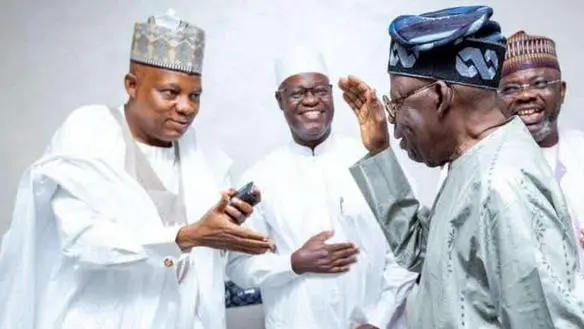
Apparently not swayed by the rumble in informed political quarters over the Muslim-Muslim ticket in the Presidential Villa, Abuja, President Bola Tinubu, has sworn his readiness to swim and sink with Kashim Shettima, as Vice President in the 2027 presidential election.
The President rested the issue of retaining or dumping the VP, which has been a subject of intense speculations over several months now, when he forwarded the name of the former Governor of Borno State for the Aso Rock Villa’s joint ticket on the platform of the All Progressives Congress (APC).
The ruling party forwarded the names of the duo on Friday to formalise its presidential ticket for the 2027 general election, brushing aside contentions that unlike the 2023 edition, such a ticket might not fly this time.
Nentawe Yilwatda, APC National Chairman, received the duly completed nomination forms for both Tinubu and Shettima from Ibrahim Masari, the Special Adviser to the President on Political Matters, at a colourful ceremony at the Ladi Kwaki International Conference Centre of Abuja Continental Hotel, Abuja, for onward transmission to the Independent National Electoral Commission (INEC) portal.
The high-profile ceremony drew heavyweights from across the party, including members of the Progressive Governors’ Forum (PGF) led by Imo State Governor Hope Uzodimma, representatives from the National Assembly, the Federal Executive Council (FEC), and state party chairmen.
Welcoming dignitaries to the brief but solemn ceremony, APC National Organising Secretary Sulaiman Muhammad Argungu noted that the event was the natural climax of a highly transparent internal process.
“The presidential flag bearer emerged through a thoroughly transparent primary process,” Argungu said, while praising President Tinubu’s “positive strides” and urging party faithful to remain united, prayerful, and steadfast.
The ceremony culminated in the presentation of the completed nomination forms for the President and his running mate by the Presidential Adviser, Masari, who was accompanied by all the governors in attendance, members of the National Assembly and the Federal Executive Council (FEC).
Reinforcing the governors’ total commitment to the ticket, PGF Chairman Governor Hope Uzodimma stated that the transparent nature of the primaries had made marketing the candidates seamless.
Uzodimma, said: “We are delighted that this event is coming after a well-organised and thoroughly supervised primary process. We reiterate our commitment to continue supporting President Tinubu and the party.”
Describing the APC as a beacon of internal democracy and inclusiveness, promising that the governors would spearhead a total clean sweep at the polls, he added: “We will continue to support him in the larger interest of Nigerians and to take the country to greater heights. Together, we are going to deliver victory for President Tinubu and ensure the party wins all elective positions, including the National and State Assemblies.”
On his part, Yilwatda stated that the revalidation of the Tinubu-Shettima ticket represents the authentic heartbeat of the party’s grassroots, adding: “Today is a reflection of the wishes of over 12 million members of our party who supported the President’s candidature,” Yilwatda remarked. “We are proud of the support already in the kitty of President Tinubu, and we are convinced that many more Nigerians will vote for him.”
The APC boss, while pointing to key initiatives such as the student loan scheme—which he noted has already benefited over 1.5 million students—alongside targeted agricultural interventions and nationwide infrastructure projects as verifiable proof of performance, urged members to return to their local communities armed with facts rather than rhetoric to dismantle opposition narratives.
His words: “While others are busy spreading propaganda, let us counter them with facts. Nigerians have seen governance that touches lives across the six geopolitical zones. APC holds a distinct institutional advantage over its rivals, being the only political platform in the country backed by a fully digitalised and verified membership database.
“We already have about 12 million verified members. We are going round the country to mobilise support for the President. I am also confident that our governors will compete among themselves to deliver the highest number of votes.
“Go and tell the leader of our party (President Tinubu) that our members and Nigerians will vote for him to continue the excellent work he is doing. As a party, we are proud to be presenting the best candidate. There is no shaking at all. Come 2027, our victory is assured.”

After a harrowing 56 days in the den of their abductors, all thel 46 schoolchildren and teachers abducted on May 15, 2026, from three schools in the Ahoro-Esiele community of Oriire Local Government Area in Oyo State have regained their freedom.
A video of the abductees thanking President Bola Tinubu and security operatives is currently on display on social media, with Folawe Alamu, the principal of Community High School, who spoke on behalf of the freed captives, attributing their survival to them.
Hear her: “Hello Sir! Our father, we’re very grateful. The President, Sir, we’re grateful. We understand your commitment to our safety and we appreciate all you did for us. We could see your hand. Thank you very much. And every security operative, they tried very much and that is why we’re still alive now. W’re very grateful unto you. Thank you very much!”
In the short video, which ended with a chorus of thank you from the other freed captives, inclucing the children surrounding her, there was no mention of Seyin Makinde, Governor of Oyo State, who had also said he was on the case.
Earlier, the Presidency had broken the story of the freedom of the abducted teachers and students, with a statement by Bayo Onanuga, presidential spokesman, who used his X account to announce the development on X on Friday.
He wrote: “Finally, all the kidnapped pupils and teachers in Oriire, Oyo have been rescued by our security agencies.
“One of the rescued teachers in Oyo sends a thank you message to President Tinubu and the security agencies.”
In the video, one of the rescued victims, Rachael Alamu, principal of Community High School, said “President sir, our father, we are grateful, we understand your commitment to our safety and we appreciate all you did for us…. And every security operatives, they tried so much and that is why we are still alive by now, God bless you”



-

 News4 weeks ago
BREAKING: Troops rescue wife of kidnapped General! *Terrorists flee scene
-

 News4 weeks ago
BREAKING: Count me out, Okonkwo tells Atiku *Amaechi VP’s choice an insult to Ndigbo
-

 News2 weeks ago
BREAKING: Court sentences Nigerien, two others to death over terrorism
-

 News4 weeks ago
Dickson: Obi, a big asset to NDC, we’re working together … but!
-

 News4 weeks ago
Ovia, ex-Zenith Bank boss swings into luxury apartments *Flats hit $2.8million price tag
-
 News1 week ago
BREAKING: EX-SSG mowed down by gunmen! *He resisted being kidnapped – driver
-

 News3 weeks ago
Abductors of Oyo teachers panicking, freedom coming for victims soon!
-

 News3 weeks ago
Two hours after Igboho’s ‘red-eyes’ to ‘Fulani’ leaders, gunmen free kidnap victims!