

News
War-torn Ukraine donating food to Nigeria, national tragedy – Obi


“Despite the conflict, Ukraine feeds itself, and exports agricultural products worth over $25 billion which is about the same value as our crude oil export earnings, and it serves as a strategic global food supplier, even providing aid to a peaceful yet unproductive Nigeria.”
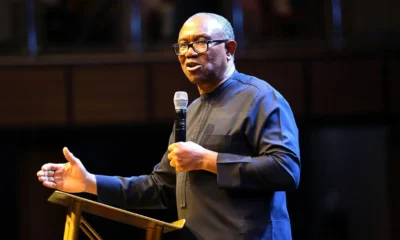
This is a development, Peter Obi, presidential candidate to the Labour Party (LP), in the 2023 election, sees as the tragedy of the Nigerian story, after it was reported that East European country donated 25,000 tonnes of wheat as emergency food assistance to 1.3 million vulnerable, crisis-affected people in Nigeria’s northeastern region.


Regretting that the development bespoke volumes as to the failures of the Nigerian government to cater for its people, Obi, who used his X platform to express his disgust, on Monday, asserted that this development underscored a national disgrace arising from years of leadership failure, adding that the nation needed an urgent reflection and reordering of national priorities.
“Let me begin by sincerely appreciating the war-torn nation of Ukraine for their generous donation of tons of grains to Nigeria thereby aiding our current fight against nationwide hunger. As laudable as Ukraine’s kind gesture is, it speaks volumes for us as a people endowed with all needed human and natural resources, that a country officially prosecuting a brutal war of national survival with its powerful neighbor, Russia, is generous and kind enough with their food supplies to help us who are officially at peace.
“For the people of Ukraine, this act of human solidarity testifies to a rare generosity of spirit which should earn them greater global solidarity. It demonstrates our shared humanity. However, a situation like this underscores vigorously the importance of sound political leadership as the first concrete requirement for any nation desiring to develop and enhance the standard of living of its citizenry.
“It is disheartening that our once economically confident nation, blessed with vast arable land and abundant natural resources, now relies on a war-torn Ukraine for food assistance. This national disgrace stems from years of leadership failure, necessitating urgent reflection and a reordering of our national priorities and resource management and allocation.
“Instructively, Ukraine, with a population of 43 million on 603,728 km2, outshines Northern Nigeria, covering 744,249 km2 with a young, energetic population exceeding 100 million. In 2015, Ukraine’s GDP per capita was $2125, compared to Nigeria’s $2680. By 2022, despite being at war, Ukraine’s GDP per capita exceeded $4000, while Nigeria’s regressed to $2184. Ukraine cultivates over 60% of its arable land, whereas Nigeria has over 60% uncultivated arable land.
“To overcome this embarrassment, we must aggressively reorder our priorities by investing resources in productive sectors like agriculture. Addressing insecurity is crucial for farmers to return to their fields, enabling a productive manufacturing sector and supporting small businesses. In 4 to 5 years, this concerted effort can reverse the current trend, leading us toward a productive and New Nigeria that I believe is possible and within reach.”






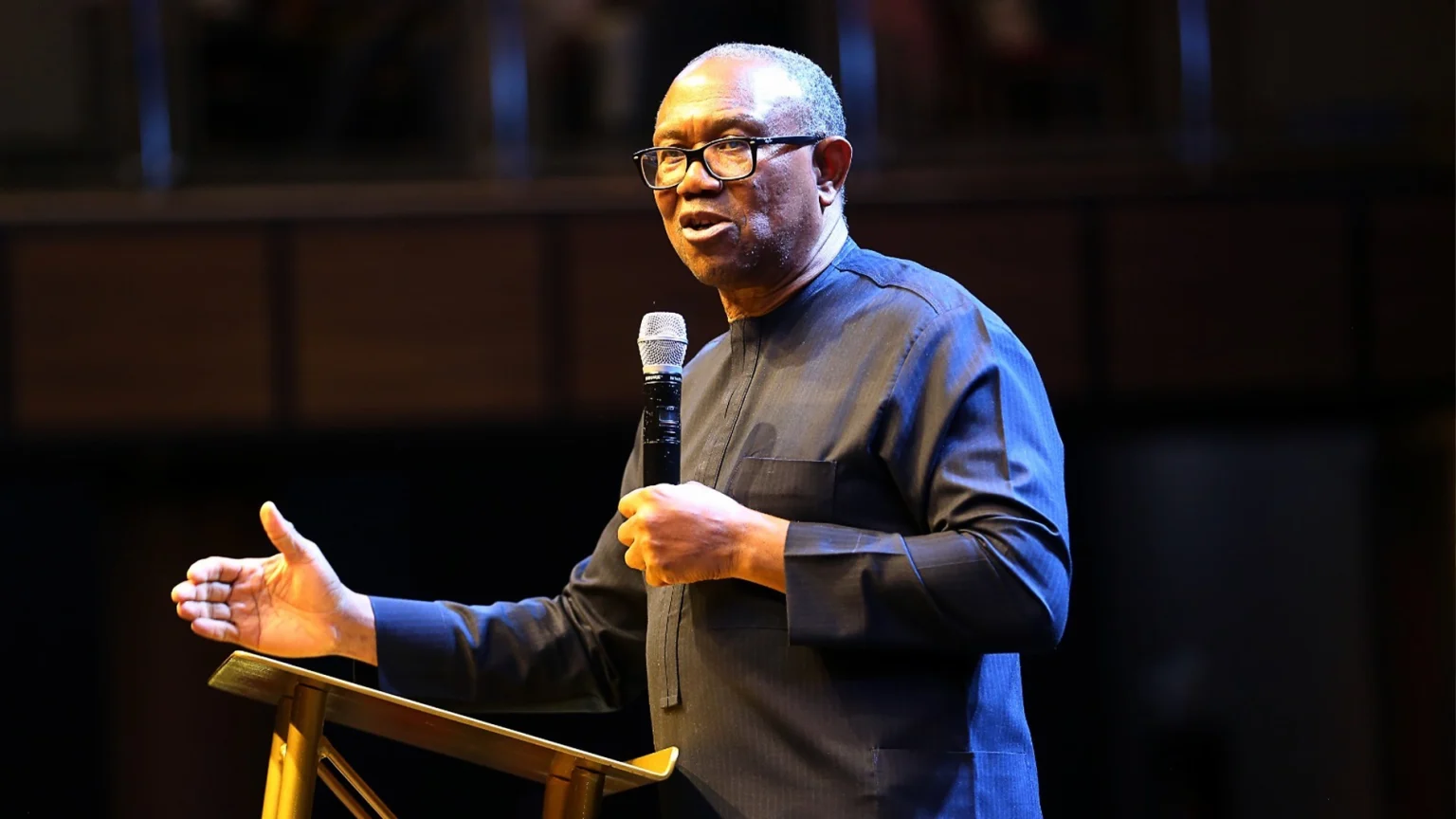

On Wednesday, July 8, 2026, Peter Obi, candidate of the Nigeria Democratic Congress (NDC), practically took the media space of Nigeria by storm, with his alarming claim that he might not be alive to contest the 2027 presidential election.
Obi was not talking about some strange illness discovered by his doctors, which had limited his days on earth or alluding to any other kind of natural cause of death. On the contrary, he was forecasting of a more diabolical, highly sinister variant of unnatural, untimely kind of death – political assassination or any other dimension relating to it.
The former Governor of Anambra State, who has remained the main thing in the polity since taking the Nigerian political firmament by storm with his emergence as contender for the nation’s number one job in 2022, ending up with a stunning performance in the February 25, presidential election as candidate of the Labour Party (LP), despite all odds, and prediction of naysayers, was not in doubt about where the threat was domiciled.
A guest of #WithChude, a popular podcast, hosted by Chude Jideonwo, he was instead quite emphatic that his reading of his current ordeal suggests that his traducers, might not stop with their clear intent of preventing him from being on the ballot in the 2027 presidential contest, but up the ante to the level of taking his life if the push eventually graduated to shove.
He did not mince words where the arrows were coming and who was pulling the bows, but was equally emphatic of that as well – the All Progressives Congress (APC) government of President Bola Ahmed Tinubu.
Hear him: “Every single thing I do for a living, this government is frustrating it. Deliberately so. Everything. So, there is even a possibility, if they have the opportunity, I will not be alive.
“It’s not an accusation. I know. I get frustration every day. Because you do things that you think would be normal – it is not normal anymore. They won’t come directly and say, ‘Oh, we’re doing this,’ but you can see their hand in virtually everything.
“They are attacking everybody who is in opposition personally. I am being attacked personally. Everything. Even to provide me with necessary things that I should have been entitled to, not at all. I had a case recently at the airport, where people who work in the airport came and locked my car. And I said, ‘It’s me.’
“But I said, ‘Look at the cars of other people.’ And you could see them talking to each other, as if, ‘Who is this one? And I see people I know at the airport, they will not greet me because they are fearing that if they greet me…And I have people send me invitations and say, ‘My son, my daughter is wedding, but please don’t come.’”
Since this outing, it has been hoopla on the Nigerian turf as the centrifugal and centripetal forces pull from all sides on the matter in a dog-fight between the government forces and Obi’s supporters.
In fact, Abuja did not waste time in producing a quick riposte, with Bayo Onanuga, spokesman of the President, ostensibly conveying the sentiments of his boss on the matter, dismissing the NDC candidate as a liar and a cry-baby.
He has support from Festus Keyamo, a Senior Advocate of Nigeria (SAN), Minister of Aviation and Aerospace Management, who quickly pulled out a video of what was supposed to be the airport incident Obi was referring to underscore the point that the former governor was indeed the guilty party.
In fact, so intense was Keyemo’s intervention that he not only instructed Obi to render an immediate and unreserved apologies to the airport staff – the selfsame people he accused of insulting him – but pay N25,000, which he claimed was the mandatory fine for the “crime” of parking in an unauthorised place, he allegedly committed.
Now as the drama in the nation’s theatre of the absurd continues to build up into a fearsome political fireball, it is pertinent to assess the situation, based on the facts on the ground – past and present.
In so doing, it is apposite to review the images on the huge national screen playing from the reel of events since Obi happened on the Nigerian political space. This will underscore whether his outcry could be considered as coming from genuine fears or dismissed as non-issues, as the Aso Rock Villa, enjoins.
Does NEXT International Supermarket, arguable once the biggest monuments in Abuja and one of the visible concerns linked to Obi, suddenly going up in flames some years back, not deserve a mention in the current conversation?
What about the outburst of Monday Okpebholo, Governor of Edo State, warning the NDC candidate never to step his foot in Benin the capital or anywhere within the territory without his express say-so? Where does that fit in?
How does Abuja capture the real life attack on Obi, then a chieftain of the African Democratic Congress (ADC), in the same Benin under the nose of the selfsame Okpebholo? Does that bullet-ridden vehicle that told the story of the entire macabre event in more ways than words not mean anything?
Okay, how is Obi supposed to process the silence of Abuja after an APC chieftain warned him not to step his feet into Rivers State or do so at the pain of death, when elsewhere such open threat ought to instigate an instant action, including the arrest and prosecution of the culprit?
What about the outburst of the selfsame Onanuga warning the NDC candidate – never to interfere in Lagos politics – following the blitzkrieg that came after trouncing Tinubu in his own backyard during the 2023 presidential election?
How was Obi supposed to process the pulling down of a prime property in Lagos belonging to his brother, in the context of this warning and other events that nuanced the actions of Alausa and other players since that 2023 routing?
Given this list of what is in the public domain, though not exhaustible yet – not knowing what else could have transpired beyond what is known to him and his supposed traducers alone, does it make for Obi to be complacent and believe that all is well?
For us, no politician in Nigeria today could be accused of being too careful with the foregoing events, not the least, Obi, given the long list of unresolved political killings history in the country.
The horrendous cases of the likes of Funso Williams, Bola Ige, Aminasori Dikkibo, Harry Marshal, Ogbonnaya Uche (OGB), who fell to the bullets of gunmen at various times, have not continued to blur the nation’s political firmament, but remain sad reminders of how awry things could go.
WHIRLWINDNEWS believes, therefore that the case of Obi deserves more than being dismissed with a wave of the hands as Abuja has since done. We believe that, not only the NDC candidate, but the nation needs the assurance that he is alive to contest in the election.
The consequences of Obi coming to harm might be graver than those who believe they are safe in the fortresses of Abuja foresee. It might signal the doomsday. Therefore, that assurance must come in visible words and deed. Now!
News
The Sundiata Post Model (2): Historical and intellectual foundations of a knowledge-producing newsroom

Every institutional framework has a history, even when it introduces something new. Ideas rarely emerge in complete isolation; they arise from deep, structural conversations that began long before us, evolving across generations as societies confront new realities, systemic shocks, and unanswered questions.
The Sundiata Post Model is no exception. Although formally introduced in the previous essay as an institutional framework for media-based knowledge production, its intellectual roots extend much further back. They lie within a long tradition of journalism’s engagement with ideas and society, while simultaneously responding to a distinctly twenty-first-century challenge: the transformation of the newsroom in the age of artificial intelligence, digital knowledge architectures, and global scholarly networks.
The question at the heart of this essay is therefore not whether journalism has ever produced ideas—history provides an unequivocal answer to that. The more critical question is whether the modern newsroom can become an institution deliberately organised to generate original analytical constructs that contribute simultaneously to journalism, deep scholarship, and public policy. That is a different, more demanding question altogether.
Nigeria’s Tradition of the Newspaper as an Intellectual Institution
Long before the emergence of today’s hyper-accelerated digital media, some of Nigeria’s most influential newspapers were already serving purposes far beyond the passive reporting of daily events.
The press architectures established by pioneers like Nnamdi Azikiwe and Obafemi Awolowo—both of whom I previously discussed, alongside Chinweizu, as members of Nigeria’s rare tradition of framework builders—became foundational vehicles through which sophisticated ideas about nationalism, constitutional development, socio-economic planning, democracy, and self-government entered the public consciousness. Their publications did not merely describe political transformation; they actively generated the conceptual architecture that shaped it.
Crucially, they achieved this by building powerful media infrastructures designed to carry these ideas at scale. Azikiwe did not just publish in Lagos; he deployed a sweeping, cross-regional syndicate anchored by the West African Pilot alongside a network of provincial pillars including the Eastern Guardian in Port Harcourt, the Nigerian Spokesman in Onitsha, and the Southern Nigeria Defender in Warri. Similarly, Awolowo founded the Nigerian Tribune in 1949 as a highly structured institutional vehicle to systematically articulate socio-political theory and regional constitutional destiny.
In his seminal work, Renascent Africa (1937), Azikiwe laid out a broad intellectual and ideological vision that extended far beyond the immediate horizon of standard journalism, charting a course for mental emancipation and African self-determination. A decade later, Awolowo’s Path to Nigerian Freedom (1947) demonstrated how a publisher and institutional thinker could systematically articulate a rigorous, structured constitutional vision for a developing nation.
This historical experience reminds us that journalism in Nigeria has never been confined solely to stenography. At critical turning points in the nation’s history, newspapers operated as the primary intellectual laboratories through which society debated its structural future.
This tradition of intellectual leadership through journalism is not merely of historical interest. In The Sunday Stew essay mentioned earlier, ‘The Insecurity Triad: Azikiwe, Awolowo, and Chinweizu — Nigeria’s Elite Class of Framework Builders’, I argued that Nigeria has, on rare occasions, produced public intellectuals who moved beyond commentary to construct enduring analytical frameworks. Azikiwe and Awolowo exemplified that earlier tradition, while Chinweizu demonstrated that independent conceptual innovation could continue outside formal state institutions and conventional academic structures. The present essay extends that argument by asking a different question: can the contemporary newsroom itself become an institution deliberately organised for systematic framework building and knowledge production?
Yet, an important distinction must be recognised between that era and our contemporary challenge:
The Nationalist Press primarily advanced political ideas, anti-colonial mobilisation, and national aspirations.
The Sundiata Post Model represents a shift from ideological mobilisation to systematic institutional knowledge production. It asks whether an independent newsroom can generate original analytical constructs capable of standing up to the rigorous validation of the global academic ecosystem while serving active policy discourse.
The distinction is subtle, but fundamental. It marks the evolution from political journalism to scholar-journalism.
Journalism and the Life of Ideas
The structural relationship between journalism and ideas extends well beyond regional borders. To understand the global intellectual foundations of this model, we must reconcile two complementary traditions of public thought—both of which proved invaluable in shaping the conceptual foundations of my Trinity of State Decay (TSD) theory.
In framing the mind dimension of the Money–Land–Mind dynamic of the TSD, I found the works of Walter Lippmann and Hannah Arendt particularly illuminating, insightful, and enriching. Few journalists have shaped modern thinking about public communication as profoundly as Lippmann. Throughout his six-decade career in American journalism, he demonstrated that journalism could become far more than a chronicle of events; it could serve as an instrument for decoding how societies acquire knowledge, construct public opinion, and navigate increasingly complex realities.
In his foundational classic, Public Opinion (1922), Lippmann demonstrated that journalism could contribute not merely rapid information, but macro-level interpretation, permanently altering how we view the relationship between media, knowledge, and public policy. It is this Lippmannesque understanding on how information is filtered, misperceived, and understood that informs the epistemic foundations of the TSD.
From a different, deeply philosophical tradition, Hannah Arendt, a political theorist and independent scholar whose ideas reached wide audiences through public intellectual magazines and cultural journals, devoted her life’s work to understanding the structural anatomy of politics, authority, institutional decay, and the conditions that make collective civic life possible.
In The Human Condition (1958), Arendt examined human action, public space, and the enduring value of disciplined conceptual inquiry in explaining political reality far beyond the fleeting nature of immediate headlines. Her profound insights into the erosion of institutional authority and the fragility of the public realm provide an important philosophical foundation for understanding the Trinity of State Decay’s vectors of systemic fragility.
Although operating within vastly different institutional environments, Lippmann and Arendt represented complementary pillars of intellectual rigor:
One demonstrated journalism’s unmatched capacity to shape and democratise public understanding.
The other demonstrated the enduring value of rigorous, uncompromised conceptual thinking regarding public life and the human world.
Together, they illuminate an important institutional possibility. If journalism can generate immediate public understanding, and disciplined inquiry can generate enduring concepts—as demonstrated by their influence on the conceptual foundations of the Trinity of State Decay—might there exist an institutional framework capable of integrating both traditions within a single, independent newsroom?
That synthesis is the exact intellectual domain of the Sundiata Post Model.
An Abuja Newsroom and a Contemporary Question
The Sundiata Post Model emerged not from an insular academic department, a government research institute, or a foreign-funded policy think tank, but from an independent newsroom in Abuja. That geographical and operational fact is highly significant.
The framework did not begin as an abstract theory searching for practical application. It emerged from journalism itself—from the lived, daily experience of reporting, investigating, analysing, and reflecting on the severe structural forces shaping Nigeria and the wider Global South.
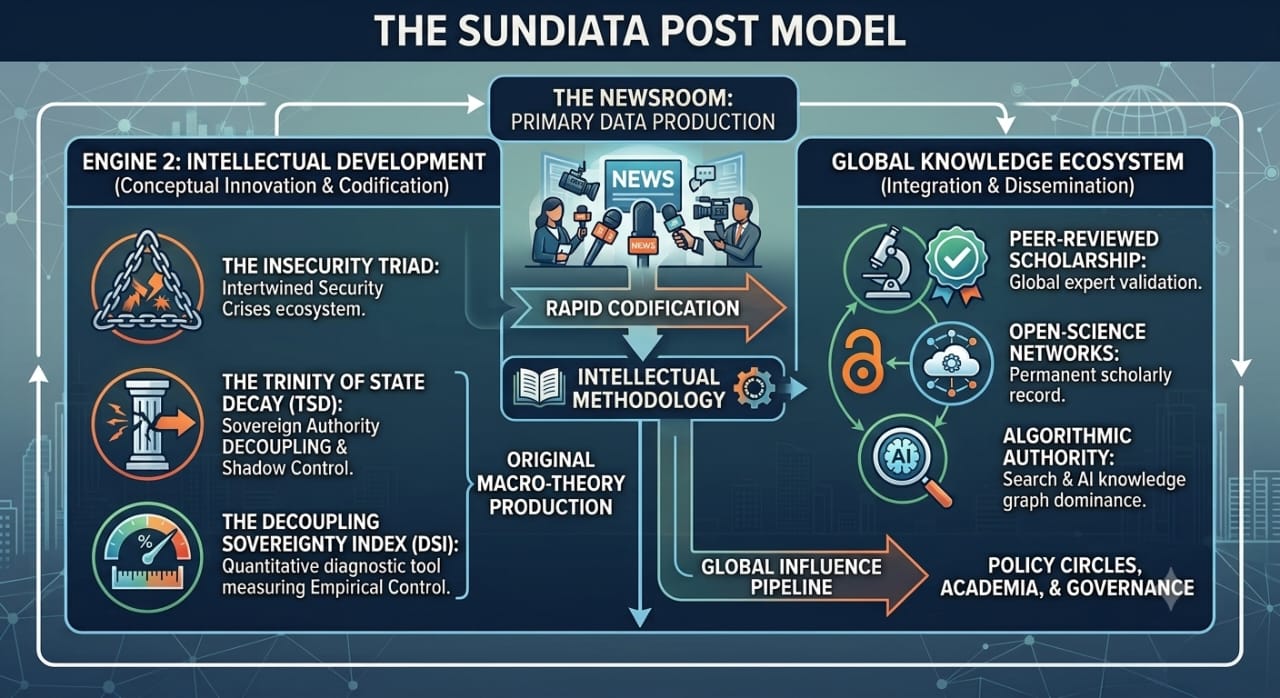
Over time, The Sunday Stew gradually evolved beyond a weekly opinion column into a platform for systematic, empirical inquiry. Through that deliberate evolution emerged a succession of original analytical frameworks:
•The Insecurity Triad: A conceptual framework explaining how kidnapping (Money), banditry (Land), and terrorism (Mind) function as mutually reinforcing dimensions of contemporary insecurity, generating parallel systems of violence, governance, and authority;
•The Trinity of State Decay (TSD): A macro-theoretical formulation explaining how the interaction between the Institutional Mirage, the Shadow Order, and the Money–Land–Mind dynamic drives the decoupling of formal sovereignty from effective state authority, and
•The Decoupling Sovereignty Index (DSI): An indigenous, multidimensional measurement framework designed to quantify the extent to which effective sovereignty has decoupled from formal state authority across subnational territories.
What gradually became apparent was that these were not isolated intellectual exercises. They were the deliberate products of an emerging institutional philosophy developed through the Sundiata Post Intelligence Unit (SPIU).
More importantly, these constructs did not emerge as a single research project conceived in advance. They appeared sequentially, each responding to new empirical observations while simultaneously expanding the analytical capacity of the newsroom itself. The Insecurity Triad provided a structured lens for understanding the interconnected dimensions of insecurity. The TSD extended that inquiry into a broader theory of institutional authority and governance. The DSI subsequently translated those theoretical insights into an operational framework capable of empirical assessment. Viewed together, this progression revealed something larger than the individual frameworks themselves. It demonstrated that the newsroom had begun to develop an internal capacity for cumulative knowledge production, with each construct building upon and extending the intellectual foundations laid by its predecessor.
The fundamental question therefore shifted from “What new framework has been developed?” to “What kind of newsroom structure makes the systematic development of such frameworks possible?” The answer is the Sundiata Post Model.
A New Institutional Proposition
The Sundiata Post Model does not argue that journalism should become academia, nor does it suggest that scholarly research should migrate from the university to the newsroom. Instead, it advances a new institutional proposition:
The Core Proposition: An independent media institution can systematically integrate high-velocity journalism, original qualitative research, conceptual innovation, and global scholarly dissemination within a single institutional framework, contributing simultaneously to
informed public discourse and the international knowledge ecosystem. The Sundiata Post experience demonstrates the practical viability of this proposition.
This proposition reflects neither a rejection of journalism’s traditional role nor an attempt to merely imitate academic institutions. Rather, it represents a strategic institutional adaptation to the changing architecture of knowledge itself.
In an era when global digital repositories, artificial intelligence discovery layers, academic networks, and news organisations increasingly intersect, the traditional boundaries separating journalism from formal knowledge production have become entirely permeable. The Sundiata Post Model seeks to explore what becomes possible when those boundaries are approached not as rigid barriers, but as unprecedented opportunities for intellectual sovereignty.
The historical journey from Azikiwe and Awolowo to Lippmann and Arendt reveals a long-standing, symbiotic relationship between journalism and ideas. The Sundiata Post Model does not seek to replicate any of those legacy traditions perfectly. It seeks to answer a contemporary institutional question:
What becomes possible when an independent newsroom deliberately organises itself as a primary knowledge-producing institution?
The answer begins with philosophy. The next essay examines structure.
Trust is sacred. Stay seasoned
•Dr. Max Amuchie is a Scholar-Journalist, Media CEO, Lead Researcher at the Sundiata Post Intelligence Unit (SPIU), and an Expert Member and Peer Reviewer at ScienceOpen. He is the architect of The Insecurity Triad framework for African security analysis as well as the Trinity of State Decay theory, and the Decoupling Sovereignty Index (DSI)—original frameworks for understanding, categorising, and measuring conflict, state decay, and sovereignty in the Global South. He writes ‘The Sunday Stew’, a weekly syndicated column on faith, character, and the structural forces that shape society, with a focus on Nigeria, Africa, and the Global South in a changing world.
X (formerly Twitter): @MaxAmuchie | Email: max.a@sundiatapost.com | Tel: +234(0)8053069436

In a quick riposte on Saturday, Dave Umahi, Minister of Works, has cautioned Nigerians to be circumspect in the manner they react to the story of the death of a female student in his home in Ebonyi State, warning against the temptation of jumping to conclusion.
Conveying his position on the highly-volatile matter through Francis Nwaze, his spokesman, Umahi, former Governor of Ebonyi State and a key figure in the government of President Bola Tinubu, said caution was needed to enable the police conduct unfettered investigation into the matter.
It was his response to breaking of how one Mary Habila, a female physiotherapist reportedly died in his palatial home at Uburu, Ohaozara Local Government Area of Ebonyi State, on June 27, hours after arriving the day before.
Nwaze, a Senior Special Assistant on Media and Publicity, specifically cautioned against speculations by “tale bearers,” while conveying the Minister’s shock over the matter and his eagerness for the authorities to get at the root of the matter through forensic investigations.
He wrote in the statement: “The attention of the Media Office of the Honourable Minister of Works, Senator Engr. David Nweze Umahi, has been drawn to a publication by a publication concerning the unfortunate passing of Miss Mary Habila in Uburu, Ebonyi State, alleging that the circumstances surrounding her death were shrouded in secrecy.
“The Honourable Minister received the news with profound shock and sadness and has since extended his heartfelt condolences to the bereaved family. For the avoidance of doubt, immediately the unfortunate incident occurred, appropriate emergency steps were taken. Medical personnel, including the Chief Medical Director of the David Umahi Federal University of Health Sciences, Uburu, were contacted without delay, while the Nigeria Police was promptly notified in accordance with the law.
“Following confirmation of Miss Habila’s passing, the Honourable Minister personally received her parents, conveyed his sincere condolences, and advised that an autopsy be conducted to scientifically establish the exact cause of death. At the time, however, the family declined the recommendation.
“It is important to clarify that Miss Mary Habila and Miss Anita Baski are employees of the David Umahi Federal University of Health Sciences, Uburu, who had been on secondment to the Federal Ministry of Works as physiotherapists for the past three years until the unfortunate passing of Miss Habila.
“Following the recent developments and in the interest of ensuring that the truth is established beyond doubt, the Honourable Minister has again reiterated his position that an autopsy must be conducted. He remains convinced that this is the most credible and responsible path to resolving all questions surrounding the unfortunate incident.
“We therefore urge the public to exercise restraint, refrain from speculation or premature conclusions, and allow the relevant authorities to carry out their responsibilities without interference. At this difficult time, our thoughts and prayers remain with the family of the deceased, and we pray that God grants them the strength to bear this irreparable loss.”



-

 News2 days ago
BREAKING: Mystery death! *Female student dies a day after arriving Umahi’s home!
-
 News4 weeks ago
BREAKING: Troops rescue wife of kidnapped General! *Terrorists flee scene
-
 News4 weeks ago
BREAKING: Count me out, Okonkwo tells Atiku *Amaechi VP’s choice an insult to Ndigbo
-

 News3 weeks ago
BREAKING: Court sentences Nigerien, two others to death over terrorism
-

 News2 days ago
Don’t jump to conclusion! *Umahi speaks on mysterious death of female students!
-
 News1 week ago
BREAKING: EX-SSG mowed down by gunmen! *He resisted being kidnapped – driver
-

 News3 weeks ago
Abductors of Oyo teachers panicking, freedom coming for victims soon!
-
 News3 weeks ago
Two hours after Igboho’s ‘red-eyes’ to ‘Fulani’ leaders, gunmen free kidnap victims!