
News
Osimhen saga: We’re misunderstood, just a joke, no insult intended – Napoli *FG wades in


Napoli has finally reacted publicly to the video in which it appeared to be mocking Nigerian-born international and ace striker, Victor Osimhen, on whose shoulder the club rode to win last year’s Serial A, for the first time in 33 years, with the player himself emerging the greatest striker in the game for the 2022-2023 season.
The now deleted TikTok post, showed Osimhen failing to score his spot-kick in a Serie A match with a high-pitched voice saying “gimme penalty please,” sparking a furious reaction from Roberto Calenda, his agent who threatened legal action against the club, saying on his X: “A serious fact that causes very serious damage to the player and adds to the treatment that the boy is suffering in the last period between media trials and fake news. We reserve the right to take legal action and any useful initiative to protect Victor.”

But in its riposte, the club said it did not intend any harm against the Nigerian international, who broke the record as the highest African scorer in Serial A, which had been held by Balon D’or winner, George Opong Weah, who is currently the President of Liberia, his country, after scoring his 47th goal in the Italian highest league.
“Calcio Napoli, wishing to avoid any exploitation of the issue, point out that we never wanted to offend or mock Victor Osimhen, who is a treasure of this club. As proof of that, during the summer training retreat, the Club firmly rebuffed every offer that was received for the striker’s transfer abroad.
“Social media, in particular, TikTok, has always used an expressive form of language with a light heart and creativity, without wanting to, as in the case with Osimhen as a protagonist, have any intention of insult or derision. In any case, if Victor perceived any offence towards him, this was not what the club intended,” the statement said.
Reports had linked the Nigerian to different clubs during the summer transfer window, with Manchester United, specifically opted to break the bank for him, but for the staunch refusal of the club to part with him, turning down all offers on the table for the player, who has now deleted all posts regarding the club on his social media handles, in apparent anger over the development.
Nigerian Federal Government, has also taken up the matter, with John Enoh,
Minister of Sports Development, conveying its reservations over the matter, saying: “My office is trying to reach Victor Osimhen directly as well to understand first-hand the issues. We are committed to establishing the facts of the matter.
“Meanwhile, I am in touch with the Honorable Minister of Foreign Affairs, H.E. Yusuf Maitama Tuggar, and the Nigerian Ambassador to the Republic of Italy, Ambassador Mfawa Abam. Together, we are employing diplomatic avenues with Italy for a more proper approach to looking into the matter as it is.”






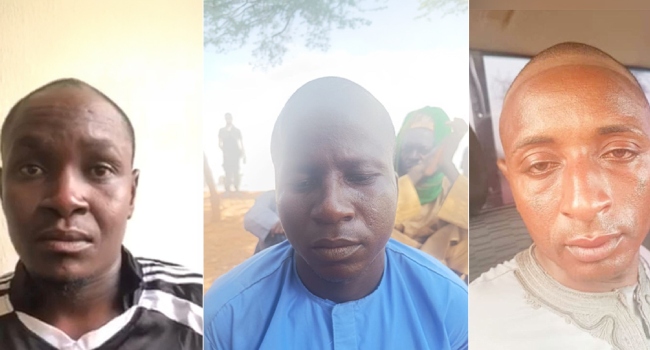
Justice Muhammad Nuraddeen Bello of High Court sitting in Sokoto State has sentenced three men, including a foreign national, to death by hanging, after convicting them on charges bordering on terrorism and arms proliferation.
The convicts, Yusuf Muhammad (alias Sallau), a Nigerien; Jabbi Alhaji Yalle; and Kabiru Muhammad, were apprehended on 13th June, 2025, by the Department of State Services (DSS) Counter Terrorism Unit in connection with cross-border criminal activities bordering on arms trafficking and terrorism.
Bello, who found all three defendants guilty as charged and sentenced them to death by hanging, while also ordering the forfeiture of all monetary exhibits recovered from the convicts to the Federal Government, said: “The conviction is the latest in a series of successful prosecutions by the DSS in its sustained operations against terrorism and organised cross-border criminal networks across Nigeria.”
The sentencing is coming about two weeks after the Federal High Court sitting in Abuja sentenced each of the five suspects arrested on May 31, 2026, by the DSS for their involvement in the November 21, 2025, attack on St Mary’s Catholic School, Papiri, Niger State, to 25 years’ imprisonment.
Justice Binta Nyako, had handed down the judgment after the men, including two Nigeriens, pleaded guilty to all four terrorism-related charges, bordering on support for the commission of an act of terrorism, breaching both Section 16 of the Terrorism (Prevention and Prohibition) Act, 2022, and the Firearms Act, were pressed against them.
According to Count One, the men were accused of jointly conspiring to assist a terrorist by agreeing and intentionally playing various roles towards conveying 15 AK 103 rifles as well as about 1,434 rounds of 7.62mm live ammunition from the Diffa region, Republic of Niger, to one Malam Ahmad, a member of the Boko Haram terrorist group based in Borgu, Niger State, and thereby committed an offence contrary to Section 26(1) of the Terrorism (Prevention and Prohibition) Act, 2022.
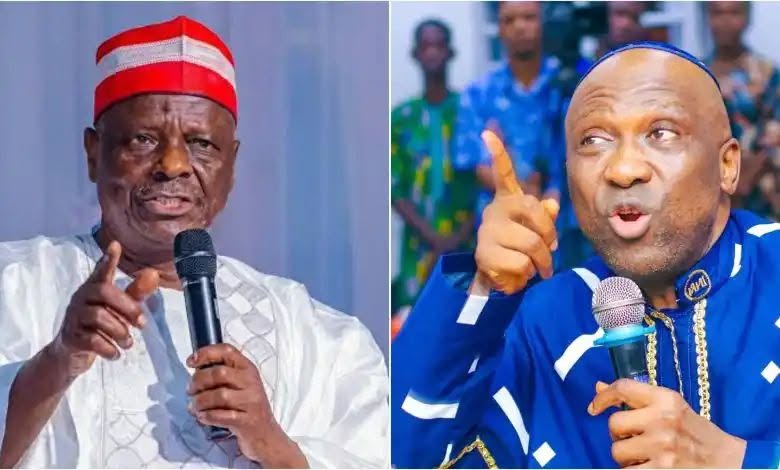
Primate Elijah Ayodele, is on the verge of coughing out a whopping N10billion, if he fails to offer unrestrained apology to Rabiu Musa Kwankwaso, former Governor of Kano State within the next 24 hours, and retract his claim that the former Minister of Defence is bidding his time to betray Peter Obi, to whom he is to contest the 2027 presidential election as a running mate.
Without doing so, the controversial cleric, should be ready for a major court battle with the vice-presidential candidate of the Nigeria Democratic Congress (NDC), the platform on which the pair is to contest the election.
In a letter indicating a legal action against Ayodele of the INRI Evangelical Spiritual Church over defamatory remarks, Kwankwaso, through Magaji Mato Ibrahim, SAN & Co., his lawyers demanded an immediate retraction and apology from the cleric over the allegations.
Details of the letter, dated June 11, and unveiled through the X platform of the legal team, was based on a viral video recorded during a live-streamed church service, where the preacher made allegations targeting Kwankwaso’s integrity as Peter Obi’s running mate under the NDC.
Quoting the cleric as stating: “KWANKWASO IS A FAKE TO OBI, KWANKWASO WILL BETRAY YOU. KWANKWASO HAS BEEN PAID TO BE VICE PRESIDENT TO OBI AMONG OTHER LIBELOUS COMMENTS WHILE PRETENDING TO BE A PREACHER,” the former governor said the comments were unprovoked, grossly unfounded, and carefully designed to create a rift within the ranks of the political party and its supporters.
Handing Ayodele a 24-hour ultimatum to publish a full and unequivocal retraction across all social media platforms and news outlets with the same prominence as the original video, they also demanded a written undertaking that he would cease and desist from making any further malicious statements against their client, warning that failure to comply, would lead to full legal actions.
The letter stated: “We shall claim substantial damages to the tune of Ten Billion Naira and cost of the action on a full indemnity basis amongst other reliefs.”

President Bola Ahmed Tinubu on Tuesday demanded the immediate end to the exportation of minerals from countries in Africa in their raw forms, which he said had led to massive exploitation of the continent.
The President, told member countries of the African Minerals Strategy Group (AMSG), a forum of Ministers in charge of Mining and Solid Minerals on the continent to speak with one voice to promote, collective interests, ensure value addition, and prevent the continent from becoming merely a source of raw materials for the rest of the world.
As the Grand Patron of the group, chaired by Dele Alake, Nigeria’s Minister of Solid Minerals Development, gave the charge while receiving a delegation of AMSG in the State House, Tinubu told the delegation that the group had a critical role to play in strengthening Africa’s bargaining power in the global mineral market and ensuring that the continent derives maximum value from its natural resources.
His words: “ What we should do is avoid bureaucracy and deceit; we must put an end to exploitation. The rest of the world won’t mind if your country is a cesspit of dams and rubbish and excavates your raw materials without giving value.
“It is our responsibility to collaborate and cooperate to ensure that these metals and minerals bring value to us, bring technology to us, and we can do it. It is how much each country will put into the research, development and refinery. I don’t see reasons we cannot demand centralisation of that conversation somewhere on the continent. So why not utilise that in our research and development and knowledge-based economy to enhance the quality of life and bring prosperity to our people.”
Emphasising that Africa possessed enormous mineral wealth that should be strategically harnessed to drive industrialisation, create jobs and accelerate economic transformation across the continent, the President, said the era of exporting raw minerals without local processing and beneficiation must give way to a new model that encourages investment in local industries, technology transfer and the development of value chains that retain wealth within Africa.
Alake, who had earlier expressed gratitude to the President for his exemplary leadership under the Renewed Hope Agenda, said the gesture had shown support for Nigeria’s mineral sector, especially in the local value-addition and economic diversification drive, where artisanal miners are empowered.
He told the President: “You encouraged us to look at the focal point of the establishment of this group, which is to ensure that the African natural resources, especially with regards to minerals, critical matters, are localised, the beneficiation coming directly to Africans generally.
“You charged us that we should set our sails very high and ensure that local value addition is a pivot around which all the objectives of this organisation should revolve.
“So, sir, we have gone implemented your charge and we are quitted that today local value addition is reverberating all over Africa.”
He added that some member countries have gone ahead to ban the export of raw minerals.
He explained members of the body were in Abuja for the Fifth edition of the African Natural Resources and Energy Investment Summit (AFNIS 2026), to push for a new continental approach to resource management and industrial development.



-
 News3 weeks ago
BREAKING: Terrorists strike Ibadan again! Abduct ex-Minister’s sister, twin children
-
 News1 week ago
BREAKING: Troops rescue wife of kidnapped General! *Terrorists flee scene
-

 News3 weeks ago
Emeka Ike: I’ll make example of Lere Olayinka for prying into my privacy
-
 News1 week ago
BREAKING: Count me out, Okonkwo tells Atiku *Amaechi VP’s choice an insult to Ndigbo
-

 News4 weeks ago
Tinubu’s $9million lobby deal in jeopardy *Group goes after US firm
-
 News2 weeks ago
Dickson: Obi, a big asset to NDC, we’re working together … but!
-
 Columns4 weeks ago
Atiku-Amaechi tag-team: An indication of ADC’s hideous plan for Obi
-
 News2 weeks ago
Ovia, ex-Zenith Bank boss swings into luxury apartments *Flats hit $2.8million price tag