
Uncategorized
Customs boss hosts GOCOP, main online news umbrella body in Abuja


The Guild of Corporate Online Publishers (GOCOP) has visited the acting Comptroller General of Nigeria Customs Service, CG Adewale Adeniyi, in Abuja as part of preparations for its Annual General Conference.
The GOCOP team was led on the visit to the CG by its President, Maureen Chigbo, who spoke about the conference.


The Guild will be holding its Annual General Conference in Abuja for the first time since its inception on October 5, 2023 at Abuja Continental Hotel.
Chigbo, who said the GOCOP is a group made up of top rated journalists who have practiced at the highest level in journalism, urged the NCS to ensure synergy with the media, especially since the new helmsman used to be in charge of the Service’s public relations.
Responding to the GOCOP President’s remarks, the customs CG expressed delight over the visit.
Adeniyi was particularly elated to learn that real professionals are the ones within the rank of GOCOP, especially since it is clear it’s made up of former Managing Directors/Editor-in-Chiefs, Editors and Line Editors, who have worked in the newspaper business for at least 10 years before venturing into online journalism practice.
He expressed confidence that the emergence of GOCOP will help in sifting the grains from the chaff in online journalism practice.
With GOCOP, he reasoned, it will be easier to determine who the real professionals in the online business are for proper synergy.
Adeniyi assured the media that he will continue to crave partnership towards achieving the goals of his service.
The GOCOP team included Dotun Oladipo, the immediate past president; Danlami Nmodu, mni, Deputy President; Ken Ugbeche, Vice President, South; Tom Chiahemen, Vice President, North; Collins Edomaruse, General Secretary; and Tajudeen Kareem, an Abuja-based GOCOP member.
The Public Relations Officer of the NCS, Abdullahi Maiwada, was also present at the courtesy visit alongside other officers.









By Sunny Igboanugo
I must confess harbouring genuine fear in the last few days. The signals filtering in from the Nigerian Democratic Congress (NDC), kept me substantially restive.
But it immediately transcended to apprehension and trepidation when Henry Seriaka Dickson, National Leader, appeared on Prime Time, the public affairs programme on ARISE NEWS Television.
This is it, I told myself. Yes, I was becoming increasingly convinced that my fear that the Ofirimapepe – the Great White Shark from Bayelsa – was about to unravel. Knowing Nigerian politicians, I had not been able to wean myself of the fear that the former Governor did not have a hidden agenda.
Listening to the same ARISE NEWS panel, this time on The Morning Show, its breakfast programme, review Dickson’s outing in the earlier encounter with Charles Aniagolu, I knew I was not alone in entertaining this fear.
There, the panelists alluded to the same fears – probably picked from their individual antenna – to the effect that Dickson would betray Obi – confirming that I wasn’t just overthinking.
Now, among the different angles that had been bandied is the one suggesting that Dickson was actually not interested in Peter Obi becoming President – “because he knows he will not win” – but that he is actually using his name to build the party for the future.
In fact, they stretch the prognosis to suggest that the real interest is for the Senator to pair with Rabiu Kwankwaso, current running mate with Obi in the 2031 presidential election. In other words, it is all about 2031. For me, this wasn’t as dangerous as the one I had been pondering over since Obi’s entrance into the NDC.
Now, my own prognosis was that the entire scenario depicted APC at work. I confess this much. I had always believed that the process of Obi’s emergence and picking the NDC was too smooth for comfort. Were APC and President Bola Tinubu particularly, who had been accused of not wanting the former Governor of Anambra State on the ballot in 2027, knowing what he did to him in the 2023 edition, sleeping?
This naughty knot in my throat, too difficult to swallow, was reinforced by Dickson’s particular expressions during the encounter. First, came the fact that nobody – make it Obi – was doing him or the NDC leadership a favour by joining the party, but rather, it was the other way.
Then came the bigger one, when he began to boast that nobody was more “qualified” to run for the nation’s number one job than him – I interpreted it to be a direct attack on Obi. The question was why? Why would he be launching such needless blitzkrieg on his own party’s candidate – the same man he would be going to war with?
Then, I concluded that it was a gambit to draw Obi out to a fight – that he was deliberately baiting the 2023 Labour Party (LP) presidential candidate – daring him to say piim in form of a reply and then – voom! The bloody battle will start and then, the inevitable – Obi’s name will either disappear from the NDC list or something close to it!
Both ways, it would be bad business for the Obi project – the only hope for citizens to get out of the nightmare they find themselves under the terrible disaster, called – APC’s Tinubu. I couldn’t bear the thought.
Now, I confess I was wrong! I have just listened to Dickson’s clarification and realised that this might not be the case. On the contrary, the culprit is actually Aisha Yusufu, arguably one of Obi’s most trusted allies. The rumble in the NDC, has all the trappings of a wounded ego she’s nursing at the moment.
It is clear that she is unable to manage her bitterness for failing to obtain the ticket of the party for the Federal Capital Territory (FCT) Senatorial election in 2027.
It is a delicate situation, because of what such anger could wrought, as already becoming evident. What is more? It might all be a matter of the self-entitlement factor, given her profile.
I could imagine what she’s struggling with and the questions in her head right now. How could a whole Aisha, Nigeria’s tough-nail activist fail to clinch such a simple trophy given her status and what she had done for the party? Why wouldn’t she get what she wanted given “all she had done” for Peter Obi?
How would I know the angle Dickson just revealed – that he (Dickson) and Obi, sat down to practically beg the self-same Aisha to take the House of Representatives ticket of the party – for FREE! But she refused flatly. For her, it was the Senate or nothing.
Now, this is where politics is different from populism. Dickson didn’t just fall into the leadership of the NDC. So many things happened to that effect. Just like Aisha is Obi’s man-Friday, so too is Dickson supposed to have his own. Politics is all about give and take – quid pro quo – rub my back I nwekee yours!
Did Aisha expect that Dickson would not have his own interests? Did Aisha expect that Obi, after picking the presidential ticket, would also begin to scramble or contest with the Ofirimapepe for the FCT ticket, his own share of the booty?
Okay, did she expect that Dickson must subsume that interest under hers for there to be peace? Just because she is Aisha – Nigeria’s number one activist? Does she expect Dickson to go empty-handed – just because she has access to “important people?” Imagine!
Dickson claimed that he and Obi pleaded with her to take the House Representatives ticket for free, but she flatly refused. Pray! Is House of Representatives too low to start as a political fresher?
I saw her earlier video that went viral, where she was complaining before party leaders that she was denied the platform to contest the ticket. What platform was she talking about?
Isn’t it akin to Atiku Abubakar insisting on contesting the African Democratic Congress (ADC’s) ticket with Peter Obi, for which he is being called names till date.
Like Atiku, who says she wouldn’t have won the primaries for the FCT ticket? Yes, if allowed, she might have defeated Amanda Pam, the lawyer whom had reportedly been penciled down by Dickson’s choice.
But wouldn’t that mimic the nuances surrounding Atiku defeating Obi, et al in the ADC primaries? Would that be the end of the story? How would Dickson feel that his candidate was shoved out of the way in place of a newcomer?
Yes! She might argue that it is all about democracy. But even democracy must be given a human face. Much more than taking Tinubu and his wicked government out of power, a major reason many people also demanded that Atiku ceded the ticket to Obi, was for this same human face of democracy – including for the South to remain in power – moreso – South East.
Just in the same way many believed that Atiku could easily pick the ADC ticket but fail woefully in the main election, isn’t it also true that Aisha could have defeated Pam in the run for the NDC ticket, but fail at the main election – especially given what many see as her deep-rooted relevance in Abuja politics – even outside Dickson’s particular interest?
Now, I understand Dickson’s outburst clearly and it is as well that he came out to make clarifications. Now I know it is not about Obi. Now I know it is not a gambit to stoke an imaginary quarrel in the NDC just to endanger the ticket. Now I know it is not APC or the Aso Rock Villa or Bourdillon at work. Now I’m so happy!
In recent days since this imbroglio, Aisha has spoken less about the Peter Obi presidency, hitherto on her lips. I hope the apparent reticence is not her way of waying the option of joining the likes of Kenneth Okonkwo and other turncoats.
Surely, the naysayers, must be on her case by now, baiting her to take a bite. I hope she’s not pecking at it, not to talk about swallowing the line. I just hope she would take the more glorious option of dusting herself and re-engaging in what she is known for – crusading for the society.
Shakespeare once wrote that “hell hat no fury than a woman scorned.” Granted that it is human to feel angry or disappointed, but the cure cannot come from taking a dive into the sea.
Impulse or recklessness could lead to plunging into the morass of infamy. I should suggest she asked Okonkwo how it feels in there. Thank God they’re both still friends. It mightn’t only be critical, but indeed fatal – like from frying pan into fire. I won’t say more!
_ The Tiny Voice!
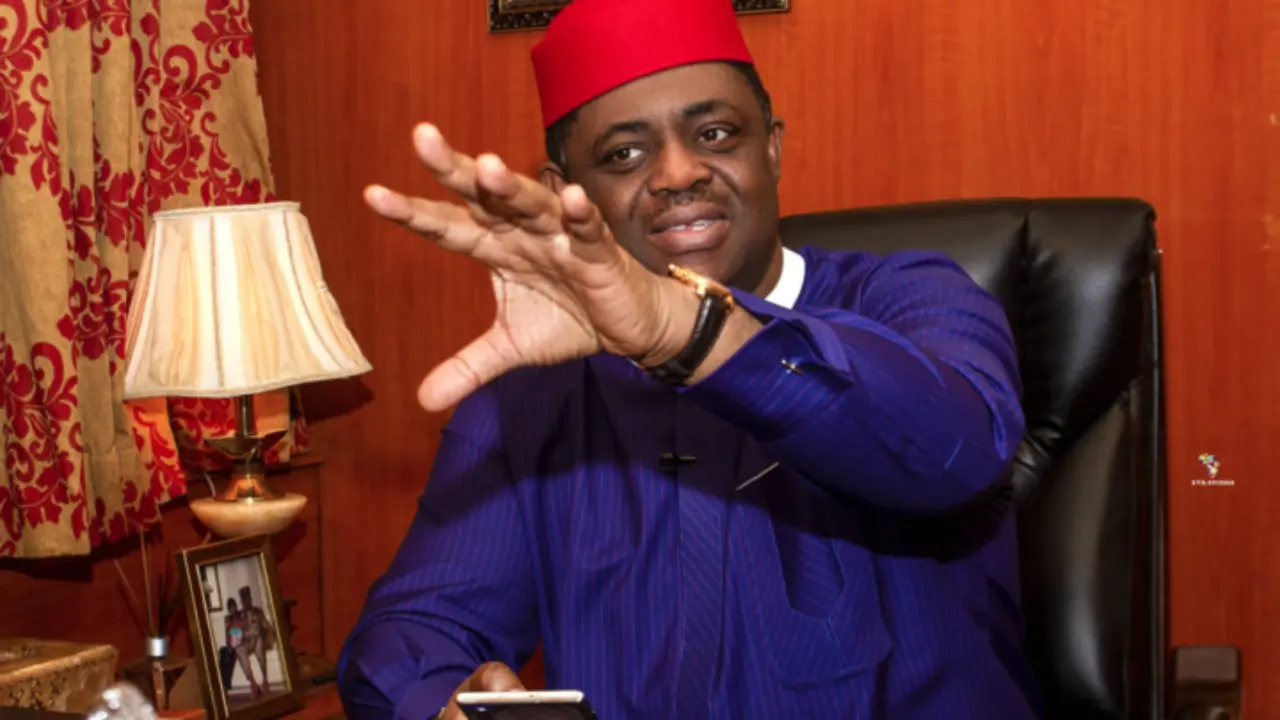
After allegedly being rejected as Nigeria’s ambassador to Germany, Femi Fani-Kayode, former Minister of Aviation, has been reassigned as Nigeria’s ambassador-designate to South Africa, while his place is said to have gone to Ita Enang, former Senior Special Assistant (SSA) to the President on Legislative Matters.
Reports had said as far back as March that the former Minister and vocal voice in national affairs was not granted a welcome to Berlin, the German capital, due to what was claimed as his divisive ethnocentric public commentaries, labelling his potential presence as destabilising to diplomatic relations, claims he promptly repudiated as fake news.
While no official statement has come from either the Presidency or the Federal Ministry of Information to confirm the new status of Enang, Fani-Kayode has since confirmed he is heading to Johannesburg.
Reacting to the news, which circulated widely on social media—particularly on X, claimed that Germany had declined to his appointment, Fani-Kayode, described the reports as “fake news” and accused political opponents of attempting to undermine his appointment.
“These opposition elements are so pained by my appointment that they are doing everything to discredit it. Whether they like it or not, I will serve my country,” he stated.
The former minister emphasized his commitment to serving Nigeria, dismissing the rumors as baseless attempts to scuttle his diplomatic role.
Regardless, the Minister confirmed on Thursday that he was how heading to South Africa, as his new posting, but quickly asserted that it was not out of rejection by Germany, but out of his own preference to serve in Africa rather than Europe where he had lived for a long time.

The African Democratic Congress (ADC) on Tuesday, called out the Federal Government of attempting to destabilise the party following Senator Rabiu Musa Kwankwaso’s defection, alleging pressure on Joash Ojo Amupitan, INEC Chairman, to interfere in its leadership.
Bolaji Abdullahi, spokesman of the party, who made the allegation in a statement, detailed how a March 28 letter by some Senior Advocates, purportedly representing an expelled member of the party, is being used to push INEC to invalidate party actions and alter its structure before the court rules.
Stressing that part of the grand plan to destabilise the only viable opposition party left in the country was to use the electoral commission to cause havoc, over a matter that was in court, the party promised to resist it using all constitutional means,
The full statement reads:
The African Democratic Congress (ADC) has observed a coordinated attempt to pressure the Chairman of the Independent National Electoral Commission (INEC), Professor Joash Ojo Amupitan (SAN), and destabilise the David Mark-led leadership of the party.
The decision of Senator Rabiu Musa Kwankwaso to join our party has understandably sent jitters through the ruling party. Since then, top officials within the Federal Government have renewed their onslaught against our party, in a bid to discourage other high-profile figures.
This conspiracy is centred on a legal dispute that is now being pushed beyond the courtroom. In a letter dated March 28, 2026, a team of Senior Advocates of Nigeria is asking INEC to enforce a curious and peculiar interpretation of a Court of Appeal ruling regarding what constitutes “status quo ante bellum.”
In the said letter, the writers even went ahead to threaten the INEC chairman with arrest if he does not grant their request within seven days. They want INEC to invalidate party meetings, remove recognised officials, and hand over the affairs of the party to a specific individual, even though the case itself has not been fully decided by the courts. Obviously, what the authors of this vexatious letter are attempting to do is to pressure INEC to take sides and grant them what no court in Nigeria has granted.
For the avoidance of doubt, Hon. Nafiu Bala Gombe, who is claiming to be aggrieved over the ADC leadership, was never the Chairman of the ADC. And, perhaps more significantly, Nafiu Gombe had earlier resigned his position alongside other members of the National Working Committee. He has also since been expelled from the party. Therefore, any attempt to recreate a “status quo” that upgrades his position to National Chairman of the ADC at any point in time is, at best, fictitious.
What we are witnessing is a convergence of legal pressure and political intent by a ruling party that is unsettled by the growing appeal of the ADC. But Nigerians can see what is happening.
No amount of pressure, no manufactured confusion, and no distortion of legal processes will stop what is already in motion. The ADC is growing. Nigerians are joining. A credible opposition is taking shape.
We call on INEC to remain guided by the Constitution, resist all forms of pressure, and uphold its duty as an impartial umpire.
This is bigger than the ADC. It is about whether Nigerians can freely choose a different path. And that must not be compromised.



-
 News4 weeks ago
BREAKING: Troops rescue wife of kidnapped General! *Terrorists flee scene
-
 News4 weeks ago
BREAKING: Count me out, Okonkwo tells Atiku *Amaechi VP’s choice an insult to Ndigbo
-

 News2 weeks ago
BREAKING: Court sentences Nigerien, two others to death over terrorism
-
 News4 weeks ago
Dickson: Obi, a big asset to NDC, we’re working together … but!
-

 News4 weeks ago
Ovia, ex-Zenith Bank boss swings into luxury apartments *Flats hit $2.8million price tag
-
 News7 days ago
BREAKING: EX-SSG mowed down by gunmen! *He resisted being kidnapped – driver
-

 News3 weeks ago
Abductors of Oyo teachers panicking, freedom coming for victims soon!
-

 News3 weeks ago
Two hours after Igboho’s ‘red-eyes’ to ‘Fulani’ leaders, gunmen free kidnap victims!