Connect with us

News

‘Banned’ from Aso Rock, Asari turns to APC, visits Ganduje

Published

on

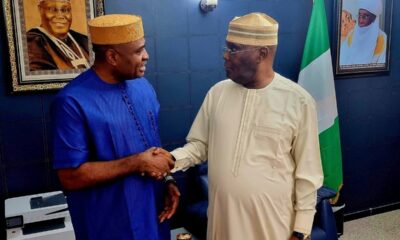
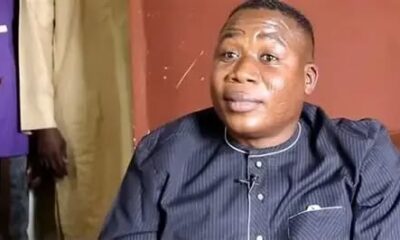
About two months after visiting President Bola Tinubu at the Presidential Villa Abuja, Asari Dokubo, leader of the Niger Delta Peoples Salvation Force (NDPSF), was at the home of the National Chairman of the All Progressives Congress (APC) Abdullahi Ganduje, on Sunday to confer with him.

The picture of the two in warm exchange of pleasantries surfaced in the social media on Monday, with the former governor of Kano and his guest, a Niger Delta activist beaming with smiles during the visit at the former’s residence in the federal capital territory (FCT).

Advertisement


“The National Chairman, H.E. Dr. Abdullahi Umar Ganduje, hosted frontline Niger Delta leader, Asari Dokubo, on a congratulatory visit at his residence in Abuja,” the party said.

Ganduje, recently took over from Abdullahi Adamu, who was forced out of office alongside Iyiola Omisore, former National Secretary, who was replaced by Ajibola Basiru, former senate spokesperson, in what is believed to be the fallout of the 2023 presidential election, where the former Chairman, was said not to have supported Tinubu in his quest to replace his predecessor, Muhammadu Buhari.

Advertisement


Share this story:

News

The ministerial endorsement of SEDC model for regional commissions

Published

on

By Emmanuel Nzomiwu
Since assuming office on May 29, 2023, President Bola Ahmed Tinubu has prioritised regional development to bridge historical infrastructural gaps and foster balanced socio-economic growth across Nigeria’s geo-political zones. In this regard, the Tinubu administration established additional regional commissions, to tackle unique socio-economic challenges, reduce regional disparities and foster localized infrastructure.
The new commissions are the South East Development Commission (SEDC), dedicated to addressing infrastructural gaps, ecological and economic challenges of Southeastern Nigeria, and South West Development Commission (SWDC), created to handle infrastructure modernization and economic empowerment of Southwestern states. The North West Development Commission (NWDC) was established to tackle developmental needs, human capital emancipation and security challenges within the Northwestern states, and the North Central Development Commission (NCDC), to drive inclusive growth, agricultural advancement and socio-economic transformation in the middle-belt zone.
These new commissions were created by the Tinubu administration to complement the pre-existing regional commissions, the Niger Delta Development Commission (NDDC), focusing on infrastructural development and environmental remediation in the oil-rich Niger Delta and North East Development Commission (NEDC), concentrating on rehabilitating, restructuring and rebuilding areas ravaged by insurgency and humanitarian crisis in Northeastern Nigeria. The NEDC was created in June 2000 by the Olusegun Obasanjo administrion, while the Muhammadu Buhari administration established NEDC in 2017.
In October 2024, President Tinubu created the Federal Ministry of Regional Development (FMRD), saddled with the responsibility of overseeing the various regional development commissions, and thus, subsuming all of them under a single, unified national framework. To show the importance he attaches to regional development, the President appointed an engineer, Abubakar Momoh as the Honourable Minister of Regional Development and a lawyer, Uba Maigari Ahmadu as the Minister of State for the Ministry.
As a southeasterner, I felt quite elated listening to the Honourable Minister of Regional Development, Abubakar Momoh, on a number of occasions, endorsing the South East Development Commission (SEDC) as a model for operating regional development commissions in Nigeria. For instance, during the unveiling of the 10-year roadmap for the transformation of South-East in Abuja, Momoh, stated that the initiatives of SEDC align with the priority areas of the federal government’s Renewed Hope Agenda, which includes strengthening national security, boosting agriculture, diversification of the economy through industrialization and unlocking natural resources.
While describing SEDC as “one sure bullet that will shoot down all major development challenges in the South East region,” the Minister viewed its coordinated approach, strategic planning and partnerships as the blueprint for transforming other geo-political zones across Nigeria. He restated this at a strategic retreat for Nigeria’s seven regional commissions in Benin City, Edo State in April this year. The retreat was held to align the objectives of Nigeria’s regional development commissions, enforce strict performance benchmarks and end fragmented project planning.
Making remarks at the retreat, the Managing Director and Chief Executive Officer of SEDC, Mark Okoye, hinted that SEDC will prioritize its long-term vision over short-term wins. The vision of the commission, according to its roadmap, is “to reposition the South East as the preferred investment destination in Africa by 2035,” while its mission is “to drive sustainable development, economic growth and unity in South East through strategic investments and empowerment initiatives.”
The strategic objectives of the roadmap include, to collaborate with state governments, private sector and development partners, development finance institutions, among others, and to achieve a $200 billion economy by 2035, leveraging key growth sectors, such as agriculture, industrialization, creative economy and tourism. The objectives also include, to pursue transformative high-impact projects that catalyze regional development, including infrastructure, energy and technology hubs, and to enhance the ease of doing business by improving infrastructure providing regulatory support and access to finance, to make the region a preferred destination for investment.
The remaining objectives are to foster partnerships among South East states to harmonise policies, pool resources and advance shared goals of economic growth and development, and to build $1 billion asset base for the commission by undertaking key phase of project structuring from conceptualization to bankability. How far has the commission gone in this regard?
Beyond rhetoric, the commission has taken concrete steps towards the achievement of these objectives. For instance, last month (June) the commission entered into Memoranda of Understanding with two South East states-Enugu and Abia-under its South East Agro-Development Programme, aimed at reinventing Dr. M. I Okpara’s agricultural and agro-industrial footprints in the Eastern region.
The programme, coordinated by the Executive Director( Natural Resources, Agriculture and Rural Development), Dr. Cliff Ogbede, targets investment opportunities, massive job creation, food security and sustainable agro-industrial development. It would also have security impact on the states as a criminal hideouts are going to be transformed into hubs for useful economic activities.
Partners of SEDC in this regard include the National Agricultural Land Development Agency (NALDA), development finance institutions, like Bank of Agriculture (BOA), Bank of Industry (BOI) and Nigeria Incentive Based Risk Sharing System for Agricultural Lending (NISRAL) PLC, a non-bank financial institution created by the Central Bank of Nigeria (CBN), to de-risk agricultural lending. The agro-development programme is just one of the numerous projects and programmes contained in the roadmap to transform South East.
Other programmes and projects are the South East Security Intervention Programme, the South East Regional Economic and Industrial Programme, the South-East Investment Company, projects preparation-feasibility studies, outlining business cases, geographical studies and detailed engineering designs, Renewed Hope Housing and New market Development, Renewed Hope Agenda Community Social Impact Programmes, $50 million South East Venture Capital Fund, and South East Youth Entrepreneurship and Empowerment Programmes, South East Grassroots Recreational Infrastructure Development (SEGRID) programme, Talent Development and Leadership, to mention but a few
Core partners of the SEDC in developing and implementing the roadmap include the United Nations Development Programme (UNDP), state governments, development finance institutions and private investors, and community and diaspora groups. The UNDP is the primary technical partner, providing critical assistance for drafting the region’s 10-year and 25-year strategic plans.
For the implementation of the programmes and projects, the commission actively enters into MOUs with the state governments. At inception, the South East governors advised the commission to view the entire region as a single economic bloc, rather than five separate states.
Thus far, the commission has operated in tandem with the advice of the governors. To augment SEDC’s 2026 N140 billion budgetary allocation, the governors of the five states of the region agreed to contribute N5 billion reach (totaling N25 billion).
As the investment vehicle of SEDC, the South East Investment Company (SEIC) acts as the funding and private sector-engagement arm of the commission. The commission partners with banks and private capital to finance infrastructure, energy and digital economy initiatives across the region.
Regarding partnership with community and diaspora groups, the commission frequently engages town hall leadership, local chambers of commerce and diaspora communities. These engagements are geared towards ensuring inclusivity in the implementation of the roadmap of the commission, in other to achieve its objectives.
In conclusion, I see the ministerial endorsement of SEDC model for regional commissions as another milestone for the South East region. Irrespective of recent attempts by detractors to smear the management with bogus allegations, I have no iota of doubt that the commission is on course. Lies and manipulations can cause temporary confusion or delay, but the truth will always prevail at the end of the day.
Nzomiwu, a public affairs commentator, wrote from Awka, Anambra State. Reactions are welcome via chekmma@yahoo.com

Share this story:
Continue Reading

News

Why Peter Obi must not be extinguished

Published

on

(08054103327, nwaukpala@yahoo.com)
Let us invoke two rich Igbo proverbs in situating the fears expressed by the presidential candidate of Nigeria Democratic Congress (NDC), Peter Obi, over threats to his life ahead of the 2027 general election. On one hand is the expression; “Ebule si na nwoke na-eri n’ude”. For want of perfect translation, it is an attribution to the Ram that a man bears his pains stoically. It lectures that even in the thick of challenges, a man does not complain but goes through them with equanimity.
There is a flipside of the philosophy which says; “So osisi huru onyike n’ukwu ya, ma kwuru”. (Only a tree remains unmoved in the presence of an axe with which it could be mowed). The lesson is that a normal human being, runs for his dear life or raises alarm when he is assailed by danger, especially the type he lacks the capacity to contend with. When the suspicion gravitates to possible threats to life and curiously, from a source that ordinarily should offer succour at moments of uncertainties, it becomes an issue that commands attention.
Obi has weathered through both philosophical worlds and keeps going. Since 2023 when Obi made an audacious outing for the presidency on the platform of the Labour Party (LP), there has been the tendency by other political parties and their supporters, of leaving the burning issues in the land and focusing on him. The trend is usually manifested when chieftains of these other parties grant television or newspaper interviews. In such instances, Obi becomes the matter of discussion. As if these are not enough, hirelings have been unleashed across the internet superhighway and other social media networks with precise briefs to attack and bruise Obi’s image and reputation. In doing this, there is nothing being spared, including Obi’s family and his private life. Foot soldiers of President Bola Ahmed Tinubu and the All Progressives Congress (APC), are the most visible in this cheap exercise.
With the race for the 2027 politics gradually gathering steam, the onslaught has been intensified, hence Obi’s outcry that he may not be alive to contest the poll, given the frustrating experiences he is getting from the presidency. Obi raised the alarm in a podcast interview with media personality Chude Jideonwo while responding to a question on the possibility of his not being a candidate in 2027. He said, “Not even a candidate. I might not even be alive. I’m telling you. Every single thing I do for a living, this government is frustrating it. So, there is even a possibility, if they have the opportunity, I will not be alive”.
In a system that places premium on the welfare and protection of its citizens, the lamentation by Obi deserves serious attention, not only because of who he is – a former governor of Anambra state and employer of labour – but for what he represents – a presidential candidate of a major political party with robust ideas on how the country can be lifted from its current comatose state. But rather than taking a critical look at the issues behind the alarm by Obi, President Tinubu’s media adviser, Bayo Onanuga, has in his usual manner of reducing serious national issues to the casual “us and them” level, dismissed Obi as “a pathological and serial liar, intent on dragging the government into every personal inconvenience he encounters, often resorting to exaggeration and baseless allegations”.
The questions however remain; Is Obi a serial liar as Onanuga alleged? Is Obi merely raising a red herring or shedding crocodile tears? The facts speak for themselves and of course, to the contrary. Let’s start with the events of 2023 shortly after the presidential election, when the same Bayo Onanuga, then, APC Presidential Campaign Council media director, had mocked; “Let 2023 be the last time of Igbo interference in Lagos politics.
“Let there be no repeat in 2027. Lagos is like Anambra, Imo, any Nigerian state. It is not No Man’s Land, not Federal Capital Territory. It is Yoruba land. Mind your business”. Calls on him to pull the brake on the dangerous path he was toeing did not deter Onanuga. He rather boasted; “Let me make myself abundantly clear: the views I express on Twitter are my personal views. I don’t owe anyone any apology for addressing the existential threats of our people. I am after all, first of all a Yoruba, before being a Nigerian”. It was obvious that he was throwing direct broadsides at Obi, who had beaten Tinubu silly in the election. Onanuga was not reprimanded over the lousy outing but was rather rewarded with his present office.
Fast forward to the present when President Tinubu’s garrulous aides, Daniel Bwala and Reno Omokri, had at a time, boasted that Obi would not be on ballot in 2027. Those were not threats that should ordinarily be taken lightly because they were deep and ominous. Recall, also that in January 2025, when Obi cried out that things were going out of control in the country while state officials kept deluding the people, the APC National Publicity Secretary, Felix Morka, accused him of inciting Nigerians to bring down the government, declaring; “Obi has crossed the red line so many times, whatever he has coming to him, he should manage it”. Morka was not known to have been called to order by the security agents for the unguarded remarks.
Rather, two APC governors, Reverend Father Hyacinth Alia of Benue State and his Edo counterpart, Monday Okpebholo, who have been very low in public performance rating, saw in moving against Obi, a shortcut to relevance. In April of same year, Governor Alia issued a directive preventing Obi from visiting and impacting on inmates of Internally Displaced Persons (IDP) Camps in Benue, citing frivolous reasons.
Okpebholo followed suit by warning Obi to obtain security clearance before visiting Edo state or take whatever that comes to him. Obi’s “sin” was visiting the state capital, on July 7, 2025 and donating N15m to St. Philomena Hospital School of Nursing Sciences for the completion of some projects in the school. Okpebholo lacked the grace to appreciate the gesture, preferring to halt Obi from extending similar goodwill to other institutions in the state. In curious coincidence, on February 24 this year, Obi visited Edo and his convoy was attacked by hoodlums. The link between the threat by the governor in July 2025 and the attack on Obi on February 24, 2026 in same Edo, can therefore be imagined.
Elsewhere in Anambra State, the governor, Prof Chukwuma Soludo, has been attacking Obi at all fronts and putting up all manners of childish antics at winning President Tinubu’s favours. Same goes with the pint-sized former Ebonyi state governor and Minister for works, David Umahi.
Lately, the discredited former Borno governor, Ali Modu Sheriff, who has been severally indicted for initiating the Boko Haram murderous group that has caused pains and tears on Nigerians, has been recruited into the anti-Peter Obi campaign. The other day, Sheriff was before the Lagos-based Channels Television, where he humoured himself with unfounded assertions that Obi would not secure the support of Northern voters in the 2027 presidential election. Obviously lacking in facts and integrity, Sheriff alleged that Obi believes in Biafra and is pursuing the division of Nigeria through his presidential ambition. The television appearance was not incidental. It was engineered, apparently to position Obi and his supporters as targets of attacks by terrorists and other shades of criminals in many parts of the country.
In a saner society, the likes of Ali Modu sheriff, given the allegations against him of orchestrating Boko Haram group that has killed many Nigerians, displaced families and threatened the sovereignty of the nation, should be hiding his face in shame. But he is among the President’s attack dogs against Obi. A man associated with the volume of blood that Boko Haram has shed on the land being recruited against a helpless Nigerian as Obi, certainly gives cause for concern.
What then remains for Obi to assume or even conclude that his life is under threats? Is it when he is eventually liquidated? Should he keep mute while his enemies do their worst? The truth is that the Obi has raised an alarm that is valid in all ramifications. It is equally worth reminding President Tinubu that the welfare and security of the citizens and their property, remain the primary functions of the government. This obligation of care, equally extends to Nigerians outside the APC orbit. In that regard, Peter Obi must not be extinguished under whatever guise.
Emeka Alex Duru, Ph.D., is the Editor, TheNiche Newspapers, Lagos.

Share this story:
Continue Reading

News

Prepare for third term! *Tinubu won’t be content with two terms – Odinkalu

Published

on

Chidi Odinkalu, Nigeria’s fiery lawyer, law teacher and former Chairman of the National Human Rights Commission (NHRC), is emphatic that President Bola Tinubu is pushing to perpetuate himself in office, beginning with gaming the electoral process in 2027.

Odinkalu, Professor of Practice in International Human Rights Law at the Fletcher School, told his host Naija Unfiltered, a popular Nigerian podcast programme, that he was as sure as death that the President would not exit office in 2031, if he succeeded with his current gambit to remain in power beyond next year.

Advertisement


Hear him: “Yes. But as I said, let me repeat myself. There’ll be a third term. President Tinubu has not done all of this just for another four years. There will be a third term. And anybody who is doing, ‘it is not our portion,’ is not reading the evidence.”

To achieve this aim, the activist, who was also emphatic that the National Assembly, would play a role, added: “The current National Assembly is anything but national or an assembly. And if it’s an assembly, it’s not a parliamentary one. Many people have called it a rubber stamp, but I think that is actually abusive of rubber stamps. I think this National Assembly is a disgrace.

Citing how bizarre and completely compliant the national legislature had become to Tinubu, the ex-NHRC’s boss, stated: “If you can change your national anthem in less than 24 hours with no public hearing, no public consultation, no public involvement, it tells you you don’t have a country because a national anthem is fundamental to the construction of a national identity.”

Advertisement


Also referring to the current move by the President to introduce state police, Odinkalu, wondered how the Nigerian Senate would introduce the bill to that effect and proceed towards the first and second readings, as well as committee stage and passage in less than two hours, questioning how that was possible in normal clime.

Hear him: “Once we finish our elections, we’re going to amend our Constitution, introduce a single six-year presidential term. The current incumbent will be elected until 2031. In 2031, what will happen? The question will be, will he be entitled to run on the six-year term or will he not?

“You will then get the best Senior Advocates in Nigeria telling you the law is not retrospective. That is why the administration is supporting the litigation over President Jonathan’s tenure—not because the Constitution is not clear, but because they will say there is precedent. There will be a third term, and I’m prepared to bet on it.”

Advertisement


Advertisement


Share this story:
Continue Reading

Trending

Copyright © 2024. WhirlwindNews