

News
Tinubu couldn’t resist my records – Abbas *Says incoming government would change Nigeria for good


“He is impressed with my credentials, the places that I have worked, particularly in the public and private sectors, and also my modest contributions in the National Assembly. I’m sure whatever makes him to say he is happy with me is probably because of those experiences, the qualifications that I have.”
These were the exact words of Tajudeen Abbas, the choice of the All Progressives Congress (APC) for Speaker of the House of Representatives in the upcoming 10th Assembly, as he assured Nigerians that the incoming lawmakers would not be a rubber stamp to the executive as in previous occasions.

Abbas who represents the Zaria federal district in Kaduna state, while appearing on the Channels Television current affairs programme Politics Today told his host that the Bola Ahmed Tinubu, Nigeria’s president-elect was impressed by his credentials and pedigree, which distinguished him from the other candidates.
He said: “Each and every contestant for the speakership has at one time or the other visited the president-elect and also visited the members of the NWC for their blessings. I, just like most of them, had cause to visit the president-elect last week, to present myself, to introduce myself, and to also inform him of my aspiration to be the Speaker of the 10th Assembly.
“We had a very engaging discussion with him. At the end of the day, I can tell you he was very happy with my candidature. He prayed for me and also told me that he would do everything possible to ensure that if it is North West that this particular position is zoned to, he would ensure that justice and fairness are done to all the contestants.
“I want to believe, first and foremost, that he is impressed with my legislative contributions. I have told him I’ve been in the National Assembly since 2011, and I’ve been there now for almost 12 years back-to-back, and I’ve contributed in sponsoring a lot of bills.
“In the 8th Assembly, I sponsored 43 bills, which gave me the number 1 ranking in terms of those who sponsored bills. And in the ninth Assembly, I had the singular honour of sponsoring 74 bills, out of which 21 have been assented to by Mr. President, and they’re now laws in the country.
“Beside that, I went to tell him where I come from, my academic background, that I was a teacher in primary school. I was the head of an accounting department of a polytechnic from 1989 to 1993. I was also a head of banking and finance of a polytechnic again between 2003 and 2005. I was the founding head of accounting of the Kaduna State University.
“I told him my private sector experience, that I was a marketing manager with the Nigerian Tobacco Company, which is now the British American Tobacco. I told him my journey there up to the time when I became the general manager of a subsidiary company before I resigned and went back to the classroom in 2001.
“What makes them think that I am weak? The fact that you don’t come out to insult anybody? The fact that you are a team player; you play along with everyone, you live along with everyone in the House? You don’t have enemies, you have only friends? The fact that you contribute more than any other member in the 9th Assembly? That you are qualified based on public and private sectors’ experience? Does that make me weak?
“Look, what people need to understand is to go and look at the pedigree and antecedents of each and every member. The issue of being rubber stamp is neither here nor there. If you recall in 2019, was it not the president-elect then, Muhammadu Buhari, that pushed for Femi and the Senate President, Lawan, to become the candidates of the party? Are we saying today, after almost four years that those people are the rubber stamps of the Executive? No.”







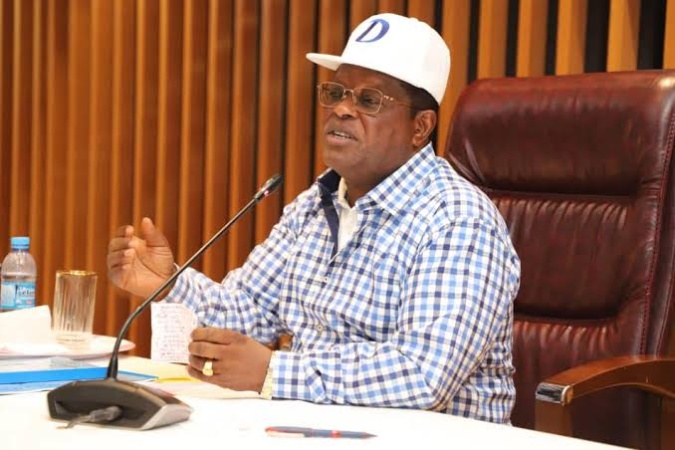
The Federal Government on Friday, announced the change of the Lagos-Calabar Coastal Highway to Bola Ahmed Tinubu Coastal Highway, in honour of the Nigerian President’s “vision” in not only conceiving the project, but actually commencing it.
Dave Umahi, Minister of Works, who made the announcement, recalled how Tinubu conceived the idea of the landmark project, estimated at N15trillion, was inspired by a vision he conceived while serving as governor of Lagos State nearly three decades ago.
Describing the renaming as recognition of Tinubu’s role in initiating the idea behind the 750-kilometre highway, he said: “That highway is named President Bola Ahmed Tinubu Coastal Highway. By the powers conferred on me as Minister of Works, in consultation with my Permanent Secretary, the Minister of State, directors and staff of the ministry, we decided to name it after him because of his dream for it.
“He had that dream about 27 years back as governor of Lagos State. It is one thing to dream and another thing to have the grace of God to actualise that dream. This is one man who dreams and has the grace and divine mandate to actualise that dream,” Umahi said.
The minister also announced that President Tinubu had approved the extension of the Fourth Legacy Highway by an additional 400 kilometres, increasing the planned corridor to about 1,100 kilometres.
He said the President also approved the reconstruction of the Lagos-Ibadan Expressway using reinforced concrete pavement, the completion of the long-abandoned Ibi Bridge in Taraba State, the construction of the 5.76-kilometre Lau Bridge, and the dualisation of another 400 kilometres of the East-West Road.
Providing an update on the Lagos-Calabar Coastal Highway, Umahi said construction was progressing across several sections of the project.
Explaining that the first phase, stretching from Victoria Island to Eleko Village in Lagos, was serving as a benchmark for modern highway construction, while the second section, from Eleko to the Lagos-Ogun boundary, was about 60 per cent complete and expected to be substantially delivered by November, he added that the construction is also ongoing in Cross River, Akwa Ibom, Ogun and Ondo states.

The family of Mary Habila, the 26-year-old lady, whose death in the home of Dave Umahi, at Uburu, Ebonyi State, on June 27, has been raising a lot of dust, has upped the ante in their demand to come to a speedy closure on the incident through the prompt burial of her remains.
Originally, the burial for the deceased, initially said to be a physiotherapist, seconded to the Minister, but now confirmed to be a nurse, was slated for this Friday, but the plan seems to have been shelved owing to the insistence by both the police and the Minister for an autopsy to be conducted on the body.
Umahi, obviously enraged by the insinuations hovering over the incident, with many Nigerians pointing accusing fingers in his direction, had told reporters on Thursday that he had requested the Ebonyi State Police Command to transfer the matter to the Louis Edet House, Police Headquarters in Abuja, for full investigation, including a full autopsy to determine the cause of death.
But insisting on the position of the family, Tanko Habila, father to the deceased, has now petitioned the Inspector General of Police (IGP), demanding the release of her remains for burial.
At the Force Headquarters, Abuja, Habila, who was accompanied by his wife, other family members and their lawyers, told reporters, on Friday that it was saddening that almost two weeks after his daughter’s demise, the Ebonyi State Police Command had refused to release her body for burial.
Insisting on the reason the family had flatly rejected the autopsy option, he said: “As we are standing here, somebody can fall and die. It has happened. All we want is her body to be buried.”

President Bola Ahmed Tinubu, on Friday, signed the Presidential Executive Order on Virtual Assets Coordination, 2026, to harmonise the regulation of virtual assets, strengthen cooperation among the nation’s financial, revenue and capital markets agencies.
The order is also to, protect citizens from fraud, and safeguard the integrity of the financial system while enabling responsible innovation, a statement by Bayo Onanuga, presidential spokesman, who the intention was pursuant to Section 5 of the Constitution of the Federal Republic of Nigeria, 1999 (as altered).
Stating that the directive took immediate effect, the statement added that the order was a response to a regulatory environment that had become fragmented as virtual assets increasingly blur the traditional boundaries between currencies, money, commodities and securities.
It said: “With relevant agencies operating in silos, overlapping in some areas and leaving gaps in others, the country has been exposed to risks, including money laundering, terrorism financing, cybersecurity and data privacy threats, fraud, and revenue losses. Too often, unregistered and fraudulent operators have exploited these gaps to prey on unsuspecting Nigerians, costing families their savings.
“The Order is designed to close these gaps through supervisory coordination, without introducing new layers of regulation or displacing the mandates of existing agencies. To achieve this, the Order establishes a Virtual Asset Council, chaired by the Central Bank of Nigeria (CBN), with the Nigeria Revenue Service (NRS) and the Securities and Exchange Commission (SEC) as vice-chairs, and comprising the Nigerian Financial Intelligence Unit (NFIU) and the Office of the National Security Adviser (ONSA).
“The Council will provide policy direction, promote synergy among the participating agencies, and work with the Attorney-General of the Federation to develop a harmonised legal and institutional framework that aligns the sector with Nigeria’s national security, economic and social objectives.
“The Order also establishes a Virtual Asset Office, the Council’s operational body, with its secretariat domiciled at the CBN. The Office will be responsible for the day-to-day coordination of information sharing, applications, and reporting among the agencies, supported by an integrated supervisory technology platform that provides shared visibility while preserving each agency’s ownership and control of its data.
“Significantly, the Order does not create a new regulator or transfer powers between agencies. Each institution retains its full statutory mandate and independence, and the framework coordinates their work rather than replacing it.
“To provide certainty for operators and protection for the public, registration will follow the nature of the activity and the asset involved: activities like securities will be registered by the SEC, while payment, settlement, custody and related services involving non-security virtual assets will be registered by the CBN, with the Council resolving any case in which responsibility cannot be readily determined.
“This closes the gaps through which unregistered operators have previously escaped oversight. As part of the coordinated approach, the Central Bank of Nigeria is proceeding with a regulatory sandbox for virtual assets.
“The sandbox will provide a controlled environment in which eligible operators can test and operate virtual asset products, services, and blockchain-based solutions under close supervision, enabling the participating agencies to assess the implications for monetary sovereignty, financial stability, market integrity, consumer protection, financial inclusion, and revenue administration before products reach the wider market. It will help ensure that innovations that reach Nigerians have been properly examined and supervised.
“The CBN will announce further details of the sandbox. In the same spirit, the Nigerian Revenue Service will release a tax policy for the virtual assets sector. The policy operationalises Nigeria’s tax laws as they apply to virtual assets, providing greater certainty for taxpayers and service providers, strengthening voluntary compliance, and ensuring that the sector contributes fairly to national revenue as it grows.
“It complements the coordination framework by aligning revenue administration with the work of the other participating authorities. The NRS will provide further details. The Federal Government is also finalising a comprehensive Virtual Assets White Paper, which will set out the country’s longer-term policy direction and implementation priorities and serve as a roadmap for stakeholders across the sector.
“The Council has been directed to develop a Harmonised Implementation Framework within 30 days to guide the participating agencies in giving effect to the Order and to ensure its expedited implementation.”



-

 News6 days ago
BREAKING: Mystery death! *Female student dies a day after arriving Umahi’s home!
-

 News6 days ago
Don’t jump to conclusion! *Umahi speaks on mysterious death of female students!
-

 News3 weeks ago
BREAKING: Court sentences Nigerien, two others to death over terrorism
-
 News2 weeks ago
BREAKING: EX-SSG mowed down by gunmen! *He resisted being kidnapped – driver
-

 News4 weeks ago
Two hours after Igboho’s ‘red-eyes’ to ‘Fulani’ leaders, gunmen free kidnap victims!
-

 News4 weeks ago
Abductors of Oyo teachers panicking, freedom coming for victims soon!
-
 News2 days ago
BREAKING: Terrorists strikes another school! *Kidnap principal, students, NECO official!
-
 News4 weeks ago
Chicagogate: Nigerians return to court! *Move to stop Tinubu from 2027 polls