
News
Chekwas Okorie: 70 feathers on the cap of a man of vision and character


By Sunny Igboanugo
He struck gold more than four decades ago, when God blessed him with wealth, a lot of it. He was still a young lad on the second floor of life’s existence. At that stage, he would have hit the streets like many of his age, painting nightclubs and social events red with money or be junketing around the globe, especially when Nigeria was practically at the beck and call of the world, with countries on bended knees, begging them to come and spend their money.

But not for this Prince of Alayi, in Bende Local Government of Abia State. He had other noble and far more enduring fancies. This was captured in a burning desire, the same David, must have been imbued with while kitting up to do battle with Goliath.
At that stage also, it was wont for the older generation, to quickly dismiss and refer his kind as a child on whose head the patch of amniotic fluid was yet to dry. But if they did, they could have found out so quickly soon after that this was not just an ordinary child. For in no time, he became a member of the prestigious Elders Council of Ohanaeze Ndigbo, the pan-Igbo socio-cultural organisation.
This particular one, was equipped with the tools needed not only to navigate through the maze of life’s vagaries and vicissitude, but the soap and water, with which to wash his hands clean enough to sit and dine with them at the elder’s table.
The trajectory of life for Chekwas Okorie, was one that saw him navigating through the shark-infested waters and contending the tempestuous wind, yet with eyes on the compass as the ship he captained headed to harbour.
Perhaps, very few people know or still remember that the political tide sweeping across the country today, has Okorie’s imprimatur somewhere in it. It was through him that Peter Obi, today’s political phenomenon cut his teeth on the turf, when he got the opportunity to run for governorship in Anambra State on the platform of the All Progressives Grand Alliance (APGA), which Okoria founded in 2002.
Like every visionary with eyes on the big picture, he had started small by founding a group named Nzuko Abia N’Imo, where the then indigenous people of Abia and Imo met to discuss issues of commonality amongst them and when Ebonyi was carved out from Abia and Enugu, the meeting expanded to Nzuko Abia, Imo N’Ebonyi.
It was at the success of that effort that he decided to expand the vision to include the entire Igboland, hence the formation of Igboezue Cultural Organisation, a powerful body that acted as a major think-tank for the younger elements of the Igbo people, as well as serving as the supply chain and footsoldier for Ohanaeze Ndigbo, the apex decision-making body of Ndigbo.
As the leader of Igboezue, there was never any dull moment at the Zik Avenue office of Chel Waters Nigeria Limited, the head office of his company, where the young, debonair, forthright and outspoken Chief Executive Officer (CEO), combined his thriving business with daily engagements with various groups on how to advance the lot of the Igboman.
It was from that engagement that the idea of forming a national political party from the South East sprout out. The idea, Okorie, had severally explained, was to offer a platform for Ndigbo to meet their counterparts across the nation at the negotiation table to enable them get a fair share of the popular national cake.
That thinking and the subsequent effort put into its actualisation, eventually bore fruit, when APGA, was birthed on Saturday, June 22, 2002, ahead of the general elections the following year. This was after an initial failure to register the Peoples Democratic Congress (PDC).
It was Okorie’s vision that led him to bringing the late Ikemba Nnewi, Emeka Odumegwu Ojukwu, a man he had associated as a major ally and right hand partner. The idea was with Ojukwu’s name and influence, the party would garner the needed fillip to attract Ndigbo and thus galvanise it through the South East into the national arena.
Indeed, contrary to wide-held view that Ojukwu founded APGA, the party was actually Okorie’s baby. In fact, the formation of the party, retold the story of Noah and the Ark in a certain way, in that he was actually abandoned by many people, who never thought it would amount to anything at the time the journey was on.
That was until he returned with certificate, which was handed over to him on that day by Abel Guobadia, National Chairman of the Independent National Electoral Commission (INEC). But despite the carnival-like activities and atmosphere that heralded its birth, many Igbo politicians still avoided APGA in preference to the Peoples Democratic Party (PDP) and the opposition All Peoples Party (APP), they believed had the levers of power.
It was Okorie’s persistence and power of persuasion that to led to the dragging of Ojukwu, who was actually not making any major headway in his APP into the new platform. With the handing of the APGA presidential ticket to Ojukwu on a platter, Okorie eventually recorded achieved his goal. For in no time, the party began to gain traction across the country, which led to the big wins in 2003. That was how Obi came into the fray, though he was declared the winner of Anambra governorship, three years after.
In fact the process was in itself a hard work on Okorie’s part. For despite the fanfare which was evident when Ojukwu hosted Okorie and his team from Abuja at his number 4 Isi-Uzor street, Independence Layout, Enugu home, when they returned with the party’s registration certificate, seemed to have gone no further thereafter.
No doubt the Ikemba was visibly excited, which he displayed with a huge bear-hug he gave Okorie, which he followed up by ordering a carton of Moet Chandan, to be handed to the new party boss as a symbol of his appreciation, while hosting the team on that day. Yet, he still stuck with the APP, perhaps out of apparent political reality, until he was persuaded otherwise.
Elsewhere, the late former Vice President of Nigeria, Alex Ekwueme, who was equally enthusiastic, when he received Okorie’s team to bless the certificate, appeared too deep into the leadership of the PDP. Ekwueme, who was the arrowhead in its formation of the then ruling party, had twice failed to claim its ticket as the presidential candidate. Yet he seemed not moved with his misfortunes to leave the party.
Even the Eze Ozobu, then President General of Ohanaeze Ndigbo, made his own efforts in attempt to ginger Igbo patronage of the party. Earlier, when the party’s certificate had landed in his house, the former Chief Justice of Enugu State, was so excited that he proclaimed on touching the document that he was ready to die at that moment, because he now had something positive to report to departed Igbo heroes like the late Owelle of Onitsha, Nnamdi Azikiwe, Michael Iyeonukara Okpara and others.
There and then, he had directed Ndigbo to troop en-masse to APGA as their party of choice. Indeed, so celebrated was the party among Ohanaeze and the Igbo leadership that Okorie was conferred with the Ogbatuluenyi Ndigbo, at the meeting of the body in Asaba that year where, again, emphasis was made on Ndigbo adopting it as their platform.
But then, the dream and vision were shared by few. But Okorie dreamt on. Just like the story of Joseph, the trajectory points to an unravelling. Just like the story of Joseph sons of Israel was full of ups and downs intrigues and mischief APGA has also witnessed its own fair share of crisis, part of which it is still suffering today.
But it was out of that set of events, strung together by God himself that Moses emerged to lead the people out of Egypt. Today, does the picture not seem similar. Does the story of Nigeria not appears like resemble that of Israel in the land of Egypt?
Is the political struggle in Nigeria today not akin to the confrontation between Moses and Israel on the one hand and Pharaoh and Egyptians on the other? Are the intrigues not there – the hard-heartedness of Pharaoh the sufferings of the oppressed and the hopelessness? Are they not quite apparent?
If indeed, God is planning to manifest Himself once again as He did to the freedom of the Israelites in the land of Egypt, if it is His plan to set Nigerian free from their oppressors, where would Chekwas Okorie be found in the whole story? Could he be denied the position of a Joseph who dreamt dreams and through whose dream God’s plan for his people was made manifest?
Like Joseph, he dreamt dreams, like Joseph, he was betrayed by his brothers and thrown into the prison by the evil deeds of Potiphar. But in all those trials and burdens, God still showed His hands and the reasons for them made clear.
Perhaps, it is still God’s plan divide the Red Sea of Nigeria to allow his people pass through the dry land. He might yet clog the chariots of Pharaoh and drown their charging soldiers in the sea that would return. Nigerians, to the last man, might look back to see as their traducers who refuse that they would never be free struggle with the red sea as it swallows them. They may sing songs of praises as Israelites sang as they to the Promised Land. If and when all that happens, historians would have to connect the dots and fix Chief Chekwas Okorie in his own place.
On this Monday, April 10, 2023, as friends and well-wishers, both at home and in the Diaspora, gather at the BMO Event Centre, Riverplate Park, 174 Ahmadu Bello Way, Wuse 2, Abuja to pay homage to the Ojeozi Ndigbo, who has just turned 70, only those who know the true story would put it in proper perspective.
Indeed, others would have other reasons to be at that party. Having climbed the biblical three scores and ten, who knows what else God is planning. For Ojeozi is a good man. Still in stable health, mind and spirit, there might just be something else to end his efforts with a crown of glory. But that decision lies with the Almighty, whose ways confounds creation. Happy Birthday, Ojeozi Igbonine!
Igboanugo, a journalist, wrote from Lagos









“They apologised to me privately. I said they should put it on social media. They said they will not put it on social media, it will affect their credibility, because it’s not just them, but their other programmers at the Al Jazeera network too.”
These were the words of Daniel Bwala, while giving further insight into what has transpired along the line since his controversial interview with Mehdi Hasan of Al Jazeera, a global television network in March 2026, stating that the station privately apologised to him.
Bwala, who appeared on The Morayo Show, a private talk-show programme, hosted by Morayo Afolabi-Brown, a popular television presenter, however said because both Mehdi and Al Jazeera, refused to make the apology public, he was prompted him to instruct his lawyers in England to sue for defamation.
Clips on the controversial outing in which Bwala, spokesman for the campaign of Atiku Abubakar during his presidential bid in 2023, were in the public domain for several weeks after where a groundswell of commentators believed his performance was not only underwhelming, but he was outrightly disgraced.
He added: “The substance of the apology was that they should have told me that part of what they discussed with me was a talking point, that they were also going to interrogate me on my credibility for supporting the person I had attacked before.
“By their own ethics, they ought to have told me that, but they said they were sorry they didn’t. If you’re bold, if you call yourself a journalist, a fact-checker, you run your programme live and let people judge live.
“If you’re thinking straight, that’s what you’d do. You took creative control of the programme. You made a recorded programme. Ethics demanded you publish it exactly as it was recorded.”
Informing that the programme ran for one hour and 30 minutes but Al Jazeera published only 49 minutes, he accused the network of skewing the footage in Hasan’s favour, adding: “The deeper point is that they cut out the parts where I was fact-checking him and the crowd was clapping for me, and instead kept the parts where he was speaking and people were clapping for him. He’d ask me a question, I’d deny it, then he’d play the old clip. We call that ‘cut and joined’ in media. After doing that, which amounts to a smear campaign, he didn’t give me the chance to react to it.
“Instead, he let it appear that I was simply asked a question, denied it, was shown the clip, denied it again, was shown another clip, and denied it again. He removed that part, because if he’d left it in, anyone watching would understand that I had already answered the question upfront, and that my later denials were a response to his repeated bringing it up. That’s where the unethical conduct of a professional issue arose.
“When they apologised, I said no, put it on social media. They refused. So, I instructed my lawyers in England to go to court. The case is currently in court. Because my advisers in England said it’s defamation of character.”
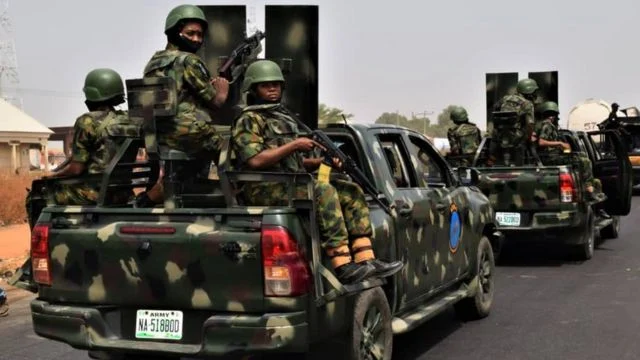
More successes are being recorded by Nigerian forces trying to rout out terrorist in parts of the country, with emerging reports indicating that the perpetrators are currently running scared from the hot onslaughts they are getting from the operatives.
Channels Television, is quoting military authorities at the Operation Hadin kai (OPHK) conducting military blitzkrieg against the terrorists in the North East as saying that the troops received six Islamic State of West African Province (ISWAP), one of the major terrorist groups operating in the area, who surrendered alongside their families, at the 192 Battalion (Main) Sector 1 of the body.
Quoting a statement on Wednesday by Mohammed Goni, spokesman of the military operation, with headquarters in Maiduguri, Borno State, the report, said that among the items recovered from the terrorists and their families included a cumulative sum of more than N1.5 million, two Tecno mobile phones, and other items.
Th statement, added that troops of 115 Task Force Battalion, while conducting ongoing search and rescue operations in Askira/Uba Local Government Area of Borno State, on July 7, rescued two additional abductees from a terrorist hideout, where they also recovered cash of N1.2 million suspected to be proceeds of criminal activities, food items, and other logistics believed to have supported terrorist operations.
The rescued victims have since been evacuated to a secure location where they are receiving appropriate medical care and psychosocial support, the report said, adding that during the same period, the troops noted that it contained a coordinated attack by ISWAP terrorists in Borno, and one of the soldiers was killed.
“Although the insurgents briefly exploited a section of the base’s defensive perimeter during the intense firefight, the troops rapidly regrouped, mounted a determined counter-offensive and decisively expelled the attackers, inflicting significant casualties and forcing the surviving terrorists to flee with varying degrees of gunshot wounds.
“Regrettably, one gallant soldier paid the supreme price, while two gun-trucks and some combat enablers sustained damage during the engagement. The situation at FOB Logomani remains firmly under the control of Operation HADIN KAI troops, with reinforcements deployed, exploitation operations ongoing and additional measures being implemented to further strengthen the defensive resilience of the location.”
Detailing how troops of 232 Battalion apprehended a notorious criminal in Gombi Local Government Area of Adamawa State, the statement, said: “Follow-up exploitation of the arrest led to the recovery of one AK-47 rifle, two magazines, and twenty-eight rounds of 7.62mm special ammunition.
“The suspect and recovered items are currently in military custody, while further investigations are underway to identify and apprehend other members of the criminal network.”
Similarly, the statement said troops of the 149 Battalion arrested two suspected terrorist logistics suppliers in the Mobbar Local Government Area of Borno State.
The recovered items include cash sums, a Volkswagen Golf vehicle, construction materials, household items, and other supplies suspected to have been destined for terrorist elements.
The suspects are currently undergoing interrogation, while the recovered items remain in military custody as investigations continue.
As part of ongoing offensive operations, troops of 24 Task Force Brigade, in conjunction with members of the Civilian Joint Task Force, conducted a clearance operation on known terrorist enclaves around Wulgo.
During the operation, the troops said they exploited the terrorists’ hasty withdrawal and recovered a sack containing assorted illicit drugs abandoned by the fleeing insurgents.
“The recovery further underscores the sustained pressure being mounted on terrorist elements, denying them freedom of movement and disrupting their operational capabilities.”
Relatedly, the troops apprehended a suspected BHT/ISWAP logistics supplier at the Molai checkpoint in possession of large quantities of medical supplies without due clearance. The suspect and items recovered are in custody for further interrogation.
Again, in Sector 2 Area of Responsibility, Troops of 233 Tank Battalion, in conjunction with local hunters, intercepted and arrested a suspected BHT/ISWAP terrorist logistics supplier from Ngirya village of Tarmuwa LGA with five motorcycle tires. The suspect and items are in military custody for investigation.
“These latest operational gains underscore the effectiveness of sustained offensive operations, actionable intelligence and the seamless collaboration among security agencies and auxiliary forces in dismantling terrorist logistics networks, disrupting criminal activities and protecting vulnerable communities across the North East”, the statement added.
Headquarters Operation HADIN KAI assured the public that ongoing search and rescue operations will continue with unwavering resolve until every abducted person is accounted for and safely reunited with their families.
“The Theatre Command also issues a stern warning to individuals involved in supplying food, fuel, construction materials, transportation or any other form of logistics to terrorist groups to immediately desist. Anyone found aiding, abetting or collaborating with terrorist elements, directly or indirectly, will be identified, apprehended and prosecuted in accordance with the law.”

Peter Obi, candidate of the Nigeria Democratic Congress (NDC), in the 2027 presidential election, is insistent President Bola Tinubu has so battered the Nigerian economy that Nigerians with thriving businesses are now selling kulikuli – a local groundnut cake snack.
Obi, former Governor of Anambra State, who contested the same election in 2023, where Tinubu was declared winner by the Independent National Electoral Commission (INEC), told Chude Jideonwo, a popular social media programme host, while appearing in his #WithChude podcast, that the way things were going today, the President had nothing more to offer Nigeria than more misery.
Citing a situation in which Tinubu had taken Nigeria from the 87 million poor people to the current figure of 140 million in his three years of governance, Obi, said the idea of Renewed Hope the President sold the country through his All Progressives Congress (APC), indicated a total collapse of the economy and a complete mess of the system that must result in him throwing in the towel and going home to take his rest.
Hear him: “Those who jumped into Tinubu’s experimental things that this man did this or did that and is going to create a future, have seen that the whole thing has become a mess. Renewed Hope has now become Renewed Hopelessness.
“When President Tinubu came into power, 87million Nigerians were living in poverty, today it is 140million. We were number five below where we are today in hunger-list. Today, it has increased. Everything has gotten worse. We are no longer talking about ghost workers now, you can see where we’ve gotten.
“So, everything – insecurity – everything is getting worse. Which hope are they going to renew again? You can’t renew failure. So, the only thing to do now is to plead with them – there is a way you fail in school and they’ll ask you to leave the school.
“Tinubu’s supporters have joined my supporters. They have, because they’ve seen it themselves. Nobody can tell you that things are moving well. What are you going to do now? Those who had businesses – people who had businesses before he came into power – they’re now the people who’re selling kulikuli.”



-
 News3 weeks ago
BREAKING: Troops rescue wife of kidnapped General! *Terrorists flee scene
-
 News2 weeks ago
BREAKING: Court sentences Nigerien, two others to death over terrorism
-
 News3 weeks ago
BREAKING: Count me out, Okonkwo tells Atiku *Amaechi VP’s choice an insult to Ndigbo
-
 News4 weeks ago
Dickson: Obi, a big asset to NDC, we’re working together … but!
-
 News4 weeks ago
Ovia, ex-Zenith Bank boss swings into luxury apartments *Flats hit $2.8million price tag
-
 News6 days ago
BREAKING: EX-SSG mowed down by gunmen! *He resisted being kidnapped – driver
-
 News2 weeks ago
Abductors of Oyo teachers panicking, freedom coming for victims soon!
-
 News3 weeks ago
Two hours after Igboho’s ‘red-eyes’ to ‘Fulani’ leaders, gunmen free kidnap victims!