
News
PDP to INEC: Stop applying double-standards in Abia, announce results now


Again, the Peoples Democratic Party (PDP), has taken on the Independent National Electoral Commission (INEC), over its suspension of the processes in the collation and announcement of the results of last Saturday’s governorship election in Abia State.
The party, for the umpteenth time, denied that there was any sort of violence, as claimed by the commission, for which it announced cessation of further action of the process indefinitely indicating that it would carry out a review.

Faulting the commission’s decision to suspend collation of the results, over its claim that its office in Obingwa Local Government Area (LGA), of the state was attacked, the party, maintained in a statement, signed by its state Chairman, Asiforo Okere, said the electoral umpire should announce the results collated in the council, which he claimed had already passed through unit, ward and Local government collation processes.
Stating that the party was not aware of the said attack he said: “There were also reports of INEC officials allegedly being held hostage in Ohafia LGA, Umuahia South and Umuahia North. Yet, INEC accepted results from those LGAs. It is on record that Obingwa is the only LGA where polling agents insisted on full compliance with the INEC’s stated guideline of announcement of results at the unit, and collation at wards, so that polling agents can have copies prior to submission to state collation office.
“We are not aware of any report by security agencies in the state, including the Nigerian Police Force or the Department of State Services (DSS), indicating violence in Obingwa LGA before, during and after the election of March 18th, 2023. Our party and indeed others, have seriously complained about results that were changed at INEC office Umuahia, contrary to INEC procedures, with particular reference to Unuahia North, Umuahia South, Osisioma, Aba North, Aba South and Arochukwu without any action taken by INEC.
“We suspect strongly that this so-called review is another grand design to subvert the 2022 electoral guidelines, as published by INEC in our state given that in the case of presidential elections, PDP and other parties made similar calls for review without acceptance by INEC that simply asked them to go to court.
“We, therefore, call on INEC to immediately accept and announce Obingwa LGA result as collated from units through the wards, using the same guideline and rules they applied during the 2023 presidential election.”







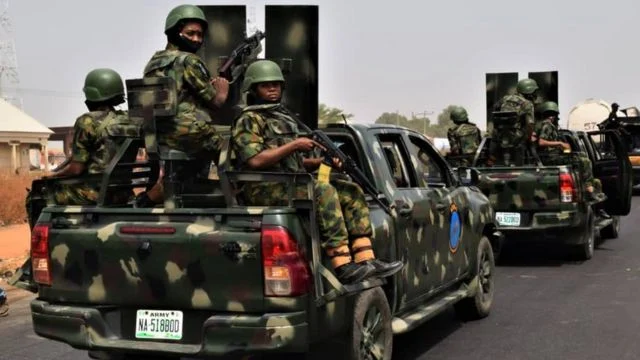
More successes are being recorded by Nigerian forces trying to rout out terrorist in parts of the country, with emerging reports indicating that the perpetrators are currently running scared from the hot onslaughts they are getting from the operatives.
Channels Television, is quoting military authorities at the Operation Hadin kai (OPHK) conducting military blitzkrieg against the terrorists in the North East as saying that the troops received six Islamic State of West African Province (ISWAP), one of the major terrorist groups operating in the area, who surrendered alongside their families, at the 192 Battalion (Main) Sector 1 of the body.
Quoting a statement on Wednesday by Mohammed Goni, spokesman of the military operation, with headquarters in Maiduguri, Borno State, the report, said that among the items recovered from the terrorists and their families included a cumulative sum of more than N1.5 million, two Tecno mobile phones, and other items.
Th statement, added that troops of 115 Task Force Battalion, while conducting ongoing search and rescue operations in Askira/Uba Local Government Area of Borno State, on July 7, rescued two additional abductees from a terrorist hideout, where they also recovered cash of N1.2 million suspected to be proceeds of criminal activities, food items, and other logistics believed to have supported terrorist operations.
The rescued victims have since been evacuated to a secure location where they are receiving appropriate medical care and psychosocial support, the report said, adding that during the same period, the troops noted that it contained a coordinated attack by ISWAP terrorists in Borno, and one of the soldiers was killed.
“Although the insurgents briefly exploited a section of the base’s defensive perimeter during the intense firefight, the troops rapidly regrouped, mounted a determined counter-offensive and decisively expelled the attackers, inflicting significant casualties and forcing the surviving terrorists to flee with varying degrees of gunshot wounds.
“Regrettably, one gallant soldier paid the supreme price, while two gun-trucks and some combat enablers sustained damage during the engagement. The situation at FOB Logomani remains firmly under the control of Operation HADIN KAI troops, with reinforcements deployed, exploitation operations ongoing and additional measures being implemented to further strengthen the defensive resilience of the location.”
Detailing how troops of 232 Battalion apprehended a notorious criminal in Gombi Local Government Area of Adamawa State, the statement, said: “Follow-up exploitation of the arrest led to the recovery of one AK-47 rifle, two magazines, and twenty-eight rounds of 7.62mm special ammunition.
“The suspect and recovered items are currently in military custody, while further investigations are underway to identify and apprehend other members of the criminal network.”
Similarly, the statement said troops of the 149 Battalion arrested two suspected terrorist logistics suppliers in the Mobbar Local Government Area of Borno State.
The recovered items include cash sums, a Volkswagen Golf vehicle, construction materials, household items, and other supplies suspected to have been destined for terrorist elements.
The suspects are currently undergoing interrogation, while the recovered items remain in military custody as investigations continue.
As part of ongoing offensive operations, troops of 24 Task Force Brigade, in conjunction with members of the Civilian Joint Task Force, conducted a clearance operation on known terrorist enclaves around Wulgo.
During the operation, the troops said they exploited the terrorists’ hasty withdrawal and recovered a sack containing assorted illicit drugs abandoned by the fleeing insurgents.
“The recovery further underscores the sustained pressure being mounted on terrorist elements, denying them freedom of movement and disrupting their operational capabilities.”
Relatedly, the troops apprehended a suspected BHT/ISWAP logistics supplier at the Molai checkpoint in possession of large quantities of medical supplies without due clearance. The suspect and items recovered are in custody for further interrogation.
Again, in Sector 2 Area of Responsibility, Troops of 233 Tank Battalion, in conjunction with local hunters, intercepted and arrested a suspected BHT/ISWAP terrorist logistics supplier from Ngirya village of Tarmuwa LGA with five motorcycle tires. The suspect and items are in military custody for investigation.
“These latest operational gains underscore the effectiveness of sustained offensive operations, actionable intelligence and the seamless collaboration among security agencies and auxiliary forces in dismantling terrorist logistics networks, disrupting criminal activities and protecting vulnerable communities across the North East”, the statement added.
Headquarters Operation HADIN KAI assured the public that ongoing search and rescue operations will continue with unwavering resolve until every abducted person is accounted for and safely reunited with their families.
“The Theatre Command also issues a stern warning to individuals involved in supplying food, fuel, construction materials, transportation or any other form of logistics to terrorist groups to immediately desist. Anyone found aiding, abetting or collaborating with terrorist elements, directly or indirectly, will be identified, apprehended and prosecuted in accordance with the law.”

Peter Obi, candidate of the Nigeria Democratic Congress (NDC), in the 2027 presidential election, is insistent President Bola Tinubu has so battered the Nigerian economy that Nigerians with thriving businesses are now selling kulikuli – a local groundnut cake snack.
Obi, former Governor of Anambra State, who contested the same election in 2023, where Tinubu was declared winner by the Independent National Electoral Commission (INEC), told Chude Jideonwo, a popular social media programme host, while appearing in his #WithChude podcast, that the way things were going today, the President had nothing more to offer Nigeria than more misery.
Citing a situation in which Tinubu had taken Nigeria from the 87 million poor people to the current figure of 140 million in his three years of governance, Obi, said the idea of Renewed Hope the President sold the country through his All Progressives Congress (APC), indicated a total collapse of the economy and a complete mess of the system that must result in him throwing in the towel and going home to take his rest.
Hear him: “Those who jumped into Tinubu’s experimental things that this man did this or did that and is going to create a future, have seen that the whole thing has become a mess. Renewed Hope has now become Renewed Hopelessness.
“When President Tinubu came into power, 87million Nigerians were living in poverty, today it is 140million. We were number five below where we are today in hunger-list. Today, it has increased. Everything has gotten worse. We are no longer talking about ghost workers now, you can see where we’ve gotten.
“So, everything – insecurity – everything is getting worse. Which hope are they going to renew again? You can’t renew failure. So, the only thing to do now is to plead with them – there is a way you fail in school and they’ll ask you to leave the school.
“Tinubu’s supporters have joined my supporters. They have, because they’ve seen it themselves. Nobody can tell you that things are moving well. What are you going to do now? Those who had businesses – people who had businesses before he came into power – they’re now the people who’re selling kulikuli.”

President Bola Tinubu has directed the Federal Competition and Consumer Protection Commission (FCCPC) to investigate major technology companies and Generative Artificial Intelligence (AI) platforms operating in Nigeria over allegations of anti-competitive practices, unlawful exploitation of news content and other potentially unfair market conduct.
The investigation follows a joint petition submitted to the Presidency by the Nigerian Press Organisation (NPO), comprising the Newspaper Proprietors’ Association of Nigeria (NPAN), the Nigeria Union of Journalists (NUJ), the Broadcasting Organisations of Nigeria (BON), and the Guild of Corporate Online Publishers (GOCOP).
Announcing the development in a statement on Monday, the FCCPC said the directive was conveyed by the Minister of Information and National Orientation, Mohammed Idris.
“The Federal Government’s position was communicated to the FCCPC in a letter signed by the Honourable Minister of Information and National Orientation, Alhaji Mohammed Idris. The investigation promises to open a new vista in Nigeria’s media history.
“In recent years, concerns have been raised by the Nigerian media industry over the growing impact of certain digital platforms on the sustainability of the country’s news ecosystem. Specifically, the NPO is increasingly uncomfortable with major technology companies including Meta, Alphabet, X (formerly Twitter), and certain generative AI platforms, citing practices capable of undermining fair competition, the commercial viability of Nigerian media organisations, and the legitimate rights of content creators and publishers,” the Commission stated.
Reacting to the directive, the Executive Vice Chairman and Chief Executive Officer of the FCCPC, Mr. Tunji Bello, said the Commission would conduct an independent, transparent and evidence-based investigation.
“We recognise the strategic importance of the media to Nigeria’s democracy and the equally significant role of technology in driving innovation and economic growth. Our responsibility is to objectively determine the facts and ensure that competition within the digital ecosystem remains fair, transparent, and consistent with Nigerian law,” Bello said.
He stressed that the investigation should not be interpreted as a presumption of wrongdoing against any organisation, but as an opportunity to establish the facts through due process.
“Every party will be accorded a fair opportunity to present relevant information before any conclusions are reached. In specific terms, FCCPC will determine whether the practices in question constitute a breach of the Federal Competition and Consumer Protection Act (FCCPA) 2018 or any other applicable law.
“In the past, FCCPC had investigated META and in 2025, won a landmark case against the tech giant for violations of FCCPA, including data breach, for which the tech giant was fined $220m. Meta has, however, appealed the fine,” the statement signed by Director of Corporate Affairs, Ondaje Ijagwu, added.
According to the FCCPC, the investigation will examine allegations of market dominance and potential anti-competitive conduct by the companies involved.
It will also probe claims of unauthorised extraction, scraping, ingestion or commercial use of copyrighted news articles, broadcast materials and other original journalistic content for developing and training Generative AI models.
Another key area of inquiry is the allegation that Nigerian news publishers have been denied meaningful opportunities to negotiate fair compensation or appropriate commercial arrangements for the use of their journalistic content.
The Commission noted that similar concerns had previously been raised in South Africa, where, following an investigation by the South African Competition Commission, it said Google agreed to compensate South African news media with R688 million ($40 million) annually for three to five years.



-
 News3 weeks ago
BREAKING: Troops rescue wife of kidnapped General! *Terrorists flee scene
-
 News3 weeks ago
BREAKING: Count me out, Okonkwo tells Atiku *Amaechi VP’s choice an insult to Ndigbo
-
 News2 weeks ago
BREAKING: Court sentences Nigerien, two others to death over terrorism
-
 News4 weeks ago
Dickson: Obi, a big asset to NDC, we’re working together … but!
-

 News4 weeks ago
Ovia, ex-Zenith Bank boss swings into luxury apartments *Flats hit $2.8million price tag
-
 News6 days ago
BREAKING: EX-SSG mowed down by gunmen! *He resisted being kidnapped – driver
-
 News2 weeks ago
Abductors of Oyo teachers panicking, freedom coming for victims soon!
-
 News3 weeks ago
Two hours after Igboho’s ‘red-eyes’ to ‘Fulani’ leaders, gunmen free kidnap victims!