
Columns
Garlands, as Umeoji, ‘Ijele’ of Nigerian banking steps out


By Sunny Igboanugo
Ijele is the greatest masquerade in Igboland in every material particular. It is the largest, most beautiful, most feared, most adorned and most adored. So, naturally, it is rarely seen. Its appearance, is only to mark the biggest events. At such events, it is the last to perform. Why? It does not share space with others. After its performance the event closes and everyone is supposed to disperse, for there is nothing more to expect and nothing more to see. What other spectacle or performance would near or equal that of the Ijele?

That is exactly the message Zenith Bank seems to be passing when it announced the appointment of Dame Adaora Umeoji, as the Managing Director, Chief Executive Officer (MD-CEO), on Tuesday, March 20, 2024. It was a momentous break from its 34-year-old history, as she became the first female to occupy that position.
Though the late Maria Sokenu, the first Managing Director of the now defunct Peoples Bank of Nigeria (PBN), is the first in history to emerge as a CEO of a bank in the country, that piece of history pales into insignificance in the context of the emerging scenario, as it was not only part of the military adventure in Nigeria, due to its peculiarity. The PBN, was a government institution established to provide special needs and cater for a segmented interest.
What comes more closely to women playing key leadership roles in the banking sector began when First Bank of Nigeria (FBN), in 2015, appointed Ibikunle Awosika as Chairman, the first in history. This was followed by Access Bank which went for Mosunmola Belo-Olusoga and Guarantee Trust Bank (GTB) going for Osaretin Demuren, all in the same year and in the same capacity.
In the last decades or so, the sector has however upped the ante with the emerging trends, particularly Deposit Monetary Banks (DMBs). The appointments of female MD-CEOs, a fad, consistent with global thinking of equality where women share the space in virtually all human activities, particularly those hitherto depicted as exclusive preserves of the men, has now taken a pride of place.
That was how Miriam Olusanya, a pharmacist, financial and accounting guru, became the first female Managing Director of Guarantee Trust Bank (GTBank), in July 2021, and still holds the position to this day, the same year Yemisi Edun emerged in the same position for the First City Monument Bank (FCMB), armed with a chemistry degree from the University of Ife and a master’s in international accounting and finance from the University of Liverpool, England.
Before them was Halima Buba, who was appointed MD-CEO of SunTrust Bank, in January 2021, spirted from her desk as Deputy General Manager of Ecobank. With Bachelor of Science in Business Management and MBA from the University of Maiduguri, and Ireti Samuel-Ogbu, who became the MD-CEO of Citibank Nigeria, with Bachelor of Arts in Accounting and Finance from Middlesex University and an MBA from the University of Bradford, in September 2020.
Three months after, in December 2020, Fidelity Bank (FB) announced Nneka Onyeali-Ikpe, a lawyer, as the MD-CEO, the first in the history of the bank, which was established in 1988, who fully assumed her role in January 2021., six years after Tomi Somefun became the MD-CEO of Unity Bank, in August 2015. A graduate from the prestigious Harvard Business School and Columbia University, Somefun, who took a degree in English Language from Obafemi Awolowo University (OAU), has been playing that role since then.
There is also Kafilat Araoye, who was appointed MD-CEO of Lotus Bank in May, 2021. The pioneer boss of the bank, one of the latest entrants in the Nigerian financial sector, with a degree in History and an M.Sc. in Industrial Relations and Personnel Management, is said to have come into the bank with over 30 years of banking experience.
Then there is Bukola Smith, who was a month earlier, appointed as the MD-CEO of FSDH Merchant Bank. Armed with B.Sc. in Economics and an MBA from Alliance Manchester Business School, in the UK, has remained in that position since April 2021.
The emerging trend also saw the appointment of Yetunde Bolanle Oni as the MD-CEO of Union Bank, a significant part of the history of one of Nigeria’s oldest banks. She is said to hold degrees in Economics and Business Administration, including executive training at Oxford University.
The entrance of Umeoji, seems to be the icing on the cake. It is akin to the popular saying of saving the best for last. That the entire Nigerian media space has been awash with the news of the appointment, since it was posted on the bank’s website on Tuesday morning, is indicative of the significance of the development.
The statement read: “Zenith Bank Plc has announced the appointment of Dame (Dr.) Adaora Umeoji, OON, as Group Managing Director/Chief Executive with effect from June 1, 2024, subject to approval by the Central Bank of Nigeria (CBN).
“She takes over from Dr. Ebenezer Onyeagwu, whose five-year term expires on May 31, 2024, after a very successful tenure. Dame (Dr.) Adaora Umeoji is the first female GMD/CEO since the inception of the bank, and her appointment is consistent with the bank’s executive transition tradition, succession plan, and strategy of grooming leaders from within.

“Prior to this appointment, Dr. Umeoji has been the Deputy Managing Director of the bank since October 28, 2016 and has close to thirty (30) years cognate banking experience of which twenty-six (26) years has been with Zenith Bank.
“She is an alumnus of the prestigious Harvard Business School where she attended the Advanced Management Program (AMP) and an alumnus of Columbia Business School with a Certificate in the Global Banking Program. She holds a Bachelor’s Degree in Sociology from the University of Jos, a Bachelor’s Degree in Accounting and a First-Class honors in Law from Baze University, Abuja.
“She holds a Master of Laws from the University of Salford, United Kingdom, a Master in Business Administration (MBA) from the University of Calabar, and also has a doctorate in business administration from Apollos University, USA. She holds a Certificate in Economics for Business from the prestigious MIT Sloan School of Management, USA, and has attended various management programmes in renowned Universities around the world including the strategic thinking and Management programme at Wharton Business School, USA. She also attended the executive program in Strategic Management, and has a Certificate in Leading Global Business all from Harvard Business School, USA.
“She is a fellow of notable professional bodies including the Chartered Banker Institute, UK, Chartered Institute of Bankers of Nigeria, Nigerian Institute of Management, Institute of Credit Administration, Institute of Certified Public Accountants of Nigeria, Institute of Chartered Mediators and Conciliators, and the Institute of Chartered Secretaries and Administrators of Nigeria among others.
“In 2022, the Federal Government of Nigeria honored Dr. Umeoji with Officer of the Order of the Niger, as a recognition of her contributions to nation building. She is a Peace Advocate of the United Nations (UN-POLAC).
“She has impacted many lives through her philanthropic and humanitarian activities through her NGOs; Pink Breathe Cancer Foundation and the Adorable Foundation that educates, caters for Cancer patients and indigent children education especially the Girl-Child. Her contribution to humanity was recognized by the Sun Newspaper which recently bestowed on her the Humanitarian Service Icon Award for 2023.
“As a result of her passion for promoting professionalism in the banking industry and improving the well-being of the less privileged, Dr. Adaora Umeoji, OON founded the Catholic Bankers Association of Nigeria (CBAN), a platform she uses to promote ethical banking and service to humanity. She is a Lady of the Order of Knights of St. John International (KSJI), and was awarded a Papal Knight of the Order of St. Sylvester by His Holiness Pope Francis.”
The import of this historic appointment is not farfetched. It is not only captured in the tall credentials Umeoji is putting on the table or in her exquisite personality, but also her track record both in the bank itself, and the Nigerian financial sector in general, where she has played a progressive role in the last three decades.
Just as Zenith Bank, which began operation in July, 1990, two months after it was registered in May of the same year, about 34 years ago, is considered arguably the biggest bank in Nigeria, Umeoji, who is a key contributor to that enviable status, is reputed to be the biggest female player in the Nigerian banking industry today.
For 26 years of the 30 she has spent in the industry, she is believed to have buried herself in work and more work, which has contributed quite significantly in the great fortunes of the bank and the outcome is the symbiotic relationship, where the bank is posting the hugest profits, while she is reputed to be the highest paid female banker in Nigeria today, both in dividends as a director and personal wages.
As the counting begins for the full takeover of affairs at 83 Ajose Adeogun Street, Victoria Island, home of the Zenith Heights, on June 1, it is salute to the amazon from Ezinifite, Aguata Local Government Area of Anambra State. It is salute to the Ijele of Nigerian banking. Nigeria, nay, the world stands still!








By MAX AMUCHIE | The Sunday Stew
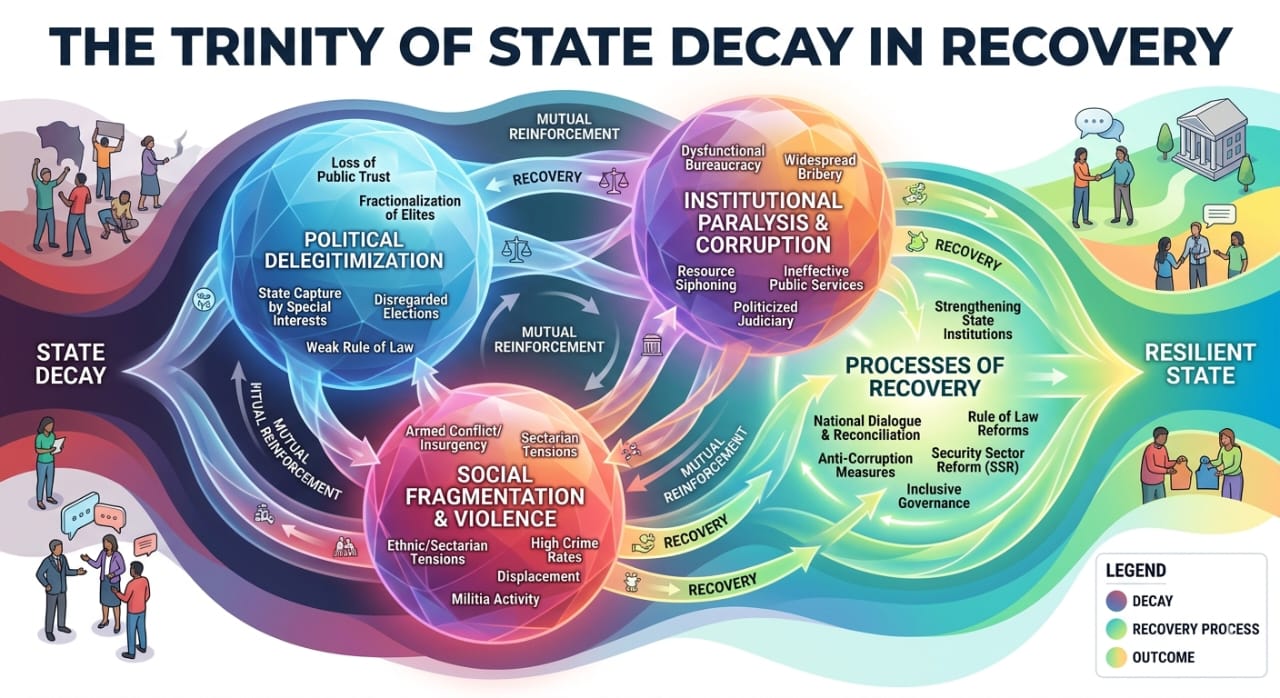
In the last two weeks, Parts One and Two diagnosed a structural mutation in the Nigerian state: a dual sovereignty system in which the Institutional Mirage performs authority while the Shadow Order exercises it, sustained by The Insecurity Triad as a mechanism of mutual reproduction.
What remains is the hardest question in political theory: not what is happening, but whether it can be reversed.
The answer is yes—but not through reform.
Systems that reproduce decay cannot be repaired within their own logic. They must be structurally interrupted.
The Trinity does not collapse. It is displaced.
From Ritual Governance to Peripheral Presence
The first reversal targets the geography of illusion.
The Institutional Mirage is concentrated in the symbolic centre—where governance is performed through summits, communiqués, and administrative ceremony—while dissolving at the periphery where authority is actually tested.
This produces a distorted state: visible in Abuja, absent in the borderlands.
To reverse the Trinity, the state must abandon Ritual Governance—the substitution of performance for presence—and return to the empirical occupation of territory.
This is not military occupation. It is administrative presence as sovereignty.
A state exists not when it speaks in the capital, but when:
a child attends a functioning school without paying a parallel tax of fear;
a farmer harvests without negotiating with non-state authority;
a dispute is resolved by a recognised court faster than an armed intermediary.
Governance is not restored by declaration. It is restored by continuity.
Where state presence becomes routine, the Shadow loses its monopoly on predictability.
From Pacification Bargaining to Sovereign Integrity
The second reversal confronts a deeper failure: negotiated sovereignty.
The state has increasingly drifted into a system of Negotiated Sovereignty sustained through what may be described as Pacification Bargaining—the purchase of temporary calm from rival authority structures through ransom logic, amnesty arrangements, protection payments, or informal accommodation.
This is not strategy. It is dependency disguised as pragmatism.
Every bargain strengthens The Insecurity Triad by:
monetising abduction economies;
legitimising territorial extraction;
reinforcing the Shadow’s role as a negotiating sovereign.
The result is a system of self-financing violence in which each concession funds the next cycle of coercion.
Pacification Bargaining does not resolve insecurity. It institutionalises it.
Each transaction deepens the perception that coercion is profitable, territorial pressure is negotiable, and sovereign authority is conditional rather than absolute.
Sovereign recovery therefore requires rupture in this economy.
The state must reassert a non-negotiable monopoly over:
taxation;
adjudication;
legitimate force.
Integrity, in this context, is not moral posture. It is institutional refusal to participate in markets of coercion.
A state that bargains over its coercive authority is not managing insecurity—it is outsourcing sovereignty.
The Critical Break: Dismantling the Insecurity Triad
To dismantle The Insecurity Triad is to break the loop between performed sovereignty and enforced sovereignty.
This cannot be achieved through security operations alone, though coercive force remains an essential and non-negotiable instrument of restoring empirical sovereignty. It requires something deeper: the reconstruction of institutional credibility in the very spaces the Institutional Mirage has abandoned.
It requires the state to stop performing governance and start delivering it. To stop negotiating the terms of its own authority and start enforcing them.
To recover the map—not in abstraction, but in detail: name by name, community by community—that armed actors are actively redrawing through coercion, taxation, and enforced renaming.
Dismantling the Triad is therefore not only a security task. It is a reversal of political geography itself.
The Cartographic Re-occupation of the Republic
The Shadow Order does not only occupy land. It reorganises meaning.
Through what may be understood as Constitutional Erasure, it renames territories, restructures local identity, and replaces the symbolic map through which authority is recognised.
Once this occurs, sovereignty is no longer contested physically alone—it is contested cognitively.
Cartographic Re-occupation is therefore not symbolic politics. It is structural restoration.
It requires three coordinated acts.
First, administrative re-anchoring: the immediate restoration of functioning institutions—schools, clinics, courts, and local administration—under continuous state presence.
Second, symbolic restoration: the reassertion of original geographic and civic identities through formal public renaming and constitutional recognition.
Third, cognitive consolidation: governance must cease to appear as intervention and become the default condition of life.
The state is not restored when it returns to territory. It is restored when territory returns to the state’s cognitive map.
Intellectual Closure: The State After Fragmentation
The deeper insight of this architecture is that sovereignty in Nigeria is no longer singular.
What has emerged is a fragmented order in which authority is distributed between competing logics of governance—one performed, one enforced, both partially functional, neither complete.
This is where African political thought clarifies the structure beneath the surface.
The logic of adaptive survival described by Jean-François Bayart explains why the state persists even as it weakens. Achille Mbembe explains how survival itself becomes managed rather than guaranteed.
Together, they clarify the central claim of the Trinity: this is not collapse. It is reorganisation.
Closing Movement
Nigeria does not face a singular collapse of authority. It faces a structured competition between performed sovereignty and functional sovereignty.
The Mirage still speaks in the language of the state.
The Shadow still governs in the language of necessity.
Between them, society survives by navigating two competing logics of order.
The question is no longer who governs.
It is whether governance itself can be reassembled into a single coherent structure.
The Reversal Condition: Sequential Sovereignty Restoration
The Trinity is reversible, but only in sequence.
Protection must be restored before compliance can shift.
Compliance must shift before territorial credibility stabilises.
Territorial credibility must stabilise before institutional authority can move from performance to function.
Any inversion of this order produces relapse.
The system is not resistant to reform. It is resistant to mis-sequencing.
The Trinity reverses only when sovereignty becomes empirically enforceable again through the sequential reconstitution of protection, compliance, and territorial credibility, thereby disrupting the mutual reproduction loop between the Institutional Mirage and the Shadow Order sustained by The Insecurity Triad.
Where this sequence fails, the loop does not weaken. It adapts.
The Social Contract Is Not Broken — It Is Being Replaced
There can be no social contract in a state where the sovereign performs authority it does not possess, negotiates with rivals it cannot defeat, and watches—from the polished corridors of Abuja—as the names of its own communities are erased from the landscape it claims to govern.
The conventional framing of Nigeria’s crisis describes a broken social contract: the state has failed its obligations, and the people are paying the price.
That framing is not wrong. But it is insufficient.
A broken contract implies a single agreement that has lapsed—and the possibility, in principle, of renegotiation and restoration.
What the Trinity of State Decay reveals is something more structural.
The social contract is not merely broken. It is being replaced.
In the spaces where the Institutional Mirage does not reach—in the northwest, northeast, and Middle Belt, in renamed villages and abandoned farmlands—a rival contract is being written.
On rival terms. Under rival authority. With rival consequences for those who refuse to sign.
The Shadow Order does not offer freedom. It offers a different captivity—one organised around extraction, fear, and the brutal clarity of power that does not pretend to be something it is not.
Within its own logic, it is internally consistent and therefore predictable.
And in conditions where protection becomes uncertain and uneven, predictability itself begins to function as a substitute for legitimacy—not as consent, but as adaptation under constraint.
The Institutional Mirage, by contrast, sustains a different form of instability: the unpredictability of protection, the inconsistency of enforcement, and the performance of authority that does not reliably translate into outcomes.
It is this asymmetry—between predictable coercion and unpredictable protection—that accelerates the silent transfer of compliance from formal sovereignty to rival order.
Conventional state failure frameworks assume a linear erosion of capacity.
The Trinity departs from this by demonstrating a dual-state condition in which formal and rival sovereignties coexist, interact, and reinforce decay.
Nigeria is not a failed state.
It is a state in the grip of a Trinity.
The Definition
Drawing on the full architecture of the foregoing analysis, I now offer a formulation of the Trinity of State Decay theory:
The Trinity of State Decay is the decoupling of a state into rival sovereignties: the Institutional Mirage, which performs authority without fully possessing it, and the Shadow Order—or competing Shadow Orders—which exercises de facto authority in spaces the Mirage has vacated, both sustained by The Insecurity Triad as the mechanism of their mutual reproduction.
The Trinity intensifies where the Mirage fragments into competing centres of performed authority, accelerating the transfer of empirical sovereignty to rival structures.
The Trinity reverses only when sovereignty becomes empirically enforceable again as a stable condition of governance.
This condition is not defined by the mere presence of the state, but by the alignment of three realities: protection must be enforceable, compliance must orient toward the state, and territorial authority must remain continuous.
Where these diverge, sovereignty fragments.
Where they converge, sovereignty reconstitutes.
Recovery is not repair or return. It is the production of a new equilibrium in which the Mirage collapses into function, the Shadow is displaced, and The Insecurity Triad loses its organising role.
This condition is produced through sequence: protection must precede compliance, compliance must precede territorial credibility, and territorial credibility must precede institutional function. Any inversion produces relapse; where the sequence holds, the loop breaks.
While derived from the Nigerian case, the Trinity offers a generalisable framework for analysing state decay in contexts where formal sovereignty persists alongside entrenched systems of rival governance.
Stay seasoned.
•Concluded
•Dr. Max Amuchie is the CEO of Sundiata Post and architect of The Insecurity Triad Analytical Framework, and the Trinity of State Decay theory. He writes The Sunday Stew, a weekly syndicated column on faith, character, and the forces that shape society, with a focus on Nigeria and Africa in a global context.
X — @MaxAmuchie | Email: max.a@sundiatapost.com | Tel: +234(0)8053069436

Godwin Obaseki, former Governor of Edo State was the first to raise the alarm. He rang the bell in the most dramatic manner in that video that went viral on the heels of the 2023 presidential election. It was about the impending tsunami confronting the Nigerian political space – the Peter Obi phenomenon!
The forum the ex-governor spoke was supposed to be a family meeting – a kitchen cabinet affair, where he interacted with the inner caucus of his Peoples Democratic Party (PDP) in his state. But he ended up not only alerting the nation, but passing the message about the new reality in the must pungent, direct and unobtrusive manner – something new has come – Peter Obi.
Whether it was meant to be a warning, an admonition or simply a subject of amusement – as the governor seemed tickled while delivering it – Obaseki’s words in that outing hit the right spot in national consciousness across board. The young, the old, the healthy and the infirm, all heard it clearly. Now whatever they did individually remains a different kettle of fish.
In that encounter, Obaseki had told his audience how, despite being a governor and the engine room of the PDP in the state, his own family had turned against him with all children and other young members enlisting into the Obidient Movement and how that was true of every other family in Nigeria.
Now, was Obaseki’s depiction false? Didn’t it come to pass on February 25, 2023, when Nigerians went to the polls? If Yakubu Mahmoud and his INEC had not contrived that technical glitches arrangement to abjure the mandate of the people in line with the grab, snatch and run philosophy of the present beneficiary of that obvious heist, Obi certainly would have been Nigerian President.
Had that happened, Obi’s would have been not only a clean and wholesome mandate, untainted by the paintbrush of rigging or other electoral infamies bespattering previous efforts, it would have been a national mandate – delivered by the people of Nigeria – likened only to Moshood Abiola’s June 12, 1993 presidential election victory.
In fact, so pan-Nigerian was the Peter Obi effort that Nigerians of all ethnic and religious persuasions came together and on their own, in clusters, within housing estates, in villages and communities, contributed money to fund their individual campaigns to promote the project of getting him to the Aso Rock Villa for the nation’s number one job.
Nigerians abroad – Yoruba – Hausa – Ibibio – Jukun – Igala – Tiv – Kalabari – Igbo – Edo – made special arrangements to return home with the sole purpose of not only promoting the agenda, but actually making the idea a reality by casting their votes for him.
Obi was the only one out of the lot that contested the election in 2023 that secured the endorsement of virtually all the ethic organisations across Nigeria.
Afenifere – the pan-Yoruba socio-cultural organisation – the Middle-Belt Forum (MBF) from the North Central – Pan-Niger Delta Forum PANDEF – for the South South region and Ohanaeze – their South East counterpart – all came together to declare their support for his presidential ambition.
Now this is the same person that some naysayers are labouring too hard, day and night to closet inside the straightjacket of ethnicity and religion. From Reno Omokri to Daniel Bwala to Bayo Onanuga and others controlling working from the Presidency to their counterparts at the Blantyre Plaza APC secretariat in Abuja – they continue to trumpet the spurious, bogus and fake narrative of Obi’s ambition being steeped in some sort of Igbo agenda.
Ironically, out of the entire lot, the selfsame Obi, is the only one who came out to boldly declare that nobody should cast a vote for him because he is Igbo, rather, they should do so because they are convinced about his ability to deliver on a new Nigeria of their dreams. No other had the courage to make such a bold declaration.
Surprisingly, even Wole Soyinka, one of Nigeria’s most iconic figures – a central voice in national and international affairs – Nigeria’s man of the century – the Kongi himself – who had hitherto shot himself to a position of a super being – of immortality – beyond reproach – without any credible reason even by his own conjecture – called the Obi ambition – an IPOB agenda.
That underscores the seriousness of the entire scenario. But interestingly, no matter how they try to trumpet it, their efforts have continued to mimic a snake striking at the shell of the tortoise with the aim of infusing its killer poison.
Their frustration not only hinges on this apparent failure but their current desperation too! The Obi brand has continued to soar beyond comprehension. So, when you hear the echoes of ethnic baiting, religious smears or other primordial sentiments, just know they are trying to increase the tempo of the din! Such a frustrating task!
My name is Sunny Igboanugo, I’m The Tiny Voice!

“This is Lagos!”
How many of you have seen this sign that introduces you into Lagos? Whoever coined that expression is highly ingenious because the essence of those three words ensconces a lot within its bowels.
It could mean that Lagos is a land of opportunities, where a man who started off as a truck loader at Iddo Motor Park, could discover opportunities to become the next billionaire around. There is a surfeit of examples.
It could also be introducing you to Nigeria’s Centre of Excellence and the pride of the nation where high-stake activities from the signing of multi-billion-dollar transactions conducted in the penthouses of Ikoyi and Victoria Island and the beautiful ambiances of the Victoria Garden City (VGC), Lekki, Banana Island and other high-brow places mimic other big cities across the globe.
Yet, it could also be a warning to the new entrants to the fact that Lagos is not for the faint-hearted, the indolent and imprudent. In other words, Lagos is not a place to loose-guard, as it is said in the local parlance, but a city where street-wisdom is as important as existence itself being the major factor and fine line between success and failure.
For me, the third example is the most relevant and essential here, because it is quite germane to the matter at hand – the current political scenario in Nigeria – regarding Peter Obi and Atiku Abubakar. Obi’s defection from the African Democratic Congress (ADC) to the Nigerian Democratic Congress (NDC), is a demonstrable example of street-wisdom at play and an emphatic message of its potency!
Since Sunday when it came to the fore that Obi had dumped the ADC and moved to the new party alongside Rabiu Kwankwaso, his new-found ally, the Atiku camp has remained on the offensive, raising the battle-cry – BETRAYAL!
They say Obi abandoning the ADC ship and porting to the NDC represents a betrayal of not only Atiku and the coalition arrangement but the battle to end the calamitous governance President Bola Tinubu – its main goal. How laughable!
Dino Melaye – Obi detests the heat of a kitchen and prefers an air-conditioned one. If he couldn’t face party primaries, having not participated in any right from his APGA days, how would he face the presidential election?
Dele Momodu – I would have wished that Obi would have waited to test his popularity in ADC…Obi did not leave because of Atiku, he left because he knew he lacked the capacity to take on Atiku.”
Even Babachir Lawal – a hitherto Obi supporter, fired his own arrow – Obi is shifty! A politician who fears elections, have no business being one. He doesn’t want to participate in primaries. He prefers a consensus candidate and that consensus must be him!
All the well-choreographed mantra, you hear from these guys, bespeak more of lamentations at missed plot to capture Obi into Atiku’s inextricable ADC web than reality of Obi lacking the sturdiness, durability and gusto to face tough battles.
In fact, Obi has nothing to prove in terms of his ability to fight. He proved this in the 2023. So by this outing alone the pale, trembling coward image they’re trying to sell to the world through this desperate narrative, falls flat on its face. But there’s more!
Talking about battles and the heat of the kitchen, this was the same Obi that stood through the courts to snatch his stolen mandate after it was snatched by the hounds in the 2003 governorship elections in his home Anambra.
This was the same Obi that sacked Chris Ngige in 2006 to retrieve his mandate and Andy Uba in 2027 in the tenure interpretation case – two seating governors in a space of one year. Who else has achieved this? This was the same Obi, who fought and returned to office after he was impeached from office as a governor.
Isn’t it laughable that it is the same man they claim is afraid to fight? What Obi is afraid of is his name being soiled in any way. It was for the reason of maintaining a clean name that he would rather yield to the pain of impeachment than offer bribes to the members of then Anambra State House of Assembly to spare his job.
Obi simply showed the hounds in ADC the import of that inscription – This is Lagos. It showed how much he understood its implication in terms of street-wisdom. How could Atiku and his men believe they could outwit Obi in that manner?
It’s like urging Ishi-Udene, my village dibia to sit at a beautiful table underneath which you buried a drum of boiling oil. He would have seen the danger in his divinity pot long before you concluded the plot.
Obi, fighting for the ADC ticket is akin to that dapper-looking bank manager, decked in designer suits, alighting from his sleek automobile and engaging those red-eyed, broken-tooted, scared faces at Mushin, Agege or Ajegunle bus stops, just to prove his toughness. What’s the use?
Now, picture this! You ran into a crowd and out of curiosity, went to observe, only to discover your spouse, clothes off, drenched in mud, broken bottles in hand, in roforofo fight at Oshodi bus stop!
Would you excuse your spouse even if provoked into that fight or celebrate the outcome, assuming the opponent was beaten to a pulp and taught a lesson?
For Peter Obi to engage in the ADC battle, it would not only take energy and sweat, it would certainly take away INTEGRITY and CREDIBILITY – the two elements that give essence to the Obi brand.
That would mean committing suicide to polish an ego. That is foolhardiness! The last time I checked, recklessness is the opposite of wisdom. And Peter Gregory Obi is not foolish. He’s a wise man!
My name is Sunny Igboanugo, I’m The Tiny Voice!



-
 Columns4 weeks ago
Abike Dabiri: Did Obi raise a monster or you’re drunk on Tinubu’s poisoned chalice?
-
 News3 weeks ago
Jandor: Tinubu didn’t endorses Hamzat *I’ve briefed President on my ambition
-
 Columns4 weeks ago
Be the hero that saved Nigeria! Open letter to Alhaji Atiku Abubakar
-

 News2 weeks ago
BREAKING: Makinde, Turaki, lose! *S’Court affirms Wike’s PDP leadership
-

 Columns4 weeks ago
Now VDM has become Sowore’s nemesis, does Peter Obi need anther advocate?
-

 News4 weeks ago
Relief for ADC? Supreme Court decides fate of Mark after INEC’s hammer
-
 Features2 weeks ago
Jim Nwobodo: The Sun shines, thrills, at ‘The Vanguard Awards’
-
 News4 weeks ago
I’m shocked at Tinubu’s volte-face – Obi *Insists President culpable in ADC crisis