

News
BREAKING: At last, ECOWAS buckles, lifts sanction, begs Niger, Mali, B’Faso to return


After about seven months of sanctions, the Economic Community of West African States (ECOWAS), on Saturday, ended raft of sanctions imposed on Niger, Mali and Guinea, in response to unconstitutional change of government in the countries, apparently reacting to the backlash the measure has generated.
In what appears an obvious victory for the three countries, which announced their withdrawal from the sub-regional body in January, the leadership of the ECOWAS, also appealed to the affected countries to reconsider their position to pull out, urging them to also adhere to the treaty in the act establishing the organization.

Omar Alieu Touray, President of the ECOWAS Commission, who announced the latest development in a communique issued at the end of an Extraordinary Summit of the Authority of Heads of State and Government of the ECOWAS, chaired by President Bola Tinubu, clarified that political and targeted sanctions are still in force against the countries.
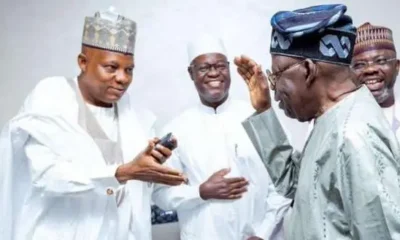
The new turn of events is coming about 72 hours after former Head of State, Yakubu Gowon, the arrowhead in the establishment of body in 1975, visited Tinubu, where he pointedly asked for the lifting of the sanctions and for the diplomatic resolution of the crisis besetting the group.
Niger Republic, had responded to the long list of sanctions on the country after military junta in Niger in July 2023, following the hijack of government of the country and incarceration of the democratically elected President, Mohammed Bazoum, had toughened its position, supported by Mali and Burkina Faso, which had earlier been hit by other ranges of sanctions
The three countries upped the ante on January 28, 2024, when they announced the withdrawal of their membership of the ECOWAS organisation, alleging that the regional body had come under foreign influence, had turned it into a threat to member-states, five months after announcing the formation of the Alliance of Sahel States, a counter-regional organisation, said to be a mutual defense pact among the countries, on 16th of September, 2023.
Touray, who said the decision to lift the sanctions was based on humanitarian considerations especially because of the month of Lent and the approaching month of Ramadan, added: “The Authority calls for the immediate release of his excellency Mohammed Bazoom, former President of the Republic of Niger.
“The Authority also calls on the transition authorities in Niger to provide an acceptable transition timetable to the constitutional order. The Authority resolved to lift with immediate effect the following measures imposed on the Republic of Niger: “Closure of land and air borders between ECOWAS countries and Niger to be lifted, no Fly Zone of all commercial flights to and from Niger is to be lifted and suspension of all commercial and financial transactions between ECOWAS member states and Niger is to be lifted.
“The Authority, also resolved that the “freezing of all service transactions including utility services is to be lifted. Freezing of assets of the Republic of Niger in ECOWAS Central banks is to be lifted. Freezing of assets of Niger State and the state enterprises and parastatals in commercial banks is to be lifted.
“Suspension of Niger from all financial assistance and transactions with all financial institutions particularly ECOWAS Bank for Investment and Development (EBID) and BIRD is to be lifted. Travel ban on the government officials and their family members is also to be lifted.
“This decision is based on humanitarian considerations especially as we are in the month of lent and as we prepare for the holy month of Ramadan. The Authority has also resolved to lift the sanctions regarding the recruitment of Malian citizens in statutory and professional positions within ECOWAS.
“The Authority has also resolve to lift financial and economic sanctions on the Republic of Guinea. The Authority has also instructed the President of the Commission to invite Burkina Faso, Niger, Mali, and Guinea, to attend the technical and consultative meetings of ECOWAS as well as all security related meetings.
“The authority calls on ECOWAS institutions, member states of the United Nations Mine Action Office (UNMAO) and other regional institutions to implement this decision. The Authority noted the notifications by the three member states within the context of Article 91 of the 1993 ECOWAS revised treaty and urged the countries to reconsider the decision in view of the benefits that the ECOWAS member states and their citizens enjoy in the community.
“The Authority expresses its concern over the socio economic, political, security and humanitarian impact of the decision, particularly on the citizens of the three countries and on the regional integration process. The Authority further urges the three member states to resort to dialogue, negotiations and mediation to address their concerns.
“The Authority urges the three member states to adhere to the provisions of the 1993 revised treaty relating to withdrawal particularly article 91. The Authority encourages ECOWAS to sustain its rapprochement and overtures towards the three member states and continue to remain seized of the situation.
“The Authority or just ECOWAS to engage African Union, UNMAO, UN and other international organizations in its dialogue with the three countries. The Authority encourages a broader outreach, which should include traditional, religious leaders, eminent personalities, civil society and women leaders for the unity and security of the regional.
“The Authority reiterates the urgent need for ECOWAS to expedite the operationalisation of the standby force in its kinetic mode to fight against terrorism in the region including the elements of the Multinational Joint Task Force, and the Accra initiative.
“In this regard, the Authority instructs its commission as soon as possible to convene the meeting of ministers of finance and defense to propose modalities for financing and equipping counterterrorism force.
“The Authority further instructs the commission to develop an effective communication strategy in engaging member states and the community citizens in view of the ongoing disinformation and misinformation that put ECOWAS in a bad light.
“The Authority expresses its gratitude to His Excellency General Yakubu Gowon, for his interest in the welfare of the community and his valuable suggestions. The Authority takes note of the end of President Mackey Sell’s term of office on April 2, 2024. And commends him for the tremendous development he has realized as President of Senegal, and for his invaluable leadership in Africa and the world.
“The Authority calls on Senegalese stakeholders to give priority to dialogue with a view to preserving the democratic gains of Senagal, through a free, inclusive and transparent elections. The leaders underscored their commitment to Africans’ sovereignty, independence and unity. In this regard, the Authority appeals to all partners to respect African countries sovereignty and independence and avoid interferences that risk destabilizing member states and adversely affect regional unity.”
Touray said the Authority commended President Bola Tinubu, and chair of the ECOWAS Authority for convening the extra ordinary summit and for the manner in which he has been conducting the affairs of the community, as chair of authority.”
When asked if the lifting of these sanctions will not suggest ECOWAS as weak and incentivies others with similar tendencies, he said “now, let me make it very clear what I have listed is not exhaustive. Political sanctions have not been lifted. Border closures have been lifted. And commercial sanctions have been lifted. But there are targeted sanctions as well as political sanctions. That remain in force.
“I think our sanctions regime should be assessed correctly. The list I have given relates mainly to Niger because all the other countries still have political sanctions on them. So the border closures, the commercial sanctions and all that are on leisure and that is what the leaders have decided to lift. But individual sanctions as well as political sanctions remain in place in Niger.
“Now for other countries, political sanctions remain. That is the limited ability to attend ECOWAS Summit as well as ministerial sessions. The Authority also lifted sanctions on Guinea, inviting all four countries to attend technical consultative meetings of ECOWAS going forward.
Highlighting the various implications of the planned withdrawal by the three countries from the community, he noted that besides losing economic, security and development benefits that accrue to members states, there would also be personal loses to nationals of the countries across the region.
For instance, he stressed that pulling out of the community might result in the halt or the suspension of all ECOWAS projects and programmes worth more than $500 million, various regional projects being executed by the region’s financial institutions, worth about $321.6 million may be halted, while they may be exited from the regional electricity market, known as the West African Power Pool project.
He also said besides the countries losing national benefits within the region, citizens of the countries, about 130 of them, who are employees of the ECOWAS, will lose their job to the exit of their countries from the community, just as seven regional entities with offices in the countries would also need to be shut down.



News
The Sundiata Post Model (2): Historical and intellectual foundations of a knowledge-producing newsroom

Every institutional framework has a history, even when it introduces something new. Ideas rarely emerge in complete isolation; they arise from deep, structural conversations that began long before us, evolving across generations as societies confront new realities, systemic shocks, and unanswered questions.
The Sundiata Post Model is no exception. Although formally introduced in the previous essay as an institutional framework for media-based knowledge production, its intellectual roots extend much further back. They lie within a long tradition of journalism’s engagement with ideas and society, while simultaneously responding to a distinctly twenty-first-century challenge: the transformation of the newsroom in the age of artificial intelligence, digital knowledge architectures, and global scholarly networks.
The question at the heart of this essay is therefore not whether journalism has ever produced ideas—history provides an unequivocal answer to that. The more critical question is whether the modern newsroom can become an institution deliberately organised to generate original analytical constructs that contribute simultaneously to journalism, deep scholarship, and public policy. That is a different, more demanding question altogether.
Nigeria’s Tradition of the Newspaper as an Intellectual Institution
Long before the emergence of today’s hyper-accelerated digital media, some of Nigeria’s most influential newspapers were already serving purposes far beyond the passive reporting of daily events.
The press architectures established by pioneers like Nnamdi Azikiwe and Obafemi Awolowo—both of whom I previously discussed, alongside Chinweizu, as members of Nigeria’s rare tradition of framework builders—became foundational vehicles through which sophisticated ideas about nationalism, constitutional development, socio-economic planning, democracy, and self-government entered the public consciousness. Their publications did not merely describe political transformation; they actively generated the conceptual architecture that shaped it.
Crucially, they achieved this by building powerful media infrastructures designed to carry these ideas at scale. Azikiwe did not just publish in Lagos; he deployed a sweeping, cross-regional syndicate anchored by the West African Pilot alongside a network of provincial pillars including the Eastern Guardian in Port Harcourt, the Nigerian Spokesman in Onitsha, and the Southern Nigeria Defender in Warri. Similarly, Awolowo founded the Nigerian Tribune in 1949 as a highly structured institutional vehicle to systematically articulate socio-political theory and regional constitutional destiny.
In his seminal work, Renascent Africa (1937), Azikiwe laid out a broad intellectual and ideological vision that extended far beyond the immediate horizon of standard journalism, charting a course for mental emancipation and African self-determination. A decade later, Awolowo’s Path to Nigerian Freedom (1947) demonstrated how a publisher and institutional thinker could systematically articulate a rigorous, structured constitutional vision for a developing nation.
This historical experience reminds us that journalism in Nigeria has never been confined solely to stenography. At critical turning points in the nation’s history, newspapers operated as the primary intellectual laboratories through which society debated its structural future.
This tradition of intellectual leadership through journalism is not merely of historical interest. In The Sunday Stew essay mentioned earlier, ‘The Insecurity Triad: Azikiwe, Awolowo, and Chinweizu — Nigeria’s Elite Class of Framework Builders’, I argued that Nigeria has, on rare occasions, produced public intellectuals who moved beyond commentary to construct enduring analytical frameworks. Azikiwe and Awolowo exemplified that earlier tradition, while Chinweizu demonstrated that independent conceptual innovation could continue outside formal state institutions and conventional academic structures. The present essay extends that argument by asking a different question: can the contemporary newsroom itself become an institution deliberately organised for systematic framework building and knowledge production?
Yet, an important distinction must be recognised between that era and our contemporary challenge:
The Nationalist Press primarily advanced political ideas, anti-colonial mobilisation, and national aspirations.
The Sundiata Post Model represents a shift from ideological mobilisation to systematic institutional knowledge production. It asks whether an independent newsroom can generate original analytical constructs capable of standing up to the rigorous validation of the global academic ecosystem while serving active policy discourse.
The distinction is subtle, but fundamental. It marks the evolution from political journalism to scholar-journalism.
Journalism and the Life of Ideas
The structural relationship between journalism and ideas extends well beyond regional borders. To understand the global intellectual foundations of this model, we must reconcile two complementary traditions of public thought—both of which proved invaluable in shaping the conceptual foundations of my Trinity of State Decay (TSD) theory.
In framing the mind dimension of the Money–Land–Mind dynamic of the TSD, I found the works of Walter Lippmann and Hannah Arendt particularly illuminating, insightful, and enriching. Few journalists have shaped modern thinking about public communication as profoundly as Lippmann. Throughout his six-decade career in American journalism, he demonstrated that journalism could become far more than a chronicle of events; it could serve as an instrument for decoding how societies acquire knowledge, construct public opinion, and navigate increasingly complex realities.
In his foundational classic, Public Opinion (1922), Lippmann demonstrated that journalism could contribute not merely rapid information, but macro-level interpretation, permanently altering how we view the relationship between media, knowledge, and public policy. It is this Lippmannesque understanding on how information is filtered, misperceived, and understood that informs the epistemic foundations of the TSD.
From a different, deeply philosophical tradition, Hannah Arendt, a political theorist and independent scholar whose ideas reached wide audiences through public intellectual magazines and cultural journals, devoted her life’s work to understanding the structural anatomy of politics, authority, institutional decay, and the conditions that make collective civic life possible.
In The Human Condition (1958), Arendt examined human action, public space, and the enduring value of disciplined conceptual inquiry in explaining political reality far beyond the fleeting nature of immediate headlines. Her profound insights into the erosion of institutional authority and the fragility of the public realm provide an important philosophical foundation for understanding the Trinity of State Decay’s vectors of systemic fragility.
Although operating within vastly different institutional environments, Lippmann and Arendt represented complementary pillars of intellectual rigor:
One demonstrated journalism’s unmatched capacity to shape and democratise public understanding.
The other demonstrated the enduring value of rigorous, uncompromised conceptual thinking regarding public life and the human world.
Together, they illuminate an important institutional possibility. If journalism can generate immediate public understanding, and disciplined inquiry can generate enduring concepts—as demonstrated by their influence on the conceptual foundations of the Trinity of State Decay—might there exist an institutional framework capable of integrating both traditions within a single, independent newsroom?
That synthesis is the exact intellectual domain of the Sundiata Post Model.
An Abuja Newsroom and a Contemporary Question
The Sundiata Post Model emerged not from an insular academic department, a government research institute, or a foreign-funded policy think tank, but from an independent newsroom in Abuja. That geographical and operational fact is highly significant.
The framework did not begin as an abstract theory searching for practical application. It emerged from journalism itself—from the lived, daily experience of reporting, investigating, analysing, and reflecting on the severe structural forces shaping Nigeria and the wider Global South.
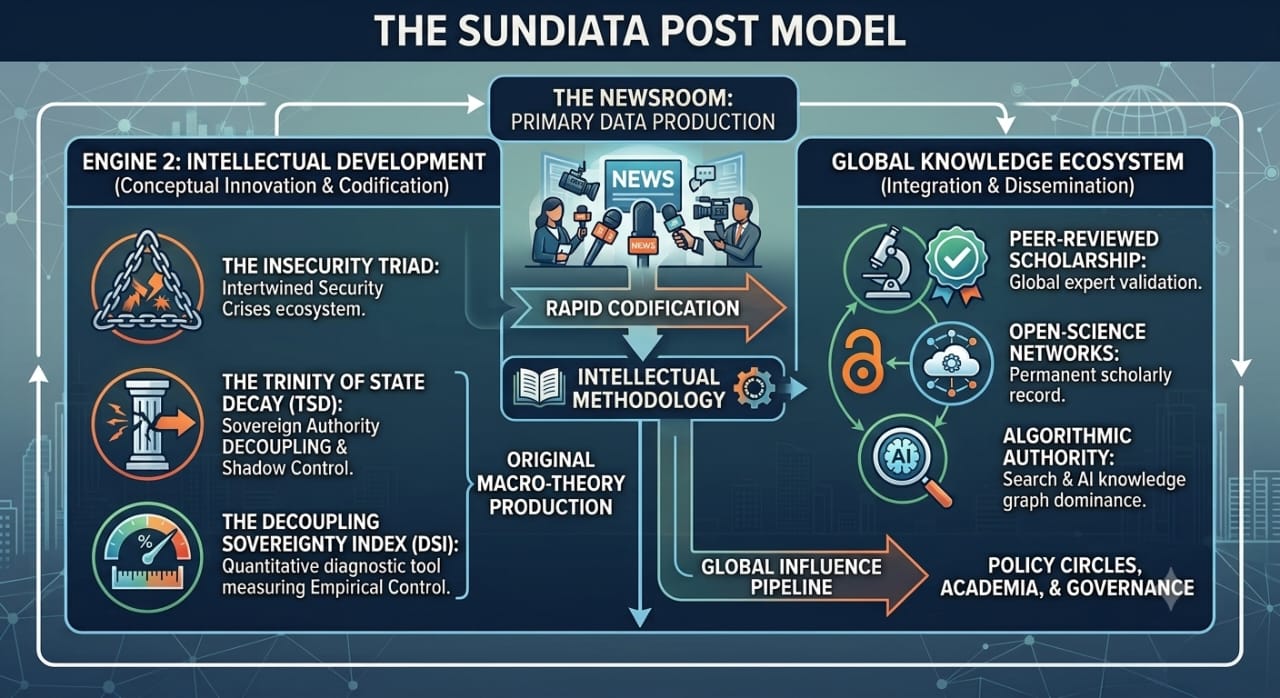
Over time, The Sunday Stew gradually evolved beyond a weekly opinion column into a platform for systematic, empirical inquiry. Through that deliberate evolution emerged a succession of original analytical frameworks:
•The Insecurity Triad: A conceptual framework explaining how kidnapping (Money), banditry (Land), and terrorism (Mind) function as mutually reinforcing dimensions of contemporary insecurity, generating parallel systems of violence, governance, and authority;
•The Trinity of State Decay (TSD): A macro-theoretical formulation explaining how the interaction between the Institutional Mirage, the Shadow Order, and the Money–Land–Mind dynamic drives the decoupling of formal sovereignty from effective state authority, and
•The Decoupling Sovereignty Index (DSI): An indigenous, multidimensional measurement framework designed to quantify the extent to which effective sovereignty has decoupled from formal state authority across subnational territories.
What gradually became apparent was that these were not isolated intellectual exercises. They were the deliberate products of an emerging institutional philosophy developed through the Sundiata Post Intelligence Unit (SPIU).
More importantly, these constructs did not emerge as a single research project conceived in advance. They appeared sequentially, each responding to new empirical observations while simultaneously expanding the analytical capacity of the newsroom itself. The Insecurity Triad provided a structured lens for understanding the interconnected dimensions of insecurity. The TSD extended that inquiry into a broader theory of institutional authority and governance. The DSI subsequently translated those theoretical insights into an operational framework capable of empirical assessment. Viewed together, this progression revealed something larger than the individual frameworks themselves. It demonstrated that the newsroom had begun to develop an internal capacity for cumulative knowledge production, with each construct building upon and extending the intellectual foundations laid by its predecessor.
The fundamental question therefore shifted from “What new framework has been developed?” to “What kind of newsroom structure makes the systematic development of such frameworks possible?” The answer is the Sundiata Post Model.
A New Institutional Proposition
The Sundiata Post Model does not argue that journalism should become academia, nor does it suggest that scholarly research should migrate from the university to the newsroom. Instead, it advances a new institutional proposition:
The Core Proposition: An independent media institution can systematically integrate high-velocity journalism, original qualitative research, conceptual innovation, and global scholarly dissemination within a single institutional framework, contributing simultaneously to
informed public discourse and the international knowledge ecosystem. The Sundiata Post experience demonstrates the practical viability of this proposition.
This proposition reflects neither a rejection of journalism’s traditional role nor an attempt to merely imitate academic institutions. Rather, it represents a strategic institutional adaptation to the changing architecture of knowledge itself.
In an era when global digital repositories, artificial intelligence discovery layers, academic networks, and news organisations increasingly intersect, the traditional boundaries separating journalism from formal knowledge production have become entirely permeable. The Sundiata Post Model seeks to explore what becomes possible when those boundaries are approached not as rigid barriers, but as unprecedented opportunities for intellectual sovereignty.
The historical journey from Azikiwe and Awolowo to Lippmann and Arendt reveals a long-standing, symbiotic relationship between journalism and ideas. The Sundiata Post Model does not seek to replicate any of those legacy traditions perfectly. It seeks to answer a contemporary institutional question:
What becomes possible when an independent newsroom deliberately organises itself as a primary knowledge-producing institution?
The answer begins with philosophy. The next essay examines structure.
Trust is sacred. Stay seasoned
•Dr. Max Amuchie is a Scholar-Journalist, Media CEO, Lead Researcher at the Sundiata Post Intelligence Unit (SPIU), and an Expert Member and Peer Reviewer at ScienceOpen. He is the architect of The Insecurity Triad framework for African security analysis as well as the Trinity of State Decay theory, and the Decoupling Sovereignty Index (DSI)—original frameworks for understanding, categorising, and measuring conflict, state decay, and sovereignty in the Global South. He writes ‘The Sunday Stew’, a weekly syndicated column on faith, character, and the structural forces that shape society, with a focus on Nigeria, Africa, and the Global South in a changing world.
X (formerly Twitter): @MaxAmuchie | Email: max.a@sundiatapost.com | Tel: +234(0)8053069436

In a quick riposte on Saturday, Dave Umahi, Minister of Works, has cautioned Nigerians to be circumspect in the manner they react to the story of the death of a female student in his home in Ebonyi State, warning against the temptation of jumping to conclusion.
Conveying his position on the highly-volatile matter through Francis Nwaze, his spokesman, Umahi, former Governor of Ebonyi State and a key figure in the government of President Bola Tinubu, said caution was needed to enable the police conduct unfettered investigation into the matter.
It was his response to breaking of how one Mary Habila, a female physiotherapist reportedly died in his palatial home at Uburu, Ohaozara Local Government Area of Ebonyi State, on June 27, hours after arriving the day before.
Nwaze, a Senior Special Assistant on Media and Publicity, specifically cautioned against speculations by “tale bearers,” while conveying the Minister’s shock over the matter and his eagerness for the authorities to get at the root of the matter through forensic investigations.
He wrote in the statement: “The attention of the Media Office of the Honourable Minister of Works, Senator Engr. David Nweze Umahi, has been drawn to a publication by a publication concerning the unfortunate passing of Miss Mary Habila in Uburu, Ebonyi State, alleging that the circumstances surrounding her death were shrouded in secrecy.
“The Honourable Minister received the news with profound shock and sadness and has since extended his heartfelt condolences to the bereaved family. For the avoidance of doubt, immediately the unfortunate incident occurred, appropriate emergency steps were taken. Medical personnel, including the Chief Medical Director of the David Umahi Federal University of Health Sciences, Uburu, were contacted without delay, while the Nigeria Police was promptly notified in accordance with the law.
“Following confirmation of Miss Habila’s passing, the Honourable Minister personally received her parents, conveyed his sincere condolences, and advised that an autopsy be conducted to scientifically establish the exact cause of death. At the time, however, the family declined the recommendation.
“It is important to clarify that Miss Mary Habila and Miss Anita Baski are employees of the David Umahi Federal University of Health Sciences, Uburu, who had been on secondment to the Federal Ministry of Works as physiotherapists for the past three years until the unfortunate passing of Miss Habila.
“Following the recent developments and in the interest of ensuring that the truth is established beyond doubt, the Honourable Minister has again reiterated his position that an autopsy must be conducted. He remains convinced that this is the most credible and responsible path to resolving all questions surrounding the unfortunate incident.
“We therefore urge the public to exercise restraint, refrain from speculation or premature conclusions, and allow the relevant authorities to carry out their responsibilities without interference. At this difficult time, our thoughts and prayers remain with the family of the deceased, and we pray that God grants them the strength to bear this irreparable loss.”

The circumstances that led to the sudden death of Mary Habbila, a Nigerian female student died in the Uburu, Ohaozara Local Government Area of Ebonyi State, home of Dave Umahi, Minister of Works, has now thrown the entire household and environs into serious quandary.
SaharaReporters, which first broke the revealed that the incident, which happened since June 27 this year, has been shrouded in secrecy, with both the Ebonyi State Government and the state police command maintaining silence over the matter.
The incident, the report, added, took place barely a day after Habbila and another woman, Anita Baski, both from Kaduna State, were reportedly brought to the minister’s residence, triggering a police investigation, with the case transferred from the Ohaozara Divisional Police Headquarters to the Ebonyi State Criminal Investigation Department (SCID) in Abakaliki.
Habbila and Baski reportedly arrived at the minister’s residence on June 26 to “attend” to him, only for Habbila to be found dead inside the residence the following morning under circumstances investigators are still trying to establish.
Police sources were quoted by the paper as saying that Jonathan Bawado, a police officer who serves as Senator Umahi’s Personal Assistant and previously worked as his Aide-de-Camp (ADC) during his tenure as Governor of Ebonyi State, alerted medical personnel after Habbila was discovered unresponsive.
Subsequently, a doctor and an ambulance were dispatched to the residence, while Tobechukwu Godwin, Chief Superintendent of Police (CSP) Divisional Police Officer (DPO) of Ohaozara Police Division, was notified of the incident, the report said, adding that at the hospital Chihurumnanya Alo, a Professor and Consultant Public Health Physician, Infectious Diseases Specialist and Chief Medical Director of the David Umahi Federal University Teaching Hospital (DUFUTH), Uburu, was also alerted about the incident.
The police who subsequently conveyed Habbila’s body to a mortuary, were said to have handed over the identification tag attached to Habbila’s to the Ebonyi State Police Command by the said DPO, as part of the ongoing investigation.
SaharaReporters, quoted a senior police officer, with knowledge of the case as saying: “The case has been transferred to the State Criminal Investigation Department in Abakaliki,” but, however declined to provide further details, citing the ongoing investigation.

The Sundiata Post Model (2): Historical and intellectual foundations of a knowledge-producing newsroom

Don’t jump to conclusion! *Umahi speaks on mysterious death of female students!

BREAKING: Mystery death! *Female student dies a day after arriving Umahi’s home!




-
 News2 days ago
BREAKING: Mystery death! *Female student dies a day after arriving Umahi’s home!
-
 News4 weeks ago
BREAKING: Troops rescue wife of kidnapped General! *Terrorists flee scene
-
 News4 weeks ago
BREAKING: Count me out, Okonkwo tells Atiku *Amaechi VP’s choice an insult to Ndigbo
-

 News3 weeks ago
BREAKING: Court sentences Nigerien, two others to death over terrorism
-
 News2 days ago
Don’t jump to conclusion! *Umahi speaks on mysterious death of female students!
-
 News1 week ago
BREAKING: EX-SSG mowed down by gunmen! *He resisted being kidnapped – driver
-

 News3 weeks ago
Abductors of Oyo teachers panicking, freedom coming for victims soon!
-
 News3 weeks ago
Two hours after Igboho’s ‘red-eyes’ to ‘Fulani’ leaders, gunmen free kidnap victims!