

Columns
What Tinubu wants, he gets! Let him have his yacht, but let Nigerians breathe


By Sunny Igboanugo
It should be obvious by now even to the dumbest that Bola Ahmed Tinubu, the Asiwaju of Lagos, and the Jagaban Borgu, has conquered Nigeria. The country is virtually in his vice grip and there is very little anyone could do about it.

Like the conquered soldier at the mercy of a superior force, the only thing left is to beg him to take it easy and pity the people. Don’t even bother to contest the fact or contemplate how he did it. Not that Nigerians did not fight, but the forces were just too much – dark forces, some might add. So, what to do? Just flow with the fact that he won the battle, if not the war – his own way.
In the run-up to the 2023 presidential election, his footsoldiers on many platforms, never minced words in telling naysayers to get prepared for the inevitability of his presidency. “Tinubu will be your President for the next eight years, you better get used to it,” they chorused as their usual mantra always. They never provided any lead as to how, but they were sure – dead sure.
Today, that declaration, or is it prophesy, has come to pass. Tinubu is President. And if it is further stretched, he would not only be for four years, but eight, as predicted by his people. Incidentally, it did not only happen, but in the most dramatic and audacious way that forcefully put a stamp of finality on it.
It is needless to state the trajectory that led to this outcome, except to emphasise the fact that the somewhat strange outcome is a reflection an African phenomenon or third world sickness – the reason countries like Zimbabwe contended with Robert Mugabe for donkey years and Cameroon is dealing with Paul Biya, Togo, the Eyedemas, and Uganda, Yuweri Musaveni.
In fact, was it not a notorious fact that out of the three major candidates, Tinubu was the only one who neither granted media interviews, addressed media conferences nor even participated in the public debates organised by different media houses and other groups. Such were either declared unnecessary or enemy territories, but yet, prevailed?
Even at rallies organised by the All Progressives Congress (APC), the ruling party, which he served as National Leader alongside then President, Muhammadu Buhari, or other forums his campaign organisation put up for him, his performances were more or less underwhelming – punctuated or decked in incoherenct expressions that provided a source of entertainment for many Nigerians and weapons of attack by his opponents rather than outlining any meaningful roadmap.
Again, Tinubu was the only one among the leading candidates that his persona was steeped in controversy. From his personal data to academic records, everything about him was all questioned both in Nigeria and even elsewhere including the United States. Yet, he seemed unperturbed. Yet, he still won the election at the end of the day, or more appropriately, declared the winner of the February 25 election by the Independent National Electoral Commission (INEC) as the winner.
How did he win? Many people, especially his opponents and their supporters, believe his victory was man-made. To them, if INEC had kept its words to conduct the election by substantial electronic means, he would not have had any chance at all. In fact they believe he would have been struggling in the third position if that had happened.
Instead, on the day of the election, a certain glitch a la INEC became the hand of the devil that put paid to the entire show. INEC server simply went caput, surprisingly for the presidential result alone as both the House of Representatives and the Senate that represented the National Assembly polls, were seamlessly uploaded into the server.
The election process over, matters were referred to the courts, where the opponents had hoped to upturn the entire show of shame, as some people labelled it. But that was a no-go area also. Strangely, the courts, either the Court of Appeal, Abuja, acting as the Presidential Election Petition Tribunal (PEPT), or the Supreme Court, rather than delve into the issues raised, resolved all of them in favour of Tinubu and INEC.
Even the question of the deposition at the US District Court in Illinois, Chicago, with which Atiku Abubakar, Presidential Candidate of the Peoples Democratic Party (PDP), was sure he would finally nail the President, was discountenanced. The Supreme Court simply threw everything into the dustbin on the ground of technicality.
With all the obstacles, daunting as they appeared initially giving way, it is now all clear for the President. Nigeria is firmly in his hand. Whether he got it through the hands of men or everything was ordained by God, nothing seems to matter at this point. The Tinubu Presidency would be there for the next four years at least and ceteris paribus – all things being equal – till 2031, as it is not likely that he would allow himself to suffer the fate of former President Goodluck Jonathan, the only one alive that did not complete his term.
Who even knows? He might even be another Paul Biya. If all the obstacles that piled up against him, a fraction which would have ended the career of even the most powerful nations of the world with the littlest adherence to the democratic decency failed to stop him, who says he could not beat the records of former President, Olusegun Obasanjo, said to have attempted a third term to prevail and even become a life-President, if he wished.
Now, what does this suggest? It simply points to the fact that whatever Tinubu sets his mind on, that he gets. Is it not evident that he neither needs the opinions of Nigerians, particularly those speaking up against his current moves to get by? Besides, it is unlikely, if not impossible for any of his admirers in the APC or elsewhere to oppose his deeds or complain about them.
So, having been handed a fait accompli, of what use would be the complaint about how he decides to share the booty of his capture of power? Is it not obvious from his conducts that he feels no obligations to Nigerians in general but to those on whose back he rode to power? Do his appointments not speak to his mindset? Do they reflect a mindset of a leader inured to public sentiments or reflect any recourse to national ethos, character or constitutionality that forbids any form of nepotism? Who are the people at the Presidential Villa today?
If Tinubu could look Nigerians in the face and continue with the one-sided appointments he has been making since he came into office, despite the grumbles around the country, what then is the use of the continued outcries, about his supposed profligacy? Yes! Even the likes of Asari Dokubo, who had been threatening thunder, brimstone and blood-flow against anyone opposing him has joined in the complaints about the uneven appointments. Before him, were elements from the South West, who believe that everything is being concentrated in the hands of the now ubiquitous Lagos Boys. But of what use?
Like Louis Xiv, king of France, who was quoted as declaring, I’m the state, when would it occur to Nigerians that this is exactly what they are dealing with now? Nigerian President is Nigeria. The only President, Goodluck Jonathan that tried to deviate from the norm, paid dearly for it. So, what is the hullaballoo about the President gifting his empire N6billion or making available N1.6billion for cars for his dear wife or the so-called N5billion yacht?









By Max Amuchie | The Sunday Stew
Every serious intellectual undertaking eventually reaches a threshold where it can no longer rely entirely on inherited language. It must create its own vocabulary.
The three-month sprint that produced The Insecurity Triad, the Trinity of State Decay (TSD), and the Decoupling Sovereignty Index (DSI) crossed that threshold repeatedly. New realities demanded new concepts, and new concepts demanded new names.
Some of those names describe the architecture of collapse. Others describe the mechanisms that sustain it. Still others describe what recovery requires. Together, they form a vocabulary of sovereignty — its decay, its distortion, and its possible reconstruction.
The Grammar Beneath the Vocabulary
Before naming the concepts, it is worth naming the architecture that organises them.
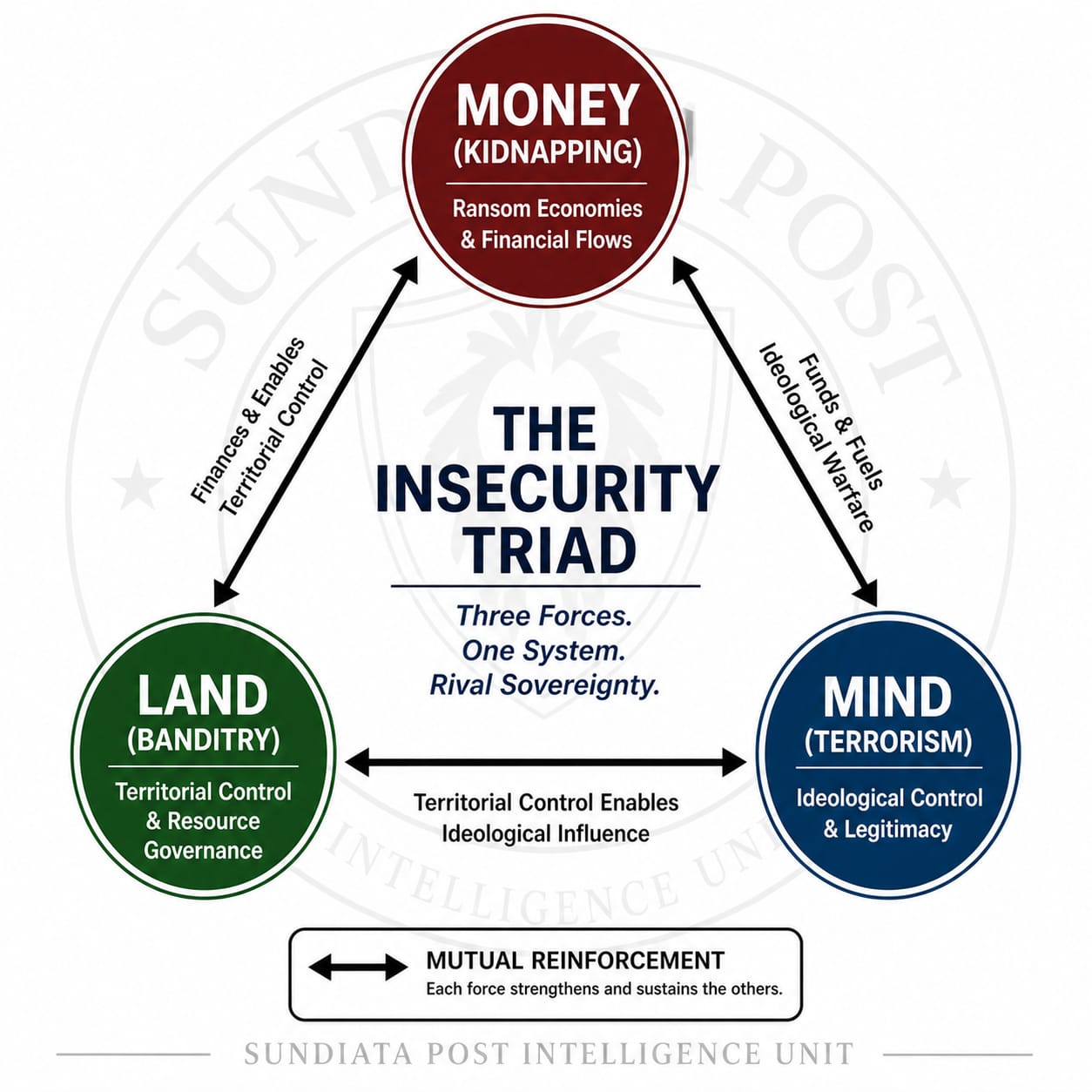
The Insecurity Triad identified three vectors through which rival sovereignty is produced: Money, Land, and Mind. Kidnapping finances violence through ransom economies — that is Money. Banditry governs territory and controls the means of production — that is Land. Terrorism reshapes the ideological order, rewriting who commands loyalty and who commands fear — that is Mind.
These three vectors do not operate in isolation. They converge. And their convergence is what makes The Insecurity Triad a system rather than a catalogue of threats.
What the Trinity of State Decay reveals is what happens to a state when that convergence is sustained. Money drains the state’s fiscal and security capacity. Land slips from its territorial grip. Mind withdraws — citizens, communities, and eventually institutions themselves stop believing that the state is the relevant authority. The Trinity maps the structural consequences of what the Triad set in motion.
The Decoupling Sovereignty Index then asks the measurement question: how far has each vector decoupled? M1 tracks the Money dimension — the degree to which ransom economies and rival revenue systems have displaced the state. L tracks the Land dimension — the erosion of territorial authority and enforceability. M2 tracks the Mind dimension — the collapse of psychological allegiance and institutional legitimacy.
Every concept that follows in this column lives inside that architecture. The Institutional Mirage is what the Mind dimension produces at the level of governance. The Shadow Order is what Land and Money produce when they combine to constitute rival authority. The Ransom Economy is Money in its most organised form. Constitutional Erasure is Land rewritten at gunpoint. The Psychology of the Table is Mind in its most exclusionary expression.
Money. Land. Mind. That is the grammar. What follows is the vocabulary it generates.
The Architecture of Collapse
Among the formulations that emerged was the Trinity of State Decay.
Consider what happens when a state begins to lose its grip.
It does not lose one thing. It loses three — simultaneously, and in ways that accelerate each other.
Territory slips first, or perhaps institutions do, or perhaps the people withdraw their faith before either of the others move. The sequence varies. What does not vary is the convergence.
The first dimension is territorial: the state’s control of physical space becomes contested, fragmented, then absent in places it once claimed without effort.
The second is institutional: governance structures remain formally intact — ministries open, officials report, procedures are observed — but effectiveness drains away, and with it, public confidence.
The third is psychological: citizens stop believing. Not all at once. Not loudly. But progressively, they withdraw their emotional allegiance from the state and redirect their trust toward other identities, other authorities, other protections.
And then the loop closes.
Land is lost because institutions have weakened. Institutions weaken because citizens no longer trust them. Citizens withdraw their trust because the state can no longer protect the land.
Each failure licenses the next. Each decay deepens the others. The trinity does not merely describe deterioration — it drives it.
That is what makes it a trinity rather than a list.
But what fills the space that the decaying state vacates? Two concepts answer that question, and they must be understood together.
The first is the Institutional Mirage. When a state loses empirical authority — the actual capacity to protect, compel and deliver — its formal structures do not always disappear. They persist. Ministers are appointed. Budgets are passed. Ceremonies are conducted. The architecture of governance remains visible, sometimes impressively so. But it no longer functions as architecture. It functions as scenery.
The Institutional Mirage is the state performing sovereignty it no longer possesses.
The second concept is the Shadow Order. Into the spaces the Mirage cannot reach, alternative authority structures move. They may be armed groups, criminal networks, ethnic militias, or insurgent organisations. They collect their own revenues, enforce their own rules, and provide their own version of protection — however brutal or extractive. They do not merely fill a vacuum. They constitute a rival sovereignty.
The Institutional Mirage and the Shadow Order are not opposites. They are a system. One performs authority without possessing it. The other possesses authority without performing it in the language of the state. Together, they represent the decoupling at the heart of the Trinity of State Decay: the separation of juridical sovereignty from empirical sovereignty, of the state that exists on paper from the state that exists on the ground.
The Mechanisms of Sustenance
Collapse of this kind does not sustain itself through inertia alone. It requires mechanisms — arrangements, transactions and distortions that keep the system operational even as it deteriorates.
Three concepts describe these mechanisms.
The first is the Ransom Economy. In zones where the Shadow Order operates and the Institutional Mirage cannot reach, kidnapping ceases to be merely criminal. It becomes economic. Ransom payments circulate as a form of revenue — funding armed groups, sustaining supply chains of complicity, and generating employment in the logistics of abduction and negotiation. The Ransom Economy is not a disorder within the economy. In the territories where it operates, it is the economy.
The second mechanism is Pacification Bargaining. Faced with armed groups it cannot defeat militarily, the state — or the communities caught between the state and the Shadow Order — enters into informal negotiations. Cattle corridors are quietly conceded. Seasonal movements are permitted. Attacks pause in exchange for unspoken accommodations. The bargaining is never acknowledged publicly, because acknowledging it would require admitting the limits of state authority. But it happens. And each round of bargaining, however tactically rational, extends the life of the arrangement it was meant to manage.
The third is Constitutional Erasure. This is not a legal phenomenon. It does not occur in courtrooms or parliamentary chambers. It occurs on the ground, at gunpoint. This is, in the most precise sense, a Violent Amendment of the Constitution — not through any legitimate process of revision, but through the barrel of a gun. The armed group does not petition the state to redraw its map. It redraws it unilaterally, inscribing its own authority where the constitution once held.
Constitutional Erasure is the illegal process by which armed non-state actors unmake the official state map and replace it with their own sovereign order. Where the state’s constitution says one thing about who governs a territory, the gun says another — and the gun wins. The armed group does not merely occupy the space. It renames it. It redraws it. It inscribes its own authority onto territory that the constitution still claims but can no longer hold.
This is counter-constitutional inscription: a rival cartography written in violence.
The constitution remains on paper. But on the ground, a different document governs — unwritten, unratified, enforced by the threat of death. What is erased is not the text of the state’s founding law but the physical reality it was meant to describe.
The Psychology of Recognition
Beneath the structural and economic dimensions of decay lies something harder to measure but no less consequential: the question of who belongs.
Political power is frequently imagined through offices, armies and constitutions. Yet societies often possess another, less visible metric of authority.
Who sits at the table?
Who is invited?
Who is absent?
The Architecture of Resurrection
Perhaps the most hopeful formulation to emerge from the sprint was the idea of the Architecture of Resurrection.
Most analyses of state fragility devote considerable attention to decline and collapse. Far less attention is given to recovery. Yet history repeatedly demonstrates that societies possess remarkable capacities for renewal.
The Architecture of Resurrection refers to the institutional, psychological and political design necessary for rebuilding state effectiveness and legitimacy after periods of profound disruption.
Resurrection is not restoration.
A building that has partially collapsed cannot simply be painted and declared repaired. It requires redesign. Its foundations must be reassessed. Structural weaknesses must be corrected. New load-bearing systems must be introduced.
The same principle applies to states.
The Architecture of Resurrection therefore concerns the deliberate reconstruction of authority, trust and institutional capability. It asks difficult questions.
How is territorial control re-established?
How is confidence in institutions rebuilt?
How are psychologically alienated populations reintegrated into a common political project?
How does sovereignty become recoupled — the Institutional Mirage dissolved into functional authority, the Shadow Order displaced, the Ransom Economy dismantled, Pacification Bargaining replaced by genuine security provision, Constitutional Erasure reversed by the renewed enforceability of rights?
How are communities that have been excluded from the table brought back — not as afterthoughts but as constitutive members of the political project?
The metaphor is intentionally architectural because durable recovery requires design, sequencing and structural coherence. Political resurrection cannot be improvised.
These concepts did not emerge in isolation. They emerged in conversation with one another— each one clarifying, qualifying or extending the others.
States do not live merely through constitutions and coercive instruments. They also live through perceptions. They survive because people believe institutions matter, believe they belong at the table, and believe collective political life remains worth investing in.
Conversely, states decay when these sustaining beliefs weaken—when the Institutional Mirage replaces genuine authority; when the Shadow Order occupies the spaces the state has abandoned; when the Ransom Economy becomes normalised; when Pacification Bargaining substitutes for security provision; when Constitutional Erasure progressively empties the law of its force; and when the Psychology of the Table degenerates into a psychology of permanent exclusion.
That is why vocabulary matters. These are not merely descriptive terms; they are diagnostic concepts that identify the mechanisms through which sovereignty decouples from authority and states slide along the continuum of decay.
The Trinity of State Decay reveals the multidimensional nature of collapse. The Institutional Mirage and the Shadow Order name the twin faces of decoupled sovereignty. The Ransom Economy, Pacification Bargaining and Constitutional Erasure describe the mechanisms that sustain it. The Architecture of Resurrection directs attention toward the design principles of renewal.
Together, they demonstrate that scholarship is not simply the accumulation of information. It is also the invention of language capable of capturing realities that old vocabularies struggle to describe.
For sometimes the first step toward understanding a crisis is learning to name it.
And sometimes the first step toward renewal is discovering the words that make recovery imaginable.
Trust is sacred. Stay seasoned.
•Dr. Max Amuchie is an Independent Scholar-Journalist, Media CEO, and Lead Researcher at the Sundiata Post Intelligence Unit (SPIU). He is the architect of The Insecurity Triad framework for African security analysis, the Trinity of State Decay theory, and the Decoupling Sovereignty Index (DSI)—original, indigenous analytical frameworks for understanding, categorising, and measuring conflict, state decay, and sovereignty in the Global South. He writes The Sunday Stew, a weekly syndicated column on faith, character, and the structural forces that shape society, with a focus on Nigeria, Africa, and the Global South in a changing world.
X (formerly Twitter): @MaxAmuchie | Email: max.a@sundiatapost.com | Tel: +234(0)8053069436
Columns
The Three-Month Sprint (1): Philosophical Architecture of an Intellectual Trilogy of State Decay
Last week on The Sunday Stew, we unveiled the Decoupling Sovereignty Index (DSI), a quantitative metric I developed as an extension of the Trinity of State Decay. It is meant to be a mathematical instrument for measuring the degree of separation between a state’s juridical sovereignty and its lived reality. I had planned to follow up today with the first instalment of a three-part series on the methodology and indicators of the DSI.
Then, from the middle of last week, there was a development that sent me into a sustained period of reflection.
On Wednesday, Zenodo — the open-access repository developed by CERN, the European Organisation for Nuclear Research, and the European Commission — published my 16,315-word theoretical treatise, ‘The Trinity of State Decay (Part 1): Sovereign Decoupling and Rival Sovereignty — A Theoretical Statement.’ On Thursday, Harvard Dataverse, owned and operated by Harvard University, published the same work. On Friday morning, an email arrived from the Social Science Open Access Repository (SSOAR), operated by GESIS — the Leibniz Institute for the Social Sciences in Germany — confirming that they too had accepted, published, and archived the paper.

Late Prof. Edward Said
I sat with that for a while. It is exactly three months since The Sunday Stew made its debut. In those three short months, we have produced an original analytical framework (The Insecurity Triad), a comprehensive theoretical formulation (the Trinity of State Decay), and a quantitative index (DSI). Within the same period, the framework entered global scholarly circulation, and now the theoretical paper has been published by three of the world’s most respected scholarly repositories within seventy-two hours of each other. I found myself thinking about the symmetry of it: three months. A trilogy of original contributions. A triple publication in a single week.
Numbers sometimes carry meaning far beyond arithmetic. This one felt like it was trying to tell me something.
I. The Seed Planted in a Library
When The Sunday Stew was conceived, I did not set out to become a framework architect, a theorist, or an index creator. But looking back, I think the seed was planted much earlier — by accident, in the history section of the University of Calabar library.
I was preparing a term paper on Nigerian history. Our lecturer was the late Dr. Erim O. Erim — a man you had to do your absolute best to satisfy. I was moving along the shelves when I stopped. What arrested me was a name on a spine: Sigmund Freud. His biography. I could not understand what such a book was doing in the history section. I took it anyway, borrowed it, and in one week read it cover to cover.
Of everything I read about Freud’s life, one idea lodged itself in my subconscious and has never left: Freud’s concept of immortality. He defined it simply but profoundly: immortality is being known by many anonymous people. Not a mystical phenomenon, but a psychological and systemic one. It is the act of leaving behind an intellectual footprint so distinct that your ideas are absorbed by millions of people who may never meet you, but who must use your language to understand their own reality.
Freud did not merely write a theory. He changed the global vocabulary. Because of Freud, anonymous people who have never read a page of psychoanalysis use the words ego, subconscious, projection, and defence mechanism every single day. They are operating within his architecture without ever knowing it. That, he argued, was immortality.
I was a young man in a university library who had come looking for Nigerian history and stumbled into a philosophy of intellectual legacy. I did not know, at the time, that I had been given a compass.

•Late Antonio Gramsci
II. The Book C.Don Handed Me
Several years later, when I lived in Lagos, I had someone who was (and still is) a friend, a big brother, and a mentor. The home of C.Don Adinuba — then at Ilupeju — was like my second home. I could walk in at any time. C.Don was the perfect host, and his wife a hostess of uncommon warmth. There was never a dull moment in that house. He knew I loved books, and he is himself one of the most intellectually deep people I have ever encountered.
On one of those days, he pulled a book from his shelf, handed it to me, and said: “Go and read this.” I looked at it. The author was unfamiliar. I asked: “Who is Edward Said?” He replied: “Just go and read the book.”
Representations of the Intellectual — which grew out of Said’s 1993 Reith Lectures for the BBC — turned out to be, apart from the Bible, one of the most impactful books I have ever read. In its pages I first encountered Antonio Gramsci, whose Prison Notebooks has made an enduring impression on my intellectual formation and theoretical development. Said’s argument — that the intellectual’s vocation is to speak truth to power, to represent the unrepresented, and to refuse the comfort of specialisation in favour of the discomfort of genuine engagement — became a way of understanding what journalism, practised seriously, is actually for.
And from Antonio Gramsci, particularly his broad conception of the intellectual, I came to understand that intellectuals are not confined to universities, research institutes, or academic titles. Gramsci argued that intellectual activity exists wherever people help shape ideas, interpret reality, organise knowledge, and influence how society understands itself. Through that lens, I realised that journalism is not merely a profession of reporting events; it is an inherently intellectual vocation.
As a journalist, I do more than gather facts and relay information. I help frame public conversations, interrogate power, highlight social challenges, preserve collective memory, and contribute to the global marketplace of ideas. This understanding deepened my sense of responsibility to society. It reinforced the belief that journalism carries a duty not only to inform but also to enlighten, challenge assumptions, encourage critical thinking, and provide citizens with the knowledge necessary to make informed decisions.
Gramsci’s perspective helped me see that the journalist occupies a vital bridge in the relationship between structured knowledge and public life. The responsibility is therefore not simply to report what happens, but to pursue truth rigorously, interpret developments thoughtfully, and contribute constructively to the intellectual and moral development of society. In that sense, journalism became for me not just a career, but a pure form of public intellectual engagement.
These two books — one stumbled upon by accident, one pressed into my hands by C.Don — formed the philosophical foundation on which everything that follows in this column rests. I did not know that at the time. I know it now.

Late Sigmund Freud
III. The Question That Started Everything
When The Sunday Stew made its debut on March 8th, I initially envisioned a column anchored broadly on faith, character, and the structural forces that shape society, with a focus on Nigeria and Africa in a global context. But the second edition on March 15 inspired our current trajectory. Entitled ‘A Country Without Earthquakes — Yet Shaken by Itself’, it explored the tragic reality of Nigeria manufacturing catastrophic man-made disasters while other nations contend merely with natural ones. The insights that came from writing that piece—drawing heavily from an expansive interview a former colleague and I conducted with the late Professor Jubril Aminu in 2012—inspired the rigorous analytical direction this column ultimately took, beginning with the development of The Insecurity Triad.
At the outset, I only set out to understand why Nigeria keeps bleeding. I wanted to discover why the same communities bury the same dead in the same circumstances decade after decade, while the state issues the same predictable condemnations, commissions the same redundant reports, and recommends the same superficial reforms that are never implemented. I set out, in other words, to do journalism.
What I did not anticipate was that the honest, uncompromising pursuit of that question would eventually produce what the academy calls a macro-theoretical framework—and that this framework would, in time, find its home at Harvard and other top-tier scientific repositories.
The Trinity of State Decay did not arrive fully formed. It emerged from a profound frustration—the frustration of a scholar-journalist who has spent years watching analytical frameworks imported wholesale from external academic traditions fail to explain the immediate reality happening in front of his eyes.
Failed state theory, useful as far as it goes, describes a static outcome. It names the corpse but completely fails to trace the actual cause of death. The Fragile States Index produces superficial comparative rankings but isolates no mechanisms. What was missing was an indigenous framework that could explain the operational process—the structural logic by which sovereign authority fractures and is progressively displaced by rival formations.
The insight, when it came, was disarmingly simple: states do not lose control randomly. They lose it systematically along three specific axes—Money, Land, and Mind. When the state loses its command of fiscal and economic legitimacy, when it loses territorial authority over its physical space, and when it loses ideological and psychological hold over the behavioural psyche of the population, something else moves in. Not chaos. Something far worse than chaos: a disciplined, purposeful Shadow Order, which is often more efficient at its enforcement functions than the formal state it is displacing.
This is what the Trinity of State Decay theorises. Not the mere failure of the state—but the active production of an alternative to it.
The geography of legitimate knowledge production has long maintained a centre and a periphery. The global centre produces the theoretical frameworks; the periphery receives them, submissively applies them, and occasionally pushes back against them in minor footnotes. What is happening right now with the Sundiata Post Intelligence Unit (SPIU)—with The Insecurity Triad already circulating in global academic repositories and the Trinity of State Decay now anchored across multiple institutions—is a clear demonstration that intellectual rigour does not possess a postal address.
The publication of the Trinity of State Decay on global scholarly platforms is not an end point. It is the formal opening of a conversation three decades in the making. If in the months, years, and decades to come, a professor at Harvard, a post-doctoral fellow in Legon, a PhD candidate in Oxford, or an undergraduate in Makerere writing a term paper finds it useful and engages with it, our purpose will have been fulfilled. None of them may ever know me personally, just as I never knew Freud, Gramsci, or Said.
Coda: The Symmetry Completes Itself
I began this reflection thinking about the symmetry of three: three months, a trilogy of contributions, a triple publication. But symmetry, I have come to understand, is not always visible at the beginning of a journey. It reveals itself exclusively in retrospect—which is, incidentally, also how Sovereignty Decoupling becomes visible to those who are living through it.
A young man borrowing a biography of Freud by accident in a university library. A mentor handing him Edward Said across a table in Ilupeju. Several years of frontline journalism asking the same stubborn questions about why our nation bleeds. A column that began as political commentary and rapidly transformed, by structural necessity, into a site of deep theoretical production. And now: Harvard, Zenodo, GESIS-SSOAR, all in a single week.
Three months. A trilogy. A triple publication. And with SSOAR’s confirmation arriving on Friday morning, our overall global archival footprint expands to seven critical institutional repositories when we include the foundational papers of The Insecurity Triad: SSRN, Harvard Dataverse, Zenodo, SocArXiv, SSOAR, ResearchGate, and Academia.edu. The symmetry, it appears, was not done with me yet.
The Trinity of State Decay is now available on Harvard Dataverse (doi:10.7910/DVN/ZQWEM7), Zenodo (doi.org/10.5281/zenodo.20580627), SSOAR (nbn-resolving.org/urn:nbn:de:0168-ssoar-110533-8), ResearchGate, and Academia.edu. Read it. Push back against it. Apply it. Find its limits. That is exactly what it is there for.
Trust is sacred. Stay seasoned.
•Dr. Max Amuchie is a Scholar-Journalist, Media CEO, and Lead Researcher at the Sundiata Post Intelligence Unit (SPIU). He is the architect of The Insecurity Triad framework for African security analysis, the Trinity of State Decay theory, and the Decoupling Sovereignty Index (DSI)—original, indigenous analytical frameworks for understanding, categorising, and measuring conflict, state decay, and sovereignty in the Global South. He writes The Sunday Stew, a weekly syndicated column on faith, character, and the structural forces that shape society, with a focus on Nigeria, Africa, and the Global South in a changing world.
X (formerly Twitter): @MaxAmuchie | Email: max.a@sundiatapost.com | Tel: +234(0)8053069436

Have you been watching the drama happening in ADC? I have, and I have been thoroughly amused doing so. Have you been following the television appearances of Rotimi Amaechi recently? Did you see how the former Governor of Rivers State had been vibrating, assuring of his victory at the party’s presidential primaries?
Did you hear him boasting how he was going to vanquish Atiku Abubakar, former Vice President and now the presidential candidate of the party, indicating that ADC members would prefer him over the seventh-time election-contesting Nigerian record holder, because of his (Amaechi’s) records?
Did you see the vehemence with which he warned that television host, to “stop that nonsense,” for suggesting that he could end up as the VP candidate to the same Atiku? Did you see how he rolled his bulging eyes and how angry he sounded?
Did you read the statement of the former Minister of Transportation, rejecting the outcome of the ADC presidential primaries, even before it was finally announced on Wednesday.
Now, pan the camera to the Abuja home of the same Amaechi – by the way – I could swear the ambiance could compete with the palace of the Sultan of Brunei – how did he do it – but how could I forget his wife is a money-minting machine!
Did you see the selfsame man with Atiku? Did you notice the difference? Did you notice the robustness, the comicalness? Did you watch the chumminess and the camaraderie? What meaning did you read into it? You actually have to be an initiate to correctly read everything perfectly.
Just wait for a few days to hear the announcement. I won’t be the one to tell you that the huffing and puffing, the air-punching and the table-banging is all for one thing – the VP position.
For those who had advocated that Obi stayed back and contested with Atiku, it would have been a fatal gambit. He would have come a distant third in the contest, competing with Mohammed Hayatu-Deen. Not because it will be so by the desires of the members, but the goons, wanted it so and would have made it so.
Even the position of the VP which hitherto had been bandied as his for the asking, would have eluded him. Amaechi was there to pick it up.
You heard Dele Momodu an accomplice in that plot telling you that Amaechi was more experienced than Obi in that interview with Charles Aniagolu on ARISE NEWS Television’s Prime Time.
It was all figured out. If Peter Obi had fallen to the plot he would have been the greatest political mugu of the century. He would have rubbished the rock-strong foundation on which his profile was built and stands today – as businessman and politician.
Indeed the plot appeared skewed towards not only making him wave goodbye to politics forever, but caast a huge slur on his exhilarating credentials that account to his being celebrated as one of the most successful Nigerian business tycoons today.
Only a few seconds and the trap would have snapped. Had he waited a few days more in that ADC environment, it would have been over. He would have been trapped in the odd situation of point of no return.
By now he would have become an object of mockery and an item of sport for his enemies. Tons of them would be having a bellyful of laughter over his ordeal by now – had he wasted a second more.
But having that laugh would mean that the eagle has lost its lustre. Obi isn’t Obi just by name. Now, here is the Obi they wanted to trick into a trap. Still in his early 20s, he drove three cars he bought with his own money before graduating from the university.
First year – a Volkswagen Beetle (today’s Venza) – second year a Peugeot 505 (today’s Prado) – third year – a BMW (Today’s Maybach). Now think of yourself as a student then. Think of your children that are students today. That would bring you closer to the persona in question.
It didn’t end there. Still as an undergraduate, he owned the supermarket on campus. There was more. He built residential houses and became a landlord to students and locals in the university community – one of them, said to be Abubakar Sa’ad, the current Sultan of Sokoto, who was then a military officer.
De hear o! This same Obi, was among the 1,000-ONLY, UK customers the American Express Bank gave their Platinum Cards. You know what that means. In the whole of the UK – including oyibo people of all nationalities doing business.
Before his 33rd birthday, this Obi, had become Chairman of a commercial bank and director of other blue-chip companies. At the same age when his colleagues still clutch files in their armpits in pursuit of jobs, he was already heading a conglomerate of firms dealing with supplies and distribution of goods.
So, add all these up! Imagine the number of intriguing situations he must have dealt with in this long journey. Imagine the boardroom politics. Imaging the various business tricks he must have survived.
In politics, this same Obi practically cut off the head of the political monster prowling Anambra for years.
Before his arrival, the whole of the state was one huge conflagration and cataclysm. Elements sponsored by patrons of evil had razing down structures including the Government House of governor’s residence. Anambra was all chaos – a huge bedlam!
But all these Obi faced and conquered, arresting the tempest, quietening the tide and smoothening the waves – not without battles – there was a deluge of them – but with willpower, wisdom, tenacity, consistency, and above all – courage.
He battled the electoral heist that stole his original mandate, won, then impeachment, triumphed, then abrupt tenure termination, challenged it and returned to power – battled entrenched interests in the labour unions – teachers, doctors, workers – et al – prevailed and handed down a new Anambra sitting on the foundation of sobriety and good behaviour.
Now this was the man they wanted to trick. Obi’s case would have been that of the late John Chukwu, the hero in the tragicomedy, Isubru Ekperi – described as the crab which swam across the mighty ocean, but fell in the woman’s pot of soup.
Had Obi, stayed in ADC to contest against Atiku, his fate would have mimicked Okonkwo in Chinua Achebe’s Things Fall Apart, whom for fear of being thought weak, destroyed his own destiny by killing Ikemefuna and ended up committing suicide! But providence was on his side;
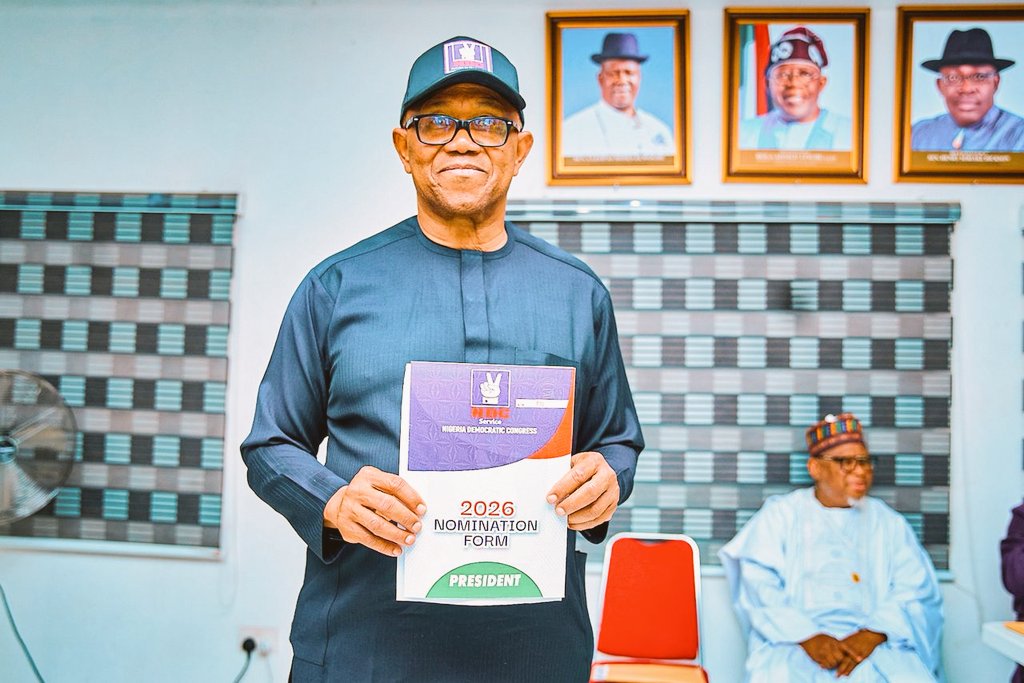
Thankfully, he did not. And today, NDC provides a new horizon. Nigerians are being provided the opportunity of a new country, that could rise from the ashes of the old order – a clean break from the past – a new hope of awakening the sleeping giant!
The Tiny Voice!



-
 News4 weeks ago
BREAKING: Troops rescue wife of kidnapped General! *Terrorists flee scene
-

 News8 hours ago
BREAKING: Mystery death! *Female student dies a day after arriving Umahi’s home!
-

 News2 weeks ago
BREAKING: Court sentences Nigerien, two others to death over terrorism
-
 News4 weeks ago
BREAKING: Count me out, Okonkwo tells Atiku *Amaechi VP’s choice an insult to Ndigbo
-
 News1 week ago
BREAKING: EX-SSG mowed down by gunmen! *He resisted being kidnapped – driver
-
 News3 weeks ago
Abductors of Oyo teachers panicking, freedom coming for victims soon!
-
 News3 weeks ago
Two hours after Igboho’s ‘red-eyes’ to ‘Fulani’ leaders, gunmen free kidnap victims!
-
 News3 weeks ago
Chicagogate: Nigerians return to court! *Move to stop Tinubu from 2027 polls